Disclaimer: This is Untrue.
2.1
Rael's claims
and this website's comment
2.1.1 Encounter with the Elohim
2.1.1.1 Encounter
Rael released several books and made the following claims.
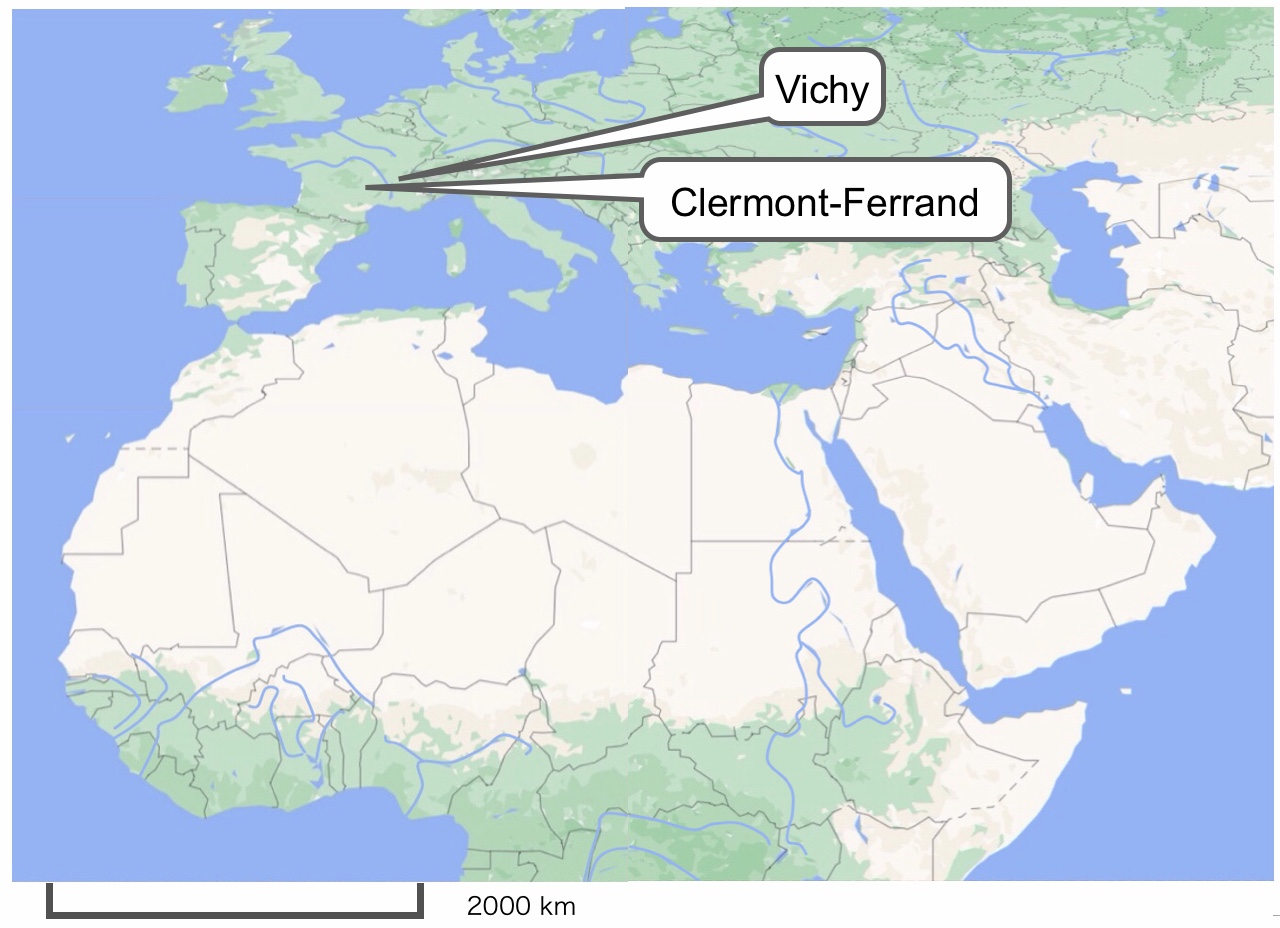
His original name is Claude Vorilhon. He was born in Vichy, Allier, France, in 1946 CE
and later became a motor journalist. He moved
to Clermont-Ferrand with his wife and children and lived there.
On December 13, 1973 CE, he encountered an alien spacecraft (UFO) and
met an extraterrestrial resembling a small Oriental human in a volcanic
crater near Clermont-Ferrand. The extraterrestrial was 1.2 meters tall.
*Attribution:
https://www.atlist.com/showcase/world-map-with-no-labels
In later versions of his books, at the latest by 2013 CE,
Rael ambiguously describes the physical appearance of
the ET with a depiction featuring a greenish face, as if he were a Grey (or a J-Rod), which is
mentioned later.
However, in some early versions of his books,
the ET was described as a small Oriental man.
His skin was white with a slightly greenish tinge, somewhat like that of someone
with liver trouble, with illustrations depicting an aged, small
Chinese-like man with 30 cm-long
black hair and a 10 cm-long black beard.
*However, after a while, Yahweh's Oriental-like descriptions were
removed and Yahweh's Chinese-like
illustrations were replaced with Grey-like (or J-Rod-like) illustrations
with black hair and a black beard.
Furthermore, black hair and a black beard became usually removed.
*
"Claude Vorilhon on Wikipedia"
http://en.wikipedia.org/wiki/Claude_Vorilhon
★
"Amazon The True Face of God"
http://www.amazon.com/gp/aw/d/2940252009/...
The ET referred to himself as Yahweh (YHWH) of the Elohim, as mentioned in the Bible.
Yahweh told Rael about the origin of humankind on the Earth.
The ETs are like humans, just smaller in size.
They developed space navigation technology, discovered Earth,
and visited Earth to conduct genetic engineering experiments.
He was told that "Elohim" in the Bible means "those who came from the sky."
Their native language is similar to ancient Hebrew, and
their planet is roughly one light-year away.
(He claims that Earth's scientists have incorrectly estimated interstellar distances.)
Claude Vorilhon was given the new name Rael and was told that it
means "the light of the Elohim."
★
"Raelian Movement Message from the Designers"
http://www.rael.org/
*
"Raelism on Wikipedia"
http://en.wikipedia.org/wiki/Ra%C3%ABlism
*Before going into details, it should be noted that Rael's wife at the time,
Marie Paul Christini, divorced him and later criticized him because of his
completely open attitude toward sexual behavior, which was based on
his teachings derived from
the Elohim, as will be mentioned later.
*
"Rexfeatures Marie Paul Christini and Children"
http://www.rexfeatures.com/set/401057
*
"Dialogue I was Married to Rael Down Load"
http://www.dialogueireland.org/dicontent/media/iwasmarried...
2.1.1.2 Choice of the Bibles for Better Understanding
As for the original texts of the Bible, the Old Testament was
mostly written in Hebrew, and the New Testament was written in Greek.
(Specifically, the practical standard for the Hebrew Old Testament
would be the Westminster Leningrad Codex, which is derived from
Ben Asher's Masoretic Text. The practical standard for the Greek New Testament
would be the Textus Receptus or the Novum Testamentum Graece.)
Provided that one has learned an outline of the Bible in English,
the best choice would be a Hebrew/Greek Bible with an interlinear word-for-word literal
translation. The Scripture4all Foundation provides appropriate texts.
"Scripture4all Foundation" provides proper texts.
★
"Scripture4all" http://www.scripture4all.org/OnlineInterlinear/Hebrew_Index.htm
The Orthodox Jewish Bible (in English with some simple Hebrew words) might
be helpful for this purpose.
The second best choice would be the New King James
Version (released in 1982 CE), followed by the English Standard
Version (released in 2001 CE). The New King James Version seems to have both
sufficient literal (word-for-word) accuracy and the elegance inherited from
the KJV. The ESV is also excellent in terms of literal accuracy and modern readability.
The NASB (released in 1971 CE and revised in 1995 CE) is regarded as the
most literal (word-for-word), including word order; however, it contains some
inappropriate mistranslations. (Since the Amplified Bible (AMP) explains the
traditional interpretations of Christianity, which can be ignored, the AMP may still be
useful for referencing traditional interpretations.) The King James, the Septuagint, and the
Vulgate contain mistranslations, but as mentioned later, these mistranslations
actually help expose
a plot by the Hata family in Japan.
2.1.1.3 Examination of the Meaning of "Elohim"
2.1.1.3.1 Elohim
When going through the Hebrew Bible, such as the one provided by "Scripture4all,"
one can clearly notice that the names written
are "אלהים (Elohim)"
or "יהוה אלהים (Yahweh Elohim)"
rather than "God," "the God," or "the Lord God." (The Hebrew alphabet
is written from right to left.)
According to traditional Hebrew grammar and its ordinary
usage, "Yahweh Elohim" means "Yahweh of the Elohim," just as "Ben Adam" means "son of Adam."
*
"The Names of God AHRC" http://www.ancient-hebrew.org/24_namesofgod.html
According to traditional theology, as found in sources like Jewish
Encyclopedia.com, the meaning of Elohim is said to be unknown or is sometimes
interpreted as "to be awed" or "strong one." The theory that interprets
Elohim as "to be awed" is based on the assumption that it is derived from the
old Arabic verb alih. The other theory, which interprets Elohim as "strong one," is
based on the assumption that its root word is אול (AWL), meaning "to be strong."
Since explaining the Hebrew alphabet is difficult, transliteration (romanization) from
Hebrew to the Roman (Latin) script is used. אלהים (Elohim) can be transliterated
as ALHYM (though there are various ways of transliteration/romanization).
The method of transliteration (romanization) used on this website is as follows:
א=Alef=A, ב=Bet=B, ג=Gimel=G, ד=Dalet=D, ה=He=H, ו=Vav=W, ז=Zayin=Z, ח=Het=X,
ט=Tet=T, י=Yod=Y, (כ(ך=Kaf=K, ל=Lamed=L, (מ(ם=Mem=M, (נ(ן=Nun=N, ס=Samekh=S,
ע=Ayin=E,
(פ(ף=Pe=pf, (צ(ץ=Tsadi=ts, ק=Qof=Q, ר=Resh=R, ש=Shin=sh, ת=Tav=th
(כ ,מ ,נ ,פ ,צ change into ך ,ם ,ן ,ף ,ץ respectively when they come to the end of a word.)
ALHYM is the plural form of ALWH: אלוה and its root word may be
ALH: אלה.
2.1.1.3.2 Semitic Root Theory
Regarding the theory of root words in Semitic languages, the
Persian linguist Sibawayh (760 - 796 CE) could be considered an early pioneer
of root theory in Arabic. Subsequently, the Masoretic Text, the practical standard
of the Hebrew Bible, was established by Ben Asher in Palestine around 950 CE.
The Hebrew linguist Hayyuj, around 1000 CE in Cordoba (southern Iberia), claimed
that each Hebrew root word is basically composed of three letters (triliteral), while
some scholars argue
that root words were originally two letters.
★
"Semitic Root on Wikipedia"
http://en.wikipedia.org/wiki/Semitic_root
*
"Arabic Grammar on Wikipedia"
https://en.wikipedia.org/wiki/Arabic_grammar
*
"Jewish Encyclopedia Root"
http://www.jewishencyclopedia.com/articles/12823-root
*
"Judah ben David Hayyuj on Wikipedia"
https://en.wikipedia.org/wiki/Judah_ben_David_Hayyuj
2.1.1.3.3 Original Meaning of Hebrew Letters and Basic Synthesis of Hebrew Words
Other than that, each Hebrew letter has its own original meaning. For example,
the original meaning of Alef is "ox head," and it commonly represents "strength."
The original meaning of Bet is "tent" or "house."
The combined word אב (AB) then means "strength of the house" and consequently "father."
The original meaning of each Hebrew letter is sometimes controversial.
Despite this controversy, the "Ancient Hebrew Research Center" website provides
an excellent interpretation, although it represents an independent viewpoint.
For example, AHRC claims that the original meaning of נ (Nun) is "seed," while
other theories claim that Nun means "snake"or "fish."
★
"Ancient Hebrew Alphabet AHRC" http://www.ancient-hebrew.org/2_alphabet.html
★
"Ancient Hebrew Alphabet Nun"
http://www.ancient-hebrew.org/alphabet_letters_nun.html
*
"Nun (Letter) on Wikipedia"
https://en.wikipedia.org/wiki/Nun_(letter)
*
"Ancient Hebrew Vocabulary AHRC" http://www.ancient-hebrew.org/2_vocab.html
Thus, some basic words are derived from or consist of the original meanings
of certain Hebrew letters.
2.1.1.3.4 Extraction and Synthesis of Root Words
However, in addition to that, according to Rael, for example, a complex root
word is formed by selecting one letter from each of three (or two) other root words.
In short, many Hebrew root words are abbreviations, just as "OMG" stands
for "Oh My God" and "HTH" stands for "Hope This Helps" in English. For example, Rael says
that "Rael" (RAL: ראל) means "light of Elohim."
"Light" is "AWR" (אור), and the letter "R" (ר) is taken from "AWR."
The "AL" in "RAL" (ראל) comes from "ALWH" or "ALHYM" (whose root is "ALH").
*
"Names of God AHRC" http://www.ancient-hebrew.org/24_namesofgod.html
For example, a complex root word is formed from three other root words, and
it is an abbreviation of the three root words.
2.1.1.3.5 Synthesis by Picking Out from Sentences (Kabbalistic Notarikon)
A similar, but extended mechanism can be seen in the Notarikon of Kabbalah.
*
"Notarikon on Wikipedia"
https://en.wikipedia.org/wiki/Notarikon
As mentioned later, it would be alleged that Kabbalah is a
structure of hidden knowledge in the Bible, particularly within the
Pentateuch (Genesis, Exodus, Leviticus, Numbers, and Deuteronomy).
Kabbalah emerged around 1200 CE. Gematria and Notarikon (and possibly Temurah) are
alleged to be methods used in Kabbalah to uncover hidden meanings in the Bible.
Gematria is a method that replaces each Hebrew letter of a
word with a number and sums up the values. For example, in the case of יהוה (YHWH), י (Y) is
replaced with "10," ה (H) with "5," ו (W) with "6," and
again, ה (H) is replaced with "5." Thus, יהוה (YHWH) is represented as 10+5+
Gematria is the method replacing each Hebrew letter of a word with
a number and summing up the numbers.
For example, as far as יהוה (YHWH), י (Y) is replaced with "10," ה (H) is replaced with "5,"
ו (W) with "6," again ה (H) with "5," then יהוה (YHWH) changes into 10+5+6+5=26.
Notarikon is a method of selecting Hebrew letters from nearby sentences, combining
them to form a presumed hidden word in the Bible. For example, as seen in a
Bible code at the beginning of Genesis, by
selecting ת (th) from בראשית (BRAshYth), ו (W) from תהום (thHWM), ר (R) from וירא (WYRA), and ה (H) from אלהים (ALHYM),
the hidden word תורה (thWRH: Torah) is revealed. (Temurah is a method that
replaces one Hebrew letter with another, for example, substituting “ב” for “א”.) Medieval
Kabbalists, particularly in the Holy Roman Empire around 1250 CE,
including Abraham Abulafia, advocated for the benefits and legitimacy of Gematria and Notarikon.
*
"Gematria on Wikipedia"
https://en.wikipedia.org/wiki/Gematria
*
"Bible Code on Wikipedia"
https://en.wikipedia.org/wiki/Bible_code
*
"Temurah (Kabbalah) on Wikipedia"
https://en.wikipedia.org/wiki/Temurah_(Kabbalah)
*
"Torah on Wikipedia"
https://en.wikipedia.org/wiki/Torah
*
"Abraham Abulafia on Wikipedia"
https://en.wikipedia.org/wiki/Abraham_Abulafia
2.1.1.3.6 Synthesis by Extracting Letters from "These That Came from the Heavens"
Like Notarikon, the Hebrew website of the Raelian Movement explains the
meaning of "elohim," stating that "ALWHYM" is an abbreviation
of "ALH shBAW MHshMYM" in ancient Hebrew.
According to Hebrew dictionaries, "ALH" means "these," "shBAW" means "that came," and "MHshMYM"
means "from the heavens (or skies)." ("M" means "from," "H" means "the,"
and "shMYM" is frequently used in the Bible to mean "heavens" or "skies.")
Thus, "elohim" means "these that came from the heavens (or skies)."
In the Hebrew Bible (Old Testament: Westminster Leningrad Codex (WLC)), "ALHYM" is
used, whereas the Raelian website suggests "ALWHYM" (with an added "W"). However,
the Hebrew New Testament Habrit Hakhadasha/Haderekh (HHH) (Hebrew Living
New Testament), which was translated from Greek or English into Hebrew, commonly
uses "ALWHYM" to mean "God" or "someone."
Aside from that, the Hebrew Old Testament (WLC) frequently uses "ALWH" as
the singular form of "ALHYM." Thus, "ALWHYM" appears to be a more modern
formal form of "ALHYM," even though it never appears in the Hebrew Old Testament (WLC).
Consequently, "ALWH," "ALWHYM," and "ALHYM" all seem to derive
from "ALH shBAW MHshMYM." In any case, they are all abbreviations.
On the other hand, Strong's Hebrew Dictionary, AHRC, LingvoSoft, or Do It in Hebrew might
be helpful. Alternatively, you can search on Google using keywords
like "Strong's," "Hebrew," and the question word to
find the corresponding "Strong's number."
*
"Sacred Name" http://www.sacrednamebible.com/kjvstrongs/STRINDEX.htm
*
"Ancient Hebrew" http://www.ancient-hebrew.org/35_home.html
*
"Lingvozone" http://www.lingvozone.com/main.jsp?do=dictionary&action=setlanguages&language_id_from=23&language_id_to=25&x=44&y=15
*
"Do It in Hebrew Dictionary" http://www.doitinhebrew.com/Translate/default.aspx?kb=IL%20Hebrew%20Phonetic&l1=iw&l2=en&txt=
2.1.1.3.7 Formal English Usage "The Elohim"
As mentioned above, the term "elohim" means "these that came from the
heavens (or skies)," and it is theoretically a common noun in English.
Accordingly, "elohim" could include meteorites and other living things that came
from the sky. However, when referring specifically to the small, Human-looking
extraterrestrials who are about 1.2 m tall and are governed by Yahweh, the
term should be "the Elohim" in English to specify this group.
Without the "the," "Elohim" would typically be understood
as referring to the gods of Judaism.
2.1.1.4 The Meaning of "Yahweh"
If we describe the meaning of "Yahweh (YHWH)" in relation to the
meaning of "the Elohim," it is as follows.
The substantive meaning of "YHWH" is the proper noun, referring to a specific male who has
held a leadership position among the Elohim for many years. When rendered
phonetically in English, it is written as Yahweh.
The formal meaning of "YHWH" is I AM". This is based on YHWH's statement at
Mount Sinai in the Book of Exodus. When Moses asked for His name,
He replied, "I AM WHO I AM", and commanded him to say to the children
of Israel, "I AM has sent me to you."
Rael also states that the meaning of YHWH is "I AM".
*"Then Moses said to God, 'Indeed, when I come to the children of Israel
and say to them, "The God of your fathers has sent me to you," and they
say to me, "What is His name?" what shall I say to them?'
And God said to Moses, 'I AM WHO I AM.' And He said, 'Thus you shall
say to the children of Israel, "I AM has sent me to you."' Moreover God said to
Moses, 'Thus you shall say to the children of Israel: "The Lord God of your
fathers, the God of Abraham, the God of Isaac, and the God of Jacob, has sent me to you.
This is My name forever, and this is My memorial to all generations"'" (Exo 3:13-15).
Return to the Home Page