Disclaimer: This is Untrue.
2.1.4 Buddhism
2.1.4.1 Outline
Yahweh created Buddhism by inspiring Siddhartha Gautama in India.
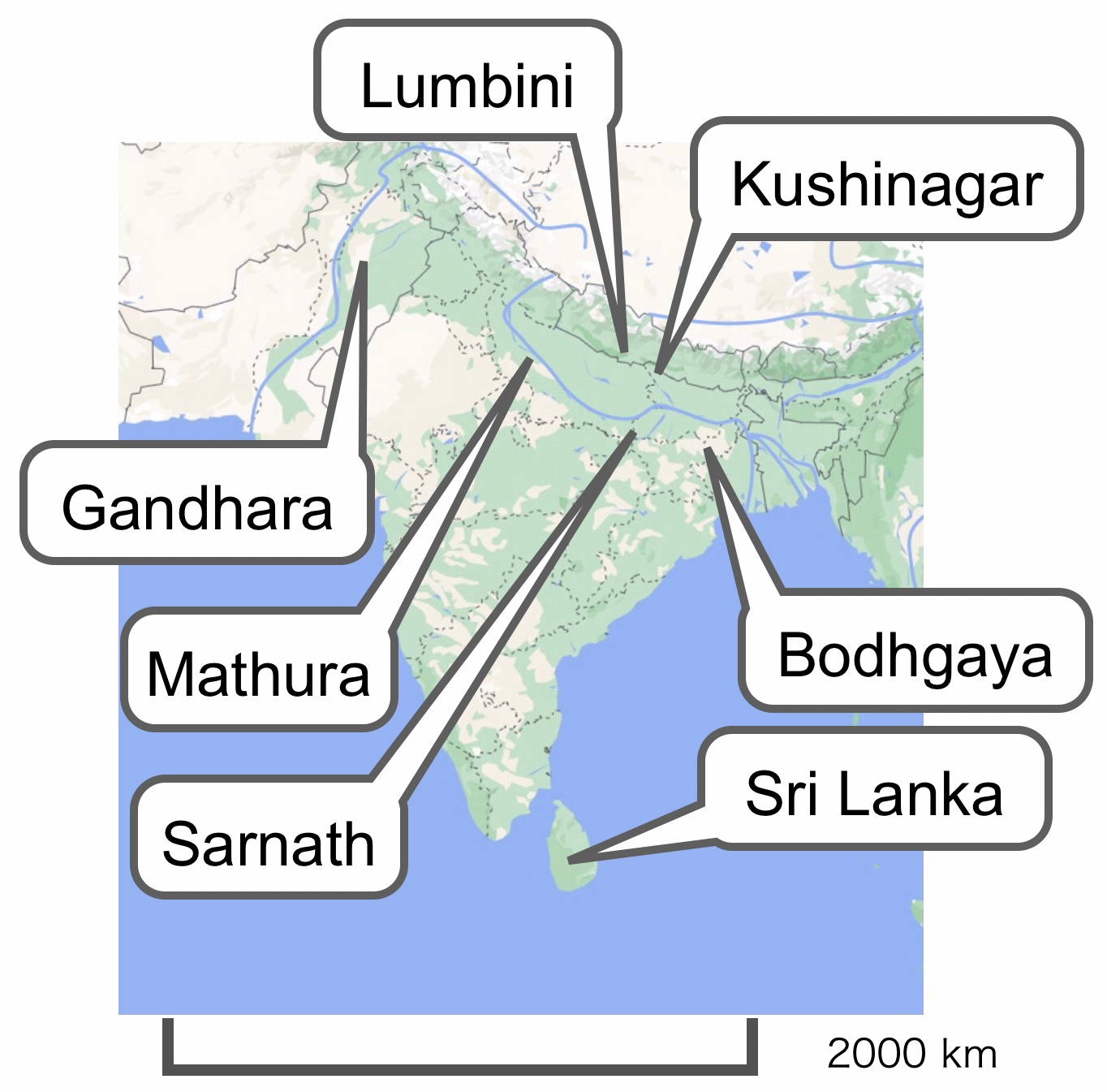
It is said that Siddhartha Gautama was born in Lumbini, at the southern foot of
the Himalayas, around 563 BCE or 480 BCE. He was purportedly the son of a chief of
a minor clan (the Shakya clan). He left the palace at the age of 29 to seek true teachings.
He was inspired and acquired the teachings at the age of 35 in Bodhgaya,
southeast of Lumbini. He began delivering his teachings in Sarnath and died in
Kushinagar, near Lumbini, at the age of 80,
around 483 BCE or 400 BCE.
"Buddha" means "awakened one" or "enlightened one" in Buddhism.
*Attribution:
https://www.atlist.com/showcase/world-map-with-no-labels

A Relief of an Ancient Buddhism (200 - 300 BCE) in Bharhut,
Central-Northeastern India, near Bodhgaya
is
*Attribution:
http://en.wikipedia.org/wiki/File:BharutRelief.jpg
*
"Bharhut on Wikipedia"
http://en.wikipedia.org/wiki/Bharhut
*
"Buddhism on Wikipedia"
http://en.wikipedia.org/wiki/Buddhism
2.1.4.2 Details
2.1.4.2.1 Teachings of Gautama Buddha
According to Rael, Yahweh briefly mentioned Buddhism.
For one thing, Buddhism teaches that the soul of a dead person should attempt
to escape devils. Otherwise, it will fall back into the never-ending cycle of reincarnation.
However, Yahweh claims that this doctrine, in fact, applies not to individuals but
rather to humanity as a whole. Humankind may progress to a certain extent anyway.
However, if humankind is not wise enough, it will ruin itself and fall back into a low-level
civilization again. On the other hand, if humankind is wise enough, it will
evade self-destruction and advance its civilization.
Secondly, Yahweh says the diffusion of Buddhism is preferable, since Buddhism is
well-balanced between science and spirituality for humans in the new era.
The teachings of Buddha are about avoiding evil, doing good, and purifying
one’s mind to overcome suffering. Specifically, he recommends believing in the
Four Noble Truths, and following the Noble Eightfold Path and the Five Precepts.
The Four Noble Truths are:
1. Life is filled with suffering.
2. Suffering comes from attachment to desires, which cannot be fully satisfied.
3. Therefore, desires should be abandoned to stop suffering.
4. The Noble Eightfold Path should be followed to abandon desires.
The Noble Eightfold Path consists of:
1. Learning the Four Noble Truths.
2. Abandoning worldly things and refraining from harming others.
3. Speaking the truth and avoiding slander.
4. Refraining from evil acts such as killing, stealing, or leading an impure life.
5. Doing good deeds and opposing evil.
6. Engaging in meaningful and ethical work.
7. Keeping your senses under control.
8. Practicing meditation as a way to understand reality.
The Five Precepts are:
1. Do not harm any living being.
2. Do not take anything that is not given to you.
3. Do not engage in sexual misconduct.
4. Do not lie or say anything that harms others.
5. Do not take intoxicants, such as alcohol or drugs, that cause heedlessness.
*
"Buddhism on Simple Wikipedia"
https://simple.wikipedia.org/wiki/Buddhism
2.1.4.2.2 Gautama’s Outward Appearance
As mentioned above, Siddhartha Gautama was born in Lumbini, in ancient
northeastern India, likely around 563 BCE or 480 BCE.
He was purportedly the son of a leader of the Shakya clan.
The Shakya clan was a small, dependent clan subject to the large country of
Kosala, which was located to the west of Shakya. The other large country, Magadha,
was located to the south of Shakya.

*Attribution:
http://en.wikipedia.org/wiki/File:Mahajanapadas_(c._500_BCE).png
The ethnic identity of the Shakya and Gautama is controversial.
Typically, Gautama’s skin color is also debated.
In relation to that, Indian ethnic groups are complex and controversial.
Some information regarding Indian populations is as follows:
The skin colors of southern or southeastern Indian populations are generally dark.
In contrast, the skin colors of northern or northwestern Indian populations are
generally light.
The major Indian languages, including major ancient Indian languages, are
generally similar to European languages and belong to the Indo-European language family.
Aside from that, earlier than 1500 BCE, Brahmanism (later Hinduism) was
established in India along with the social class system called Varna or
Caste. "Varna" means outward appearance, such as color. Brahmanism (and Hinduism)
defines four Varnas (classes):
(1) Brahmins: priests, teachers, and preachers.
(2) Kshatriyas: kings, governors, warriors, and soldiers.
(3) Vaishyas: cattle herders, agriculturists, businessmen, artisans, and merchants.
(4) Shudras: laborers and service providers, like slaves.
(The fifth varna, "Dalit (Untouchable)," was not specified at the time.)
The Varnas were closely related to skin color. The higher Varnas mostly consisted of
people with light skin, while the lower Varnas mostly consisted of people
with dark skin. Mixture between different Varnas was strictly forbidden in the early
period, but some intermixing occurred during Buddha’s era.
*
"Brahmanism on Wikipedia"
http://en.wikipedia.org/wiki/Brahmanism
*
"Varna (Hinduism) on Wikipedia"
http://en.wikipedia.org/wiki/Varna_(Hinduism)
Then, the widely accepted version is the "Indo-Aryan Migration Theory."
According to this theory, the early peoples were generally called Dravidians.
The Dravidians mostly had dark skin and came from Africa earlier than 1800 BCE,
while other minor ethnic groups, such as Mongoloids, might have been included.
(The Dravidians might have been responsible for the Indus Valley Civilization in
northwest India during 2600–1900 BCE.)
Subsequently, peoples called Indo-Aryans came from the northwest around 1700 BCE.
The Indo-Aryans were a kind of European population.
They generally had light skin and spoke a European language.
The Indo-Aryans conquered India mostly from the northwest, such as Gandhara, and the
Dravidians were rather subdued or enslaved.
The Indo-Aryans introduced European languages, Brahmanism, and the social
class system Varna to govern conveniently.
*
"Dravidian Peoples on Wikipedia"
http://en.wikipedia.org/wiki/Dravidian_peoples
*
"Indo-Aryan Peoples on Wikipedia"
http://en.wikipedia.org/wiki/Indo-Aryan_peoples
*
"Indus Valley Civilization on Wikipedia"
http://en.wikipedia.org/wiki/Indus_Valley_Civilization
*
"Indo-Aryan Migration Theory on Wikipedia"
http://en.wikipedia.org/wiki/Indo-Aryan_migration_theory
Regarding the Shakya clan and Gautama's skin color, the common theory claims
that his skin color should have been light, since Gautama and his family were rulers
and Kshatriyas.
In addition, it claims that Gautama should have been Indo-Aryan, similar to European people.
However, since intermixing between different Varnas could have occurred during
Buddha's era, Gautama might not have been Indo-Aryan.
For example, a story tells that Varna couldn't be distinguished from physical appearance.
The story describes how Kosala requested the Shakya clan to send a princess.
However, the Shakya clan sent a daughter of a slave instead, deceiving Kosala out of distrust.
The daughter of the slave became the queen of Kosala and gave birth to Vidudabha,
who later became the king of Kosala.
Subsequently, Vidudabha learned that the Shakya clan had deceived Kosala and
massacred the Shakya clan.
This means that Varna or social class of the Shakya clan couldn't be distinguished
from physical appearance.
In addition, according to Rael's book, Rael says that he met 40 recreated
humans who once lived on Earth.
Rael had a meal with them and 3 Elohim, including Yahweh.
Rael refers to Gautama as follows.
"I was sitting to the right of the Eloha whom
l had met two years earlier, and to the left
of the two other Elohim. Facing me sat a
young bearded man, very handsome and
very slim. He wore a mysterious smile and an
expression
filled with fraternal feeling.
To his right was a man with a noble face
sporting a black beard that was very thick and very long.
To his left was a more
corpulent man with an Asian face,
He had a shaven head."
Subsequently, Yahweh introduced several guests as follows.
"I am referring to Jesus, whom we were able to
recreate from a cell that we had preserved before
his crucifixion."
The handsome, bearded, young man seated
opposite offered me a smile
full of fraternity.
"To his right is Moses, to his left Elijah, and to
the left of Elijah sits the one
remembered on Earth by the name of Buddha.
A little further on you can see
Muhammad, in whose writings I am called Allah,
because out of respect they
did not dare call me by name."
If "To his left was a more corpulent man with an Asian face. He had a shaven head." refers
to the seat immediately to the left of Jesus, then the man would be Elijah.
However, it is quite odd that Elijah is depicted with a particularly Asian face, unlike
Jesus and Moses.
In contrast, if "To his left was a more corpulent man with an Asian face. He had
a shaven head." allows for the interpretation that the seat two places to the left of
Jesus is being described, then the corpulent man with an Asian face would be
Gautama, which would be rather understandable.
Thus, Gautama would be depicted as Asian in appearance.
2.1.4.2.3 History of Indian Language
Buddha's teachings could be integrated into Buddhist scriptures.
However, Buddhism holds over 7000 scriptures, and the words are so numerous
that one would not be able to grasp the point.
Thus, key scriptures should be recognized, and the history of Indian languages
should be traced to learn the meaning of each scripture, while "grammar and
words" and "letters" should be distinguished.
Going into the history of Buddhism and Indian languages, as mentioned above, the
earlier residents were Dravidians with dark skin.
The Dravidians wouldn't have developed letters, while the Indus Valley Civilization
in northwest India during 2600 - 1900 BCE had a simple Indus script.

Simple Indus Script
*Attribution:
http://en.wikipedia.org/wiki/File:Indusseal.JPG
Subsequently, Indo-Aryans with light skin came from the northwest around 1700 BCE.
The Indo-Aryans dominated India, introduced Brahmanism, and their leaders became Brahmins (priests).
Their language at the time, around 1500 BCE, would have been Vedic Sanskrit.
However, Vedic Sanskrit wouldn't have had letters.
Subsequently, Vedic Sanskrit was reformed into Classical Sanskrit by the scholar
Panini sometime between 700 BCE and 300 BCE.
On the other hand, it seems that various dialects emerged from Sanskrit,
while the "grammar and words" of the dialects were more or less similar.
These various dialects are called Prakrit.
The ancient Magadhi language (an East Indian dialect), Gujarati
language (a West Indian dialect), and Pali language would have been Prakrit around 300 BCE.
On the other hand, Indian (developed) letters were still not yet seen, even in (Classical) Sanskrit.
The language Buddha spoke would have been "ancient Magadhi" (a dialect of
present-day Bihari language).
Ancient Magadhi was a colloquial language (Prakrit; literally: natural language),
while the formal sacred language at the time was Sanskrit.
Buddha didn't leave any documented sutras.
The First Buddhist Council by 500 disciples took place near Bodhgaya in the Magadha
Kingdom just after Buddha’s death to preserve his sayings (supposedly around 486 - 400 BCE).
The disciples at the time recited oral sutras about Buddha's sayings and actions.
However, since his teachings were forbidden to be documented by
Buddha himself, his words and deeds were kept through oral instruction and
memorization for 200 years after his death, including the (oral) sutras from the
First Buddhist Council and the Second Buddhist Council.
The oral sutras from the First Buddhist Council and the Second Buddhist Council are not extant.
*
"First Buddhist Council on Wikipedia"
http://en.wikipedia.org/wiki/First_Buddhist_council
The Second Buddhist Council took place about 100 years after the First Buddhist
Council (around 386 - 300 BCE).
(As mentioned above, Buddha's teachings were kept through oral instruction.)
As a result of the Second Council, the disciples split into two
groups: the "Sthavira Nikaya school" and the "Mahasanghika school."
The Sthavira school was, in a sense, particular about the original strict teachings,
while the Mahasanghika school was, in a sense, particular
about propagation.
Other than that, many schools arose, and the oral sutras kept by these schools
became somewhat different.
*
"Second Buddhist Council on Wikipedia"
https://en.wikipedia.org/wiki/Second_Buddhist_council
*
"Sthavira Nikaya on Wikipedia"
https://en.wikipedia.org/wiki/Sthavira_nik%C4%81ya
*
"Mahasanghika on Wikipedia"
https://en.wikipedia.org/wiki/Mah%C4%81s%C4%81%E1%B9%83ghika
Subsequently, the Mauryan King Ashoka appeared and greatly patronized
Buddhism around 260 BCE.
However, because of Ashoka's patronage, bogus monks and schools appeared,
expecting wealth, and different sutras arose.
Then King Ashoka supposedly held the Third Buddhist Council at
Pataliputra (in present-day Indian state of Bihar) in the Magadha Kingdom between Bodhgaya and Lumbini around 250 BCE to clarify the teachings of Buddha by employing the monk Moggaliputta-Tissa.
The importance of the Third Buddhist Council is mostly claimed by the later Theravada school.
According to the later Theravada school, a group from the Sthavira school
prevailed in the Third Council, and this group became the Theravada school.
The Theravada school's teachings were spread to a certain extent by King Ashoka.
On the other hand, it is said that the first documented sutras were written
during the Third Buddhist Council.
However, the first documented sutras, supposedly written in the Magadhi
dialect and Brahmi script, are not extant.
*
"Third Buddhist Council on Wikipedia"
http://en.wikipedia.org/wiki/Third_Buddhist_council
*
"Moggaliputta-Tissa on Wikipedia"
https://en.wikipedia.org/wiki/Moggaliputta-Tissa
Yet Ashoka also created the Ashoka Pillars, which describe edicts based on Buddhist
morality around India.
The first attested Indian (developed) letters would be the Brahmi script on the Ashoka
Pillars around 250 BCE.
Brahmi supposedly came from the Aramaic alphabet of the Achaemenid Persian Empire.
The Ashoka Pillars were grammatically written in Prakrit (people's languages or dialects)
such as the Magadhi dialect (East Indian dialect) and the Gujarati dialect (West Indian dialect).

Brahmi Script on an Ashoka Pillar
*Attribution:
http://en.wikipedia.org/wiki/File:Brahmi_script_on_Ashoka_Pillar,_Sarnath.jpg

Another Brahmi Script on an Ashoka Pillar
*Attribution:
http://en.wikipedia.org/wiki/File:Asokan_brahmi_pillar_edict.jpg
*
"Prakrit on Wikipedia"
http://en.wikipedia.org/wiki/Prakrit
*
"Magahi Language on Wikipedia"
http://en.wikipedia.org/wiki/Magahi_language
*
"Pillars of Ashoka on Wikipedia"
https://en.wikipedia.org/wiki/Pillars_of_Ashoka
Subsequently, the Theravada school prospered in Sri Lanka, supposedly because of
Sri Lanka's isolation.
However, due to famine in Sri Lanka, many Theravada monks died.
Facing this crisis, Theravada's teachings were written on palm leaves as the Pali
Canon in Sri Lanka in the Pali dialect (grammar and words) with Brahmi script after the
Fourth Buddhist Council in Sri Lanka in 29 BCE.
(Until the council, Buddhist teachings were preserved through oral instruction, as it is
said that Gautama forbade writing down the teachings.)
Since the Pali dialect (grammar and words) is similar to the Gujarati
dialect (grammar and words) (a West Indian dialect), the Pali dialect would have
originally been a West Indian dialect that survived in Sri Lanka.
(The Pali dialect and Buddhism would have been introduced from West India to Sri
Lanka through the sea route.)
*
"Pali Canon on Wikipedia"
http://en.wikipedia.org/wiki/P%C4%81li_Canon
*
"Pali on Wikipedia"
http://en.wikipedia.org/wiki/P%C4%81li
*
"Fourth Buddhist Council on Wikipedia"
http://en.wikipedia.org/wiki/Fourth_Buddhist_Council
Afterward, Buddhism deeply split into Theravada Buddhism and Mahayana Buddhism.
Theravada Buddhism (literally: "ancient teaching") is particular about the original
teachings of Buddha.
Mahayana Buddhism (literally: "great vehicle") is particular about propagation.
On the other hand, Mahayana Buddhism succeeded to a certain extent in the Gupta
Empire in northern India around 400 CE, and sutras were documented grammatically in
Gupta's official language, Sanskrit.
(The script at the time would have been Brahmi script.)
Mahayana Buddhism then spread through Gandhara to present-day China, Korea, and
Japan, and the sutras were translated into the Chinese Buddhist Canon in Chinese.
Subsequently, in terms of script, Brahmi script gave birth to various other scripts.
The various scripts are called Brahmic Scripts.
For example, Gupta script appeared around 450 CE in northern India.
However, Buddhism in India itself declined due to oppression by
King Mihirakula (who reigned from 512 to 528 CE; supposedly a Zoroastrian) and
subsequently due to Islamic and Hindu influence.
Gupta script gave birth to Siddham script around 600 CE.
Siddham script was used to describe many Buddhist texts at the time in (Classical) Sanskrit
grammar and words.
The Siddham Buddhist texts were brought to China through Gandhara and the Silk Road.
Gupta script also gave birth to Devanagari script around 700 CE.
Buddhist texts in India started to be written with Devanagari script (in Sanskrit) around
900 CE instead of Siddham.
(In addition, Mahayana Buddhism spread to Tibet during the 7th to 14th centuries
CE, and Indian sutras were translated into the Tibetan Buddhist Canon.)
*
"Brahmic Scripts on Wikipedia"
http://en.wikipedia.org/wiki/Brahmic_scripts
*
"Siddam Script on Wikipedia"
http://en.wikipedia.org/wiki/Siddha%E1%B9%83_script
*
"Devanagari on Wikipedia"
http://en.wikipedia.org/wiki/Devanagari
Consequently, the major extant documented sutras are the Pali Canon in Theravada
Buddhism written in Pali dialect, the Chinese Buddhist Canon, and additionally the
Tibetan Buddhist Canon.
The Pali Canon exclusively consists of classic traditional scriptures called Tripitaka.
Tripitaka consists of three categories of texts:
Vinaya Pitaka (rules for monks and nuns),
Sutta Pitaka (sermons of Gautama), and
Abhidharma Pitaka (philosophical discourse and interpretation supposedly by
later scholars soon after Gautama’s death).
The Chinese Buddhist Canon includes Tripitaka and other later additional texts,
such as Mahayana Sutras and Texts of Esoteric Buddhism.
(The Tibetan Buddhist Canon consists mainly of Texts of Esoteric Buddhism.)
As far as Tripitaka in the Pali Canon and the Chinese Buddhist Canon are concerned,
they are roughly similar.
However, since each school was particular about its own beliefs, details might have
been altered, and some sutras were ignored, created, or added in accordance with their respective doctrines (or possibly through additional inspiration evoked by Yahweh).
Thus, they are to a certain extent different from each other.
(The Chinese Buddhist Canon includes later additional Mahayana Sutras and Texts of
Esoteric Buddhism.)
The extant sutras that directly describe Buddha’s life (sayings and deeds) — similar
to the Gospels in Christianity — are found in the Sutta Pitaka of both the Pali Canon and
the Chinese Buddhist Canon.
Thus, the Sutta Pitaka would be the closest source to Buddha's actual sayings and deeds.
The Sutta Pitaka in the Pali Canon and the Sutta Pitaka in the Chinese Buddhist Canon
are similar but somewhat different due to each denomination's perspective.
(The components of the Pali Canon's Sutta Pitaka are called Nikayas, while the
components of the Chinese Buddhist Canon's Sutta Pitaka are called Agamas.
For example, the Ekottara Agama of the Chinese Buddhist Canon's Sutta Pitaka roughly
corresponds to the Anguttara Nikaya of the Pali Canon's Sutta Pitaka.)
*
"Tripitaka on Wikipedia"
https://en.wikipedia.org/wiki/Tripi%E1%B9%ADaka
*
"Englis Publication Project of Buddhist Canon"
http://www.bdk.or.jp/english/english_tripitaka/publication_project.html
2.1.4.2.4 Gautama's Father
A theory claims Gautama Buddha's possible association with snakes and suggests
that Gautama's father could be Lucifer, who is often compared to a serpent.
One thing supporting this theory is the Jataka tale of Queen Maya's dream conceiving Gautama.
The Jataka tales are Buddhist records consisting of over 500 birth stories about
Buddha's previous lives before his birth from Queen Maya.
According to the Jataka tale of Queen Maya's dream, she dreamt that the trunk
of an elephant holding a white lotus flower entered her body through her right
underarm and reached her womb.
As a result, Gautama was conceived in her womb.
It means that Queen Maya became pregnant without sexual intercourse and was
informed of the pregnancy, similar to Jesus' mother Mary, who conceived a child by an Eloha.
"THEN was proclaimed in the city of Kapilavatthu the midsummer festival
of the month Āsālha, and many people celebrated the festivities.
The queen Mahāmāyā, beginning from the seven days before the full moon,
celebrated the festival with the splendour of garlands and perfumes,
and without the drinking of intoxicants. On the seventh day she rose early,
bathed in scented water, bestowed a great gift of 400,000 pieces of
money as alms, being adorned with all kinds of ornaments, ate of
choice food, performed the holy-day vows, and entered the splendidly
adorned royal bedchamber, And lying on the royal bed she fell asleep,
and dreamt this dream: The four kings raised her together with the bed,
and took her to the Himalaya to the Manosilā tableland, sixty leagues in
length, and placing her beneath a great sal-tree, seven leagues high,
they stood on one side. Then their queens took the queen to the lake
Anotattā, bathed her to remove human stain, robed her in a divine dress,
anointed her with perfumes, and decked her with divine flowers.
Not far from there is Silver mountain, and on it a golden palace.
There they prepared and set a divine bed with its head to the east.
Then the Bodhisatta became a white elephant. Not far from there is a
certain Golden mountain, and the Bodhisatta went there,
descended from it, ascended Silver mountain, approaching it from the
north, and in his trunk, like a silver chain, he bore a white lotus.
He trumpeted, entered the golden palace, made a rightwise circle three
times round his mother's bed, smote her right side, and seemed to enter
her womb. Thus at the end of the midsummer festival he received a new
existence. The next day, on awaking, the queen told her dream to the king.
The king summoned sixty-four famous brahmins, caused the ground to be
strewn with festive lāja-flowers, prepared splendid seats, filled
the gold and silver bowls of the brahmins seated there with cooked ghee,
honey, sugar, and excellent rice, and gave it to them covered with gold
and silver covers. He also delighted them with other gifts, such as new
clothes and tawny cows. Then, when they were delighted with all these
pleasures, he related the dream. 'What will take place?' he asked.
The brahmins said, 'King, be not anxious, the queen has conceived, and
the child will be a male, not a female. You will have a son, and if he lives
a household life, he will become a universal monarch; and if he leaves
his house and goes forth from the world, he will become a Buddha,
a dispeller of illusion in the world.'" (Jāt. Introd, I. 50 ff.)
*
"Buddhanet Life of Buddha 1"
http://www.buddhanet.net/e-learning/buddhism/lifebuddha/1lbud.htm
*
"Sacred Text: the Dream of Queen Maya, Jataka"
http://www.sacred-texts.com/bud/busc/busc04.htm
*
"Sacred Text: Buddhist Scriptures by E. J. Thomas, 1913"
http://www.sacred-texts.com/bud/busc/index.htm
*
"Jataka Tales on Wikipedia"
https://en.wikipedia.org/wiki/Jataka_tales
*
"Palikanon Maya"
http://www.palikanon.com/english/pali_names/maha/mahamaayaa.htm
The 2 major schools of Buddhism are Theravada Buddhism and Mahayana Buddhism.
The canon of Theravada Buddhism is the Pali Canon, while the canon of Mahayana
Buddhism is the Chinese Buddhist Canon.
The Pali Canon is quite particular about ancient texts.
Referring to the Pali Canon, according to Theragatha (the Verses of the Elders) in
the Khuddaka Nikaya of the Sutta Pitaka, Theragatha 1240 states that Gautama
is called "naga," and 1249 states that Gautama is a son of "naga."
As seen in the following website's introduction, the term "naga" has 2 meanings:
bull elephant and serpent.
Then, the elephant in Maya's dream could symbolize a serpent, and Gautama could
be the son of the serpent (Lucifer).
1240. naganamo'si bhagava isinam isisattamo mahamegho va hutvana
savake abhivassasi.
1240. "You are called a naga, Fortunate One; of seers,
you are the best of seers. Like a great rain-cloud, you rain down
upon the disciples."
1279.
tam devadevam vandami puttam te dvipaduttama anujatam mahaviram
nagam nagassa orasam.
1279. "I pay homage to you, the god of gods, and to your son,
O best of bipeds, to the great hero born in your tracks, a naga,
a true son of the naga."
*
"Vangisa Theragatha"
http://www.bps.lk/olib/wh/wh417-p.html
*
"Buddhist Schools Buddhanet"
http://www.buddhanet.net/e-learning/buddhistworld/schools1.htm
Additionally, it should be noted that the phrase "best of bipeds" in 1279 is rather
unusual. It could suggest that "naga" is not merely a metaphor related to Lucifer, and
assuming Gautama's father was actually a bull elephant or a
serpent (neither of which are bipedal), the son would then become the
best of bipedal beings.
This assumption could be linked to the concept of Reptilians mentioned later, and
the context might suggest the alleged involvement of serpents (or Reptilians) in
human history on Earth.
Another supporting point for this theory is the king cobra Mucalinda, who protected
Gautama during his enlightenment.
During Gautama's enlightenment, heavy rain began to fall, but the large king
cobra, Mucalinda, appeared and protected Gautama by coiling seven times
around him. (The snake coiling could be interpreted as a metaphor for a flying
saucer or alien spacecraft embracing Gautama.)
*
Buddhanet Life of Buddha 17"
http://www.buddhanet.net/e-learning/buddhism/lifebuddha/17lbud.htm
*
"Ancient Buddhist Texts Mucalinda"
http://www.ancient-buddhist-texts.net/English-Texts/Exalted-Utterances/2-Mucalindavaggo-01.htm
The third factor supporting this theory could be Gautama's shaved head, which
resembles that of a snake. Contrary to the common depiction of Gautama Buddha
with matted hair, Gautama shaved his head, despite Yahweh generally
recommending long hair to enhance telepathic reception.
The Vasala Sutta, Chapter 1: The Snake Chapter, in the Sutta Nipata (116 -), Khuddaka
Nikaya, Sutta Pitaka, and Tripitaka of the Pali Canon states the following.
In this discourse, "the Blessed One" refers to Gautama. "Brahmins" are practitioners
of ancient Hindu priesthood, and ancient Hinduism and the Brahmins dominated India at the time.
"Thus have I heard: On one occasion the Blessed One was
residing at Anathapindika's monastery in the Jeta Grove,
near Savatthi.
Then in the forenoon, the Blessed One having put on His
robes,
carrying His bowl and outer robe, went into Savatthi for alms.
Now at that time, in the house of the brahmin Aggikabharadvaja,
a fire was burning, and an offering
was being prepared.
Then the Blessed One, while on his alms
round, came to the brahmin Aggikabharadvaja's residence.
The brahmin seeing, the Blessed One approaching afar,
went to Him and said this:
'Stay there, you shaveling, stay there you wretched monk,
stay there you outcast.'
When he spoke thus, the Blessed One said to the brahmin:
'Do you know, brahmin, who an outcast is and what the
conditions that make an outcast?'"
*
"Ja Scribd Basic Buddhism Vasala Sutta"
https://ja.scribd.com/document/278918876/BasicBuddhism-Vasala-Sutta
(The above website correctly translates "brahmin" as a priest of ancient Hinduism.
In contrast, the following websites incorrectly translate "brahmin" as "brahman," which
refers to the highest Universal Principle in Hinduism.)
*
"Access to Insight Vasala Sutta, Sutta Nipata, KN"
http://www.accesstoinsight.org/tipitaka/kn/snp/snp.1.07.piya.html
*
"Pali Canon Online Vasala Sutta, Sutta Nipata, KN"
http://www.palicanon.org/index.php/sutta-pitaka/khuddaka-nikaya/102-sutta-nipata/953-sn-1-7-vasala-sutta-discourse-on-outcasts
In addition, 4 the Discourse to Sundarika Bharadvaja, 3 Great
Chapter, Sutta Nipata (Sn 455-), Khuddaka Nikaya, Sutta Pitaka, Tripitaka of the
Pali Canon tells that Gautama covered his shaved head with a robe.
"Thus have I heard:
At one time the Blessed One was staying on the bank of the Sundarika
river in Kosala.
Now at that time, the brahmin Sundarika Bhara,dvaja was making
an offering to the fire, performing the Agni-hotra [the fire offering],
on the bank of the Sundarika river.
Then, having made the offering to the fire and performed
the Agni-hotra, the brahmin Sundarika Bhara,dvaja rose from his seat and
looked around in the four directions, thinking:
'Who now might partake of this sacrificial remains?'
The brahmin Sundarika Bhara,dvaja then saw the Blessed One not
far away sitting at the foot of a tree, with his head covered (by his robe).
When he saw him, he took the sacrificial remains in the left hand
and his water-pot in the right hand, and went up to the Blessed One.
The Blessed One, upon hearing the brahmin Sundarika
Bhara,dvaja's footfall, uncovered his head.
Then the brahmin Sundarika Bhara,dvaja thought,
'The good man is shaven-headed! This good man is a shaveling!'
and so wanted to turn back.
Then he thought, 'Now there are some brahmins here who are
shaven-headed. What now if I were to approach him and ask
him about his descent.'"
*
"Dharmafarer Discourse to Sundarika Bharadvaja Download"
http://dharmafarer.org/wordpress/wp-content/uploads/2009/12/22.2-Sundarika-Bharadvaja-S-sn3.4-piya.pdf&sa=U&ved=0ahUKEwiRoY7lvt_SAhULS7wKHfuoCt0QFggiMAM&usg=AFQjCNH5ftkryvE8-ftZ0i8i2XOef-rgAw
26 The Holy Man, Dammapada rather tells that Gautama talked
about brahmins' matted hair.
As quoted above,
Gautama frequently talked to brahmins claiming his ideas.
As told "your matted hair," brahmins' hair was matted.
Brahmins' matted hair would be the origin of the incorrect
idea of Gautama's matted hair.
390.
Nothing is better for a holy man than when he holds his mind back
from what is endearing. To the extent the intent to harm wears away,
to that extent does suffering subside.
391. He who does no evil in deed,
word and thought, who is restrained in these three ways -- him do I
call a holy man.
392. Just as a brahman priest reveres his sacrificial fire, even so
should one devoutly revere the person from whom one has learned the
Dhamma taught by the Buddha.
393. Not by matted hair, nor by lineage, nor by birth does one
become a holy man. But he in whom truth and righteousness
exist -- he is pure, he is a holy man.
394. What is the use of your matted
hair, O witless man? What of your garment of antelope's hide?
Within you is the tangle (of passion); only outwardly do you cleanse
yourself.
395. The person who wears a robe made of rags, who is lean, with
veins showing all over the body, and who meditates alone in the
forest -- him do I call a holy man.
396. I do not call him a holy man because of his lineage or high-born
mother. If he is full of impeding attachments, he is just a
supercilious man. But who is free from impediments and
clinging -- him do I call a holy man.
*
"Pali Canon Online 26 Holy Man, Dhamma"
http://www.palicanon.org/index.php/sutta-pitaka/khuddaka-nikaya/99-dhammapada/846-dhp-xxvi-brahmanavagga-the-holy-man
Gautama Buddha's statues present typically 3 types of hairstyles.
(A) Gandhara Style
Gautama Buddha's statues would be firstly created in Gandhara,
northwest India around 100 CE
supposedly inspired by European statues.
Gandhara Buddha statues present European style Buddha in topknot hairstyle.
(B) Mathura Style
Gautama Buddha's statues would be secondly created in Mathura,
north-central India possibly
around 200 CE. Mathura Buddha statues present
Asian style Gautama Buddha in like topknot hairstyle.
(C) Later Matted Style
Thirdly, Gautama Buddha's statues would be created in various
areas including Lumbini, Bodhgaya, and other countries after 500 CE.
The later Gautama Buddha's statues present Asian and sometimes corpulent style Buddha
with short matted (frizzy) hair and a lump on the head.
Among these, the (B) Mathura style is likely the most accurate
representation of Gautama Buddha. Since Gautama Buddha was born in
Lumbini, his facial features would likely resemble those in styles (B) or (C), which
were created relatively close to Lumbini. In contrast, (A) appears excessively Europeanized.
The (B) Mathura style accurately depicts a piece of cloth wrapped around the
head and tied at the top. (The knot at the top in the Mathura style represents
the knot of the cloth.)

(A) Image of Buddha created in Gandhara around 100 CE
*Attribution:
http://en.wikipedia.org/wiki/File:Gandhara_Buddha_(tnm).jpeg

(B) Image of Buddha created in Mathura supposedly around 200 CE
*Attribution:
https://commons.wikimedia.org/wiki/File:Inscribed_Seated_Buddha_Image_in_Abhaya_Mudra_-_Kushan_Period_-_Katra_Keshav_Dev_-_ACCN_A-1_-_Government_Museum_-_Mathura_2013-02-24_5972.JPG

(C-1) Image of Buddha created near Lumbini around 500 CE
*Attribution:
http://commons.wikimedia.org/wiki/File:Buddha_from_Sarnath.jpg

(C-2) Image of Buddha created near Bodhgaya around 1000 CE
*Attribution:
http://en.wikipedia.org/wiki/File:Astasahasrika_Prajnaparamita_Victory_Over_Mara.jpeg
In contrast, the short matted (frizzy) hair in the (C) Later Matted Style originates
from the 32 Signs of the Great Man in the Digha Nikaya, which was likely
edited later than the Sutta Nipata.
*
"Physical Ccharacteristics of the Buddha on Wikipedia"
https://en.wikipedia.org/wiki/Physical_characteristics_of_the_Buddha

Buddhist Monks with Shaved Heads
*Attribution:
https://en.wikipedia.org/wiki/File:RatoMonks.jpg
Return to the Home Page