Disclaimer: This is Untrue.
2.1.6 Islam and Christianity
2.1.6.1 Outline
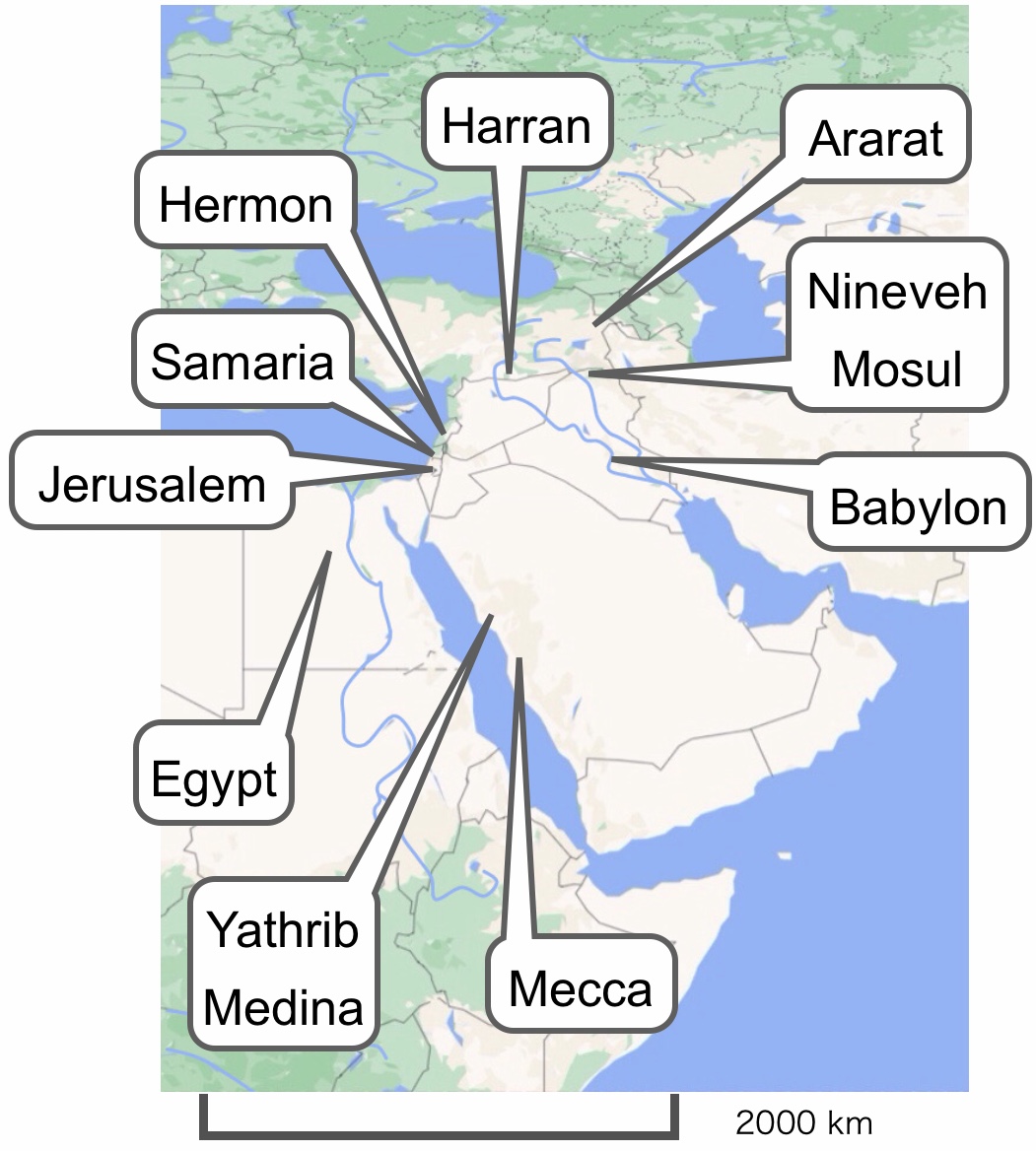
Yahweh created Islam by inspiring Muhammad (Arabic: محمد) in Mecca
through the angel Gabriel. Muhammad did not refer to Yahweh by name but
called Him "Allah" out of respect.
Muhammad was born in 570 CE in Mecca and became a merchant. One day in 610 CE,
while meditating and praying in a cave near Mecca, he encountered the angel Gabriel.
Gabriel conveyed to him stories and teachings. Muhammad began spreading these
teachings in Mecca, but he and his followers faced severe persecution. As a result,
they migrated to Yathrib (later known as Medina) in 622 CE. His teachings gained
significant acceptance in Yathrib, and he established a religious community.
In February 624 CE, Muhammad received instructions from God to direct prayers towards
Mecca. Muhammad's followers conquered Mecca in 630 CE and the Arabian Peninsula
by 632 CE. Muhammad died in Yathrib in 632 CE. However, the Islamic empires that
succeeded Muhammad
continued to expand afterward.

Muhammad Receiving the First Revelation from the Angel Gabriel by Unknown Author
*Attribution:
http://en.wikipedia.org/wiki/File:Mohammed_receiving_revelation_from_the_angel_Gabriel.jpg
*Attribution:
https://www.atlist.com/showcase/world-map-with-no-lab
*
"Muhammad on Wikipedia"
http://en.wikipedia.org/wiki/Muhammad
*
"Islam on Wikipedia"
https://en.wikipedia.org/wiki/Islam
2.1.6.2 Details
2.1.6.2.1 Annex of Judaism and Christianity
In contrast to the historical friction between Islam and Christianity, Islam,
which is centered around the Quran, generally acknowledges the contents of
the Old and New Testaments. Moreover, Islam adds stories that are not mentioned
in the Old and New Testaments and introduces new laws.
However, there are also descriptions in the Quran that contradict the New Testament.
*"Allah -there is no deity except Him, the Ever-Living, the Sustainer of existence.
He has sent down upon you, [O Muhammad], the Book in truth, confirming
what was before it. And He revealed the Torah and the Gospel" (Quran 3:2-3, Sahih International).
*
"Corpus Various English Translations of Quran"
http://corpus.quran.com/translation.jsp
*
"Corpus Quran Word by Word"
http://corpus.quran.com/wordbyword.jsp
*
"Quran.com"
http://quran.com/1
For example, according to Qisas al-Anbiya, a tafsir (exegesis) of the Quran, Adam
and Ḥawwāʾ (Eve) were separated immediately after being expelled from Paradise.
Adam was placed in what is now Sri Lanka (as of 2020), while Eve was placed in
Jeddah on the Arabian Peninsula. They later reunited at Mount Arafat, near
Mecca (as of 2020), and afterward, their sons Abel and Cain were born.
Furthermore, the Quran mentions that after Cain killed Abel, Cain struggled
with how to dispose of the body. This detail is not found in the Bible.
*
"Qisas al Anbiya on Wikipedia"
https://en.wikipedia.org/wiki/Qisas_al-Anbiya
*"And recite to them the story of Adam's two sons, in truth, when they both made an
offering [to Allāh], and it was accepted from one of them but was not accepted from
the other. Said [the latter], 'I will surely kill you.' Said [the former], 'Indeed,
Allāh only accepts from the righteous [who fear Him].
If you should raise your hand toward me to kill me - I shall not raise my hand toward
you to kill you. Indeed, I fear Allāh, Lord of the worlds.
Indeed, I want you to obtain [thereby] my sin and your sin so you will be among the
companions of the Fire. And that is the recompense of wrongdoers.'
And his soul permitted to him the murder of his brother, so he killed him and became
among the losers.
Then Allāh sent a crow searching [i.e., scratching] in the ground to show him how
to hide the disgrace of his brother. He said, "O woe to me! Have I failed to be
like this crow and hide the disgrace [i.e., body] of my brother?" And he became of
the regretful" (Quran 5:27-31, Sahih International).
Additionally, the Quran contains an account of the Annunciation to Mary
that differs from the Gospel.
*"And mention, [O Muḥammad], in the Book [the story of] Mary, when she withdrew from her family to a place toward the east.
And she took, in seclusion from them, a screen. Then We sent to her Our Angel [i.e., Gabriel], and he represented himself to her as a well-proportioned man.
She said, 'Indeed, I seek refuge in the Most Merciful from you, [so leave me], if you should be fearing of Allāh.'
He said, 'I am only the messenger of your Lord to give you [news of] a pure boy [i.e., son].'
She said, 'How can I have a boy while no man has touched me and I have not been unchaste?'
He said, 'Thus [it will be]; your Lord says, "It is easy for Me, and We will make him a sign to the people
and a mercy from Us. And it is a matter [already] decreed"'"(Quran 19:16-21, Sahih International).
Moreover, regarding the crucifixion, the Quran states that Jesus was not crucified but
rather ascended to heaven, while someone else was made to resemble him and was
crucified in his place.
*"And [for] their saying, 'Indeed, we have killed the Messiah, Jesus the son of
Mary, the messenger of Allāh.' And they did not kill him, nor did they crucify him;
but [another] was made to resemble him to them. And indeed, those who differ over
it are in doubt about it. They have no knowledge of it except the following of assumption.
And they did not kill him, for certain. Rather, Allāh raised him to Himself.
And ever is Allāh Exalted in Might and Wise" (Quran 4:157-158, Sahih International).
2.1.6.2.2 Beliefs of Islam
2.1.6.2.2.1 Overview
The beliefs of Islam consist of six articles of faith and five pillars.
2.1.6.2.2.2 The Six Articles
The six articles are:
(1) One God
Believers (Muslims) should believe in One God and monotheism
(2) Angels
Muslims should believe in the existence of angels.
(3) Revelations
Muslims should believe in the Islamic holy books.
The Islamic holy books consist of the Quran, Torah,
the Book of Psalms, Gospels, and other supposedly lost books
such as Scrolls of Abraham.
*
"Islamic Holy Books on Wikipedia"
https://en.wikipedia.org/wiki/Islamic_holy_books
The Quran is a collection of Yahweh's revelations given to Muhammad through
Gabriel, intended to be recited.
A proper English translation of the Quran would be Sahin International's
"The Noble Quran."
*
"The Noble Quran"
https://quran.com/
Otherwise, Tanzil Quran Navigator conveniently provides various translations.
*
"Tanzil Quran Navigator"
http://tanzil.net/#2:1
(4) Prophets
Muslims should believe in the prophets and messengers.
The representative prophet is Muhammad.
Authorized descriptions about
Muhammad (Muhammad' statement, acts, and attitudes)
and related persons, except the Quran,
are Hadith in a broad sense, while Hadith has multiple meanings.
*
"Hadith on Wikipedia"
https://en.wikipedia.org/wiki/Hadith
A proper English translation of Hadith would be "Sunnah.com."
*
"Sunnah.com"
https://sunnah.com/
(5) Resurrection and Judgement
Muslims should believe in the Last Judgment and Resurrection.
(6) Divine Will
It could be claimed that Muslims should believe in predestination.
The first five articles are referenced, for example, in Quran 4:136.
*"O you who have believed, believe in Allah and His
Messenger and the Book that He sent down upon His
Messenger and the Scripture which He sent down before.
And whoever disbelieves in Allah, His angels, His books,
His messengers, and the Last Day has certainly gone far astray" (An-Nisa 4:136, Sahin International, Quran).
*
"An-Nisa 4: 136"
https://quran.com/4/136
On the other hand, validity of Divine Will is controversial.
2.1.6.2.2.3 The 5 Pillars (Acts of Worship)
(1) Shahada: Faith
Muslims should declare their faith and trust by professing that there is only
one God (Allah) and that Muhammad is God's messenger.
(2) Salat : Prayer
Muslims should practice formal worship in Islam.
(3) Zakat : Charity
Muslims who are able should give to charity.
(4) Sawm: Fasting
Muslims should fast from food and drink from dawn to dusk during the month of Ramadan.
(5) Hajj: Pilgrimage to Mecca
Muslims who can afford to do it should make a pilgrimage to Mecca in their lifetime.
These rules are attributed to the Hadith of Gabriel, which is narrated by Gabriel.
*
"Hadith of Gabriel on Wikipedia"
https://en.wikipedia.org/wiki/Hadith_of_Gabriel
*From the viewpoint of Raelians, Islam requires the highest loyalty to Yahweh
since loyalty of humanity on the Earth to the Elohim is a matter of the highest importance as mentioned before.
From the viewpoint of Raelians, fasting comes from the ideas of "Sensual Meditation" mentioned later.
2.1.6.2.2.4 Other Representative Examples of Islamic Law
(1) Aniconism in Islam
Aniconism in Islam rejects idols. An attribution could be as follows.
*"And [Abraham] said, 'You have only taken, other than Allah,
idols as [a bond of] affection among you in worldly life.
Then on the Day of Resurrection you will deny one another and curse
one another, and your refuge will be the Fire, and you will not have
any helpers'" (29:25, Quran).
*
"29:25 Quran"
https://quran.com/29/25
*
"Aniconism in Islam on Wikipedia"
https://en.wikipedia.org/wiki/Aniconism_in_Islam
(2) Halal Food
Islamic Law requires compliance with some regulations as far as food.
An attribution would be as follows.
*"Prohibited to you are dead animals, blood, the flesh of swine,
and that which has been dedicated to other than Allah,
and [those animals] killed by strangling or by a violent blow or
by a head-long fall or by the goring of horns, and those from
which a wild animal has eaten, except what you [are able to]
slaughter [before its death], and those which are sacrificed on
stone altars, and [prohibited is] that you seek decision through
divining arrows. That is grave disobedience.
This day those who disbelieve have despaired of [defeating] your
religion; so fear them not, but fear Me. This day I have perfected
for you your religion and completed My favor upon you and have
approved for you Islam as religion. But whoever is forced by severe
hunger with no inclination to sin -then indeed, Allah is
Forgiving and Merciful" (5:3, Quran).
*
"5:3 Quran"
https://quran.com/5/3
*
"Halal on Wikipedia"
https://en.wikipedia.org/wiki/Halal
(3) Women Dress Code
As far as women dress code, Islamic Law requires covering
their bodies except face and hands.
An attribution would be as follows.
*"And tell the believing women to reduce [some] of their vision and
guard their private parts and not expose their adornment except that
which [necessarily] appears thereof and to wrap [a portion of] their
headcovers over their chests and not expose their adornment
except to their husbands, their fathers, their husbands' fathers,
their sons, their husbands' sons, their brothers, their brothers' sons,
their sisters' sons, their women, that which their right hands possess,
or those male attendants having no physical desire, or children
who are not yet aware of the private aspects of women.
And let them not stamp their feet to make known what they conceal
of their adornment. And turn to Allah in repentance, all of you,
O believers, that you might succeed" (24:31, Quran).
*
"24:31 Quran"
https://quran.com/24/31
*
"Women in Islam on Wikipedia"
https://en.wikipedia.org/wiki/Women_in_Islam
2.1.6.2.3 Learning Arabic Language
2.1.6.2.3.1 Arabic Alphabet
The Arabic language is written from right to left.
The Arabic alphabet is commonly written in cursive script, but it can also
appear in Unicode block letters.
On the other hand, Arabic cursive script changes shape depending on its position in a word.
Generally, there are 4 forms (isolated form, initial form, middle form, and end form).
When a letter is written alone separated from other letters,
the shape of the letter should be isolated form.
When a letter is written at the right edge of a word (at the initial of a word),
the shape of the letter should be initial form.
When a letter is written at the left edge of a word (at the end of a word),
the shape of the letter should be end form.
When a letter is written in the middle area of a word (neither initial nor end),
the shape of the letter should be middle form.
Since the Arabic alphabet has various contextual forms, a simple way to
start learning it is by studying the Unicode block isolated forms first.
The following are the Arabic block isolated forms, along with the letter names,
transliterations, and pronunciations:
1. ا=alif="a" long vowel like in apple
2. ب=baa="b" like in baby
3. ت=taa="t" like in tree
4. ث=tha="th" like in thanks
5. ج=jiim="j" like in John
6. ح=Haa="H" like in he yet light in pronunciation
7. خ=kha="kh" like in Bach
8. د=daal="d" like in dad
9. ذ=thal="dh" like in that
10. ر=raa="r" like in ran
11. ز=zay="z" like in zoo
12. س=siin="s" like in sing
13. ش=shiin="sh" like in shall
14. ص=Saad="S" like in salt
15. ض=Daad="D" like in dark
16. ط=Taa="T" like in table
17. ظ=Zaa="Z" like in those
18. ع=Ayn="'A" like in ago
19. غ=ghayn="gh" like in Ghana
20. ف=faa="f" like in far
21. ق=qaaf="q" like in Queen
22. ك=kaaf="k" like in Kent
23. ل=laam="l" like in love
24. م=miim="m" like in Moon
25. ن=nuun="n" like in nest
26. ه=haa="h" like in hand
27. و=waaw="w" long vowel like in word
28. ي=yaa="y" long vowel like in yet
In addition, other letters such as hamza (ء) should be learned.
After mastering the isolated forms, learners should move on to other
contextual forms and practice cursive writing.
*
"My Easy Arabic"
http://www.myeasyarabic.com/site/arabic_alphabet_learn.htm
*
"Arabic Alphabet on Wikipedia"
https://en.wikipedia.org/wiki/Arabic_alphabet
2.1.6.2.3.2 Introduction to the Arabic Language
A good starting point for learning Arabic is the website "Arabic Reading Course.com".
*
"Arabic Reading Course"
http://arabicreadingcourse.com/
2.1.6.2.4 Kaaba
In 630 CE, Muhammad conquered Mecca and declared the Black
Stone and the Kaaba sacred in Islam. (Kaaba means "cube" in Arabic.)
Before Muhammad's takeover of Mecca, Arab tribes worshiped their own gods
and built sanctuaries to house them. The Kaaba and the Black Stone were originally
among these pre-Islamic religious objects.
After gaining control of Mecca, Muhammad destroyed all objects of worship and
temples he deemed idolatrous, including the 360 idols housed in the Kaaba.
He then declared only the Kaaba and the Black Stone sacred.
The Kaaba had already been called by this name before Muhammad's time and
had been repeatedly destroyed and rebuilt. Around the time Muhammad reached
adulthood, the Kaaba was reportedly burned down and later rebuilt with wood and stone.
The current Kaaba is a black, cube-shaped structure approximately 10 meters
on each side, made primarily of stone and wood. Its main body consists of stacked
stones, mainly granite and basalt, and is covered with a black cloth called Kiswah.
The corners of the Kaaba are oriented toward the north, south, east, and west,
with the Black Stone embedded in the eastern corner of the wall.
During Muhammad's time, the Black Stone was a single stone with a diameter of
approximately 30 cm. However, it was later broken into several pieces sometime
between the 7th and 10th centuries CE. Today, the fragments are embedded in the
corner of the Kaaba, surrounded by a silver frame.
The origin of the Kaaba is unknown, but one theory suggests that it was originally a
place of worship for angels before the creation of humankind. According to Islamic tradition,
Abraham and his eldest son, Ishmael, rebuilt the Kaaba after it was destroyed by Noah’s
flood. It is said that an angel, possibly Gabriel, brought the Black Stone to Abraham,
who placed it in the eastern corner of the building.
Regarding the origin of the Black Stone, another tradition states that it was given to Adam
and Eve from heaven to mark the location where they should build a place of
worship (altar) after their reunion near Mecca. (As mentioned earlier, after being
expelled from the Garden of Eden, Adam and Eve were separated, with Adam wandering as
far as the Indus before finally reuniting with Eve near Mecca.) This explanation
might provide some basis for the significance of the Black Stone as an object of
reverence in Islam.

The Kaaba in December 2020 CE

Diagram Image of the Kaaba
1 the Black Stone
2 Entrance
12 Kiswah

Technical Drawing of the Kaaba

the Black Stones in the Silver Frame

Illustration of the Black Stones

Muhammad Fixing the Black Stone into the Kaaba
*Attribution:
"Kaaba on Wikipedia"
https://en.wikipedia.org/wiki/Kaaba
*Attribution:
"Black Stone on Wikipedia"
https://en.wikipedia.org/wiki/Black_Stone
However, the corner of the building is covered with a strangely
shaped silver frame featuring a vertically oval hole. There seems to be some
significance to the fact that the building housing the Black Stone is a
black cube. (The word “cube” is thought to derive from the Kaaba's cubic shape.)
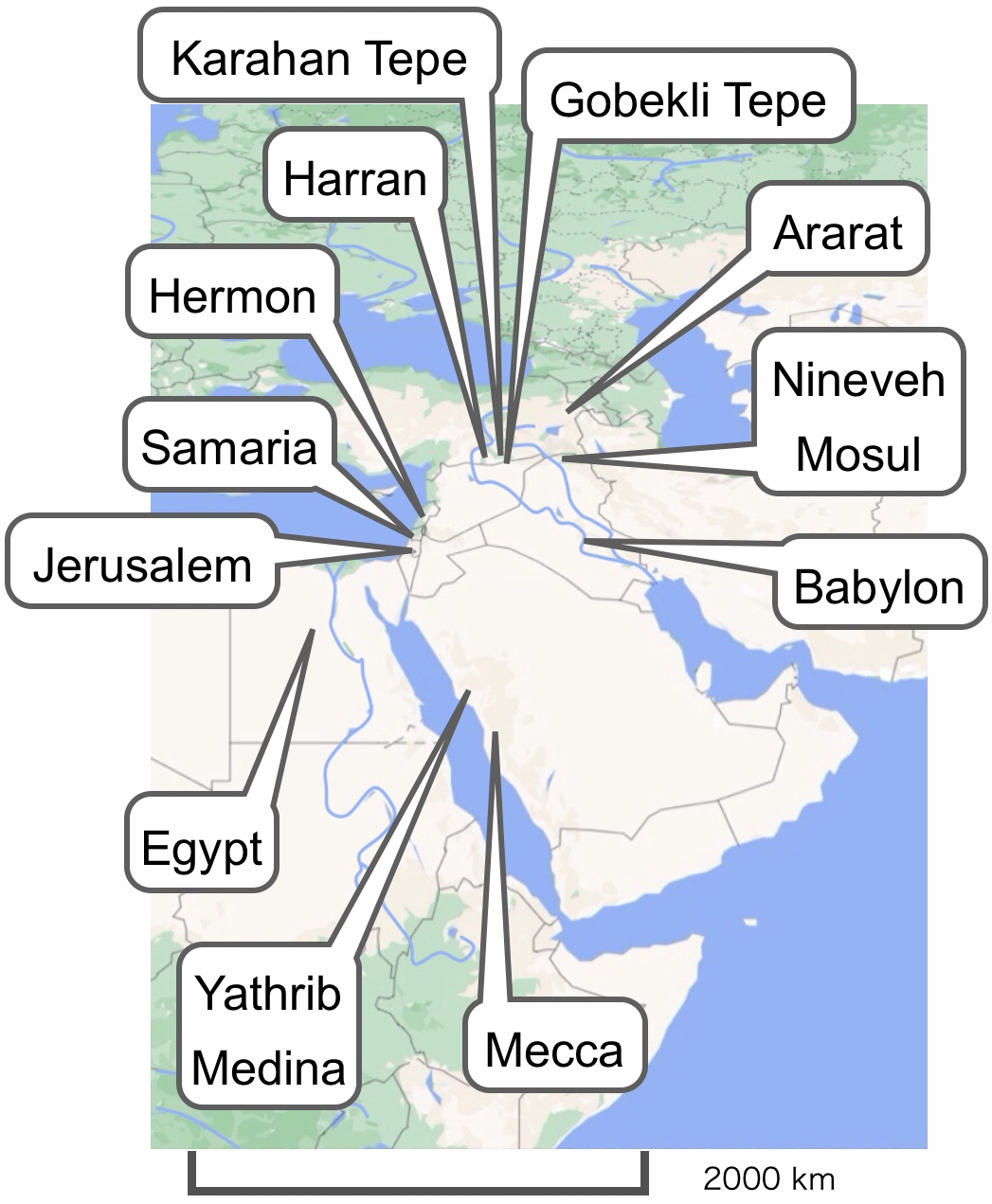
One possible clue to this is that the name "Kaaba" may be linked to Kubaba,
the Anatolian-Syrian goddess of fertility, life, and
renewal (later known as Cybele in Greece), who was worshiped in the nearby
Anatolian region or Syria. Kubaba was reportedly originally venerated in
Anatolian sites such as Çatalhöyük, Karahan Tepe, and Göbekli Tepe, the oldest
known ruins in the world, dating back to around 10000 BCE.
If the original concept of the Kaaba was inspired by a goddess, it is plausible that
her form was symbolically transformed into a cube in Islam, which prohibits idolatry.
Furthermore, since it is a customary practice in Islam for women to cover their
bodies with black cloth to conceal their sexual attractiveness, it is understandable
that the Kaaba is likewise draped in black cloth, possibly symbolizing modesty or reverence.
The vertically oval hole in the corner of the Kaaba is noteworthy, as the Black
Stone is placed inside this aperture.

*Attribution:
https://www.atlist.com/showcase/world-map-with-no-labels

A Relief of Goddess Kubaba
*
"Kubaba (Goddess) on Wikipedia"
https://en.wikipedia.org/wiki/Kubaba_(goddess)
*
"Çatalhöyük on Wikipedia"
https://en.wikipedia.org/wiki/Çatalhöyük
*
"Karahan Tepe on Wikipedia"
https://en.wikipedia.org/wiki/Karahan_Tepe
*
"Göbekli Tepe on Wikipedia"
https://en.wikipedia.org/wiki/Göbekli_Tepe

A Muslim Woman Wearing a Niqab in Saudi Arabia

Women Wearing Burqas of different colors in Afghanistan in 1975 CE
*
"Niqāb on Wikipedia"
https://en.wikipedia.org/wiki/Niqāb
*
"Burqa on Wikipedia"
https://en.wikipedia.org/wiki/Burqa
2.1.6.2.5 Progress of Islamic Empires and Christian Empires
Muhammad established the first Islamic Empire and died in 632 CE.
Two main powers competed for the position of successor leader (caliph or imam).
The fourth caliph (and the first imam in Shia Islam) was Ali, a cousin of Muhammad,
who was favored by the
Medina faction. His wife, Fatima, was Muhammad's daughter.
Muhammd established the 1st Islamic Empire and died in 632 CE.

The Marriage of Ali and Fatima
*
"Fatima on Wikipedia"
https://en.wikipedia.org/wiki/Fatima
However, Ali was assassinated by opposing forces in 661 CE, causing the sect to
split into two branches. The Shiites were associated with the Medina faction and
valued Ali's lineage, while the Sunnis, linked to the Meccan leadership, were related
to Muhammad by blood and formed the Umayyad dynasty. The Sunnis also claimed to
uphold Muhammad's doctrine.
The Sunnis established the Umayyad Caliphate in Damascus with the fifth
caliph in 661 CE, expanding their territory and making the Sunnis (Umayyads) the
mainstream of Islam.
However, a faction of Shiites loyal to Ali's descendants claimed that the Abbasids
had usurped their rightful position. The Abbasids overthrew the Umayyads in 750
CE and ruled the Arabian Peninsula and its surroundings. However, due to
domestic governance circumstances, the Abbasids adopted Sunni Islam, bringing them
into conflict with the Shiites.
*
"Abbasid Caliphate on Wikipedia"
https://en.wikipedia.org/wiki/Abbasid_Caliphate

Territories of the Islamic Empire from 622 CE to 750 CE
(750 CE as the Abbasid Dynasty)

Territories of the Frankish Kingdom as of 734 CE
As for the Frankish Kingdom, the Merovingian dynasty declined,
and the mayor of the palace, Pepin the Short, took over power. Pepin the Short
allied with the Western Trinitarian Church and established the Carolingian
dynasty in the Frankish Kingdom in 751 CE. He extended the territory and, in 756 CE,
donated parts of the Italian peninsula to the Western Trinitarian Church, which later
became the Papal States.

Territories of the Frankish Kingdom as of 801 CE
(The Papal States in Red)
Eventually, the Frankish Kingdom was divided into 3 kingdoms in 843 CE: the East
Frankish Kingdom, the Middle Frankish Kingdom, and the West Frankish Kingdom.

Territories of the Frankish Kingdoms as of 843 CE
(The Papal States in Red)
The territories of the Abbasid Dynasty of the Islamic Empire as of 850 CE are shown below.

Territories of the Islamic Empire as of 850 CE
Territories of the Empires as of 850 CE would be shown below.
The Byzantine Empire dominated the Balkans and Anatolia.

Territories of the Empires as of 850 CE
After a while, the Middle Frankish Kingdom was subdivided into the East
Frankish Kingdom, the West Frankish Kingdom, and the Kingdom of Italy in 870 CE.
The Kingdom of Italy contained the Papal States.

Territories of the Frankish Kingdoms and the Kingdom of Italy as of 870 CE
(The Papal States in Red)
The Western Trinitarian Church grew closer to the East Frankish Kingdom,
and in 962 CE, the East Frankish Kingdom and the Kingdom of Italy became the Holy
Roman Empire, allied with the Western Trinitarian Church. Meanwhile, the Eastern
and Western Trinitarian Churches became estranged.

Territories of the Holy Roman Empire as of 962 CE
(The Papal States in Red)
*Attribution:
https://en.wikipedia.org/wiki/File:HRR.gif
Meanwhile, the Abbasid Dynasty declined, and the Fatimid Dynasty,
based in present-day Tunisia (as of 2020 CE) (Central Africa along the Mediterranean Sea),
dominated around present-day Egypt (as of 2020 CE) around 1000 CE.

Territories of the Fatimid Dynasty of the Islamic Empire around 1000 CE
*
"Fatimid Caliphate on Wikipedia"
https://en.wikipedia.org/wiki/Fatimid_Caliphate
Eventually, the Eastern and Western Trinitarian Churches opposed each
other on various issues and formally separated in 1054 CE.
The Eastern Trinitarian
Church became known as the Orthodox Church or the Orthodox Catholic
Church, while the Western Trinitarian Church was called the Catholic Church
or the Roman Catholic Church.

Spheres of Influence of the Orthodox Church and the Catholic Church as of 1054 CE
*Attribution:
https://en.wikipedia.org/wiki/File:Great_Schism_1054_with_former_borders.png
Meanwhile, the Abbasid Dynasty declined, and the Seljuq Dynasty of
the Islamic Empire arose around 1071 CE.

Territories of the Seljuq Dynasty of the Islamic Empire as of 1092 CE
The Byzantine Empire faced a crisis and allied with the Western Trinitarian
Church (the Catholic Church). According to the commonly accepted theory,
the Catholic Church organized the First Crusade in 1095 CE.
The First Crusade advanced to Jerusalem and established the Kingdom of
Jerusalem in 1099 CE. However, the Kingdom of
Jerusalem eventually fell in 1291 CE.
As for the Roman Catholic Church in the Holy Roman Empire, Martin Luther
advocated Evangelicalism, emphasizing the Gospel, and established
Protestantism in 1529 CE in opposition to the system and domination of the
Roman Catholic Church. However, Protestantism still upheld the doctrine of the Trinity.
Subsequently, most of the Papal States were lost when they were annexed to
Italy around 1870 CE. The Roman Catholic Church managed to secure a
small area of 0.44 km2, Vatican City, where Saint Peter's Basilica is
located, traditionally
believed to be the
burial site of Saint Peter, in Rome.

Return to the Home Page