Disclaimer: This is Untrue.
2.3.4 History of the Children of Israel (After the Diaspora)
2.3.4.1 After the Babylonian Captivity
Thus, the ten tribes disappeared, and the Diaspora of the remaining tribes began.
In contrast to the secular theory, which assumes that the Diaspora began in 70 CE under the Roman Empire, the Jewish Diaspora actually started after the Babylonian Captivity. The Jewish population was taken to Babylon—initially in 597 BCE and then more fully in 586 BCE.
*
"Babylonian Captivity on Wikipedia"
http://en.wikipedia.org/wiki/Babylonian_captivity
Cyrus II of the Persian Achaemenid Empire defeated the Neo-Babylonian Empire,
and the Jewish people were released (538 BCE). The Jewish population in Babylonia at
that time is estimated to have been around 150,000. Some Jews returned to Jerusalem.
However, the majority remained in Babylonia, as most of them had been born there
and were already well-established. It is said that 42,360 Jewish people (initially) returned to Jerusalem (Canaan), which was roughly one-fourth to one-third of the Jewish population at the time.
*"The whole assembly together was forty-two thousand three
hundred and sixty, besides their male and female servants, of
whom there were seven thousand three hundred and thirty-seven;
and they had two hundred men and women singers. Their horses
were seven hundred and thirty-six, their mules two hundred and
forty-five, their camels four hundred and thirty-five,
and their donkeys six thousand seven hundred and twenty" (Ezr 2:64-67).
The returnees completed the Second Temple in 515 BCE.

Overview Map of the World in 500 BC
*
https://en.m.wikipedia.org/wiki/File:World_in_500_BCE.png
2.3.4.2 Establishment of Alexander's Empire
Alexander III (Alexander the Great: 356 - 323 BCE), the son of the king of Macedonia, a
small Greek kingdom (present-day Greece as of 2020 CE), focused on territorial
expansion, and founded Alexandria in present-day Egypt (as of 2020 CE) in 332 BCE.
The Jewish people welcomed Alexander III as the man prophesied by Daniel (Daniel 7:6, 8:3-8, 8:20-22, 11:3). Alexander III treated the Jewish people of Alexandria with particular care.
(Greeks of the time are also said to have dark hair and brown skin)

Roman Copy of an Original 3rd Century BC Greek Bust of Alexander III
*
"Alexander the Great on Wikipedia"
https://en.wikipedia.org/wiki/Alexander_the_Great
He overthrew the Achaemenid Empire (which included parts of present-day Egypt, Iran, Afghanistan, and Pakistan) in 330 BCE, replacing it with an empire that spanned the former Achaemenid territories and present-day Greece. This led to the development of Hellenistic culture, which fused Greek and Eastern elements. Greek became the lingua franca of these regions.
Alexander the Great died suddenly in 323 BCE. His generals (Greeks) fought a succession war as his successors (diadochoi), which lasted for about 40 years—from 323 to 281 BCE. Eventually, the empire was divided into three kingdoms: the Seleucid Empire, Ptolemaic Egypt, and Antigonid Macedonia.

The Power Structure in 323 BCE
In these areas, the Greek translation of the Old Testament began to be produced in Alexandria,
Egypt, around 250 BCE, because most Jewish people only understood Greek.
Diodotos, a Greek satrap (governor) of the northeastern region of the Seleucid Empire,
revolted in 256 BCE and began to establish the Greco-Bactrian Kingdom in the
northeastern part of the empire.

*
"Greco Bactrian Kingdom on Wikipedia"
https://en.wikipedia.org/wiki/Greco-Bactrian_Kingdom
*
"History of Europe" Wikibooks"
https://en.wikibooks.org/wiki/Brief_History_of_Europe/Print_version
In addition, Antiochus IV Epiphanes of the Seleucid Empire ruled Canaan,
imposed Greek culture, and persecuted the Jewish population there (167 BCE). Many
Jewish people in Canaan fled or migrated to Alexandria or other parts of the Hellenistic
world, from India to Rome, forming their own communities. Most of the Jewish
population that had settled outside of Canaan could no longer understand Hebrew.
Therefore, the Hebrew Bible was translated into Greek (known as the Septuagint) in
Alexandria under the Ptolemaic dynasty in 132 BCE.
2.3.4.3 Qin Dynasty in China
2.3.4.3.1 Background
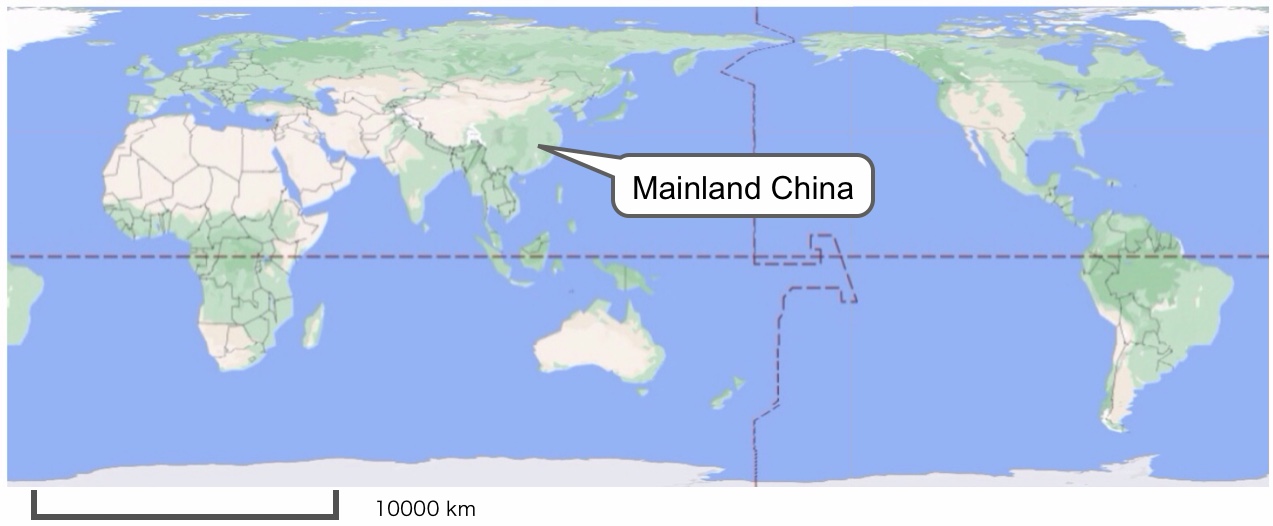
At this point, it is necessary to explain the Qin (秦) Dynasty, China's first unified state, as it may have a possible connection to the descendants of David.
The key inhabited regions of mainland China included the wide plains of the lower Yellow
River, the Weishun Basin around the Wei River (a tributary flowing westward
from the Yellow River), and the lower to middle reaches of the Yangtze River. These areas
were inhabited by an ethnic group known as the Huaxia, later identified as the Han people.
This is the region where many historical battles in ancient China occurred.
It is said that the Qin Dynasty was founded around 905 BCE in the upper reaches of the Wei River, a tributary flowing westward from the middle reaches of the Yellow River (the western edge of the key regions of mainland China).
*Attribution:
https://www.atlist.com/showcase/world-map-with-no-labels
Around 260 BCE, China was in the Warring States period, during which seven major states
existed within its core territory. Among them, Qin (Chinese: 秦), ruled by
King Zhaoxiang (Chinese: 昭襄王), emerged as a dominant power, controlling
the Weishui Basin and the middle reaches of the Yangtze River.

*
"Warring States Period on Wikipedia"
https://en.wikipedia.org/wiki/Warring_States_period
2.3.4.3.2 Unification of China by the Qin Dynasty in 221 BCE
King Zhaoxiang's son was Lord Anguo (Chinese: 安國君) (302 - 250 BCE) (later King Xiaowen), and one of Anguo's more than 20 children was Yiren (Chinese: 異人, 异人).
However, Yiren's mother, concubine Lady Xia, was shunned by Lord Anguo.
Yiren was held hostage in the enemy country of Zhao.
However, Lü Buwei (Chinese: 呂不韋), a merchant, supported Yiren.
Lu Buwei introduced his favorite concubine, Lady Zhao (Zhao's woman), and Lady Zhao married Yiren and gave birth to a child named Zheng (政). (There is also a theory that Lady Zhao was Lu Buwei's favorite concubine and Zheng was Lu Buwei's son.)
Due to Lu Buwei's success, Yiren escaped from Zhao in 258 BCE and approached King Xiaowen's step-wife, who had no children. He was adopted by Lady Huayang and took the name Zichu, eventually became the fifth king of the Qin dynasty, King Zhuangxiang (Chinese: 莊襄王).
King Zhuangxiang soon died, his son Zheng (259 - 210 BCE) ascended the throne in 247 BC at the age of 13, and under the effective control of Lu Buwei, Qin's military increased power. Supposedly Lu Buwei at that time began construction of the imperial mausoleum.
Afterwards, Zheng came of age and assumed power, conflicting with his mother Zhao and Lu Buwei, and overthrowing them both.
In 241 BCE, the Qin dynasty became powerful defeating the combined forces of Zhao, Chu, Wei, Han, and Yan.
In 221 BCE, he unified the key regions of China (the Weishui Basin, the lower reaches of the Yellow River, and the middle and lower reaches of the Yangtze River), and the "Zheng" took the name "Emperor.'' He was later called Qin Shi Huang (Chinese: 秦始皇).
He abolished the feudal system and introduced administrative units and subunits, where bureaucrats (governors) were dispatched from the central government.
He began full-scale construction of the Great Wall of China and practiced autocracy. It is said that he died and he was buried with a large-scale terracotta army at the mausoleum.
Much of this period is written in later history books called Shiji (史記).
*
"Record of the Grand Historian on Wikipedia"
https://en.wikipedia.org/wiki/Records_of_the_Grand_Historian
*
"Zh Wikisource /史記/卷006"
https://zh.wikisource.org/wiki/史記/卷006

Depiction of Qin Shi Huang (Chinese: 秦始皇)
*
"Qin Shi Huang on Wikipedia"
https://en.wikipedia.org/wiki/Qin_Shi_Huang
2.3.4.3.3 Identity of the Qin Dynasty
According to traditional understanding, Qin was a nation of the Huaxia Chinese or Han Chinese, the indigenous people of China.
However, Greek and Jewish elements can be seen in the Qin Dynasty around the time of unifying China and Qin Shi Huang (Chinese: 秦始皇), there is speculation that the government and Qin executives were Greek-Jewish.
*
"Huaxia on Wikipedia"
https://en.wikipedia.org/wiki/Huaxia
*
"Han Chinese on Wikipedia"
https://en.wikipedia.org/wiki/Han_Chinese
The arguments include the following.
His father was called Yiren (Chinese: 異人), which means
"extraordinary person" or "another person."
It is said that the mother was looked down upon and Yiren was in the position of being offered as hostages.
The name Lü Buwei (Chinese: 呂不韋) is a strange name for a Chinese person, and as a merchant, it is possible that he had close ties to foreign countries.
A theory claims that "Lu Buwei" comes from a backwards reading of the Hebrew word "YHWH EWL ((יהוה עול" (Yahweh burdens).
The district system was similar to the satrap system of Achaemenid Persia, and it is possible that they had knowledge of Achaemenid origin.
According to Records of the Great Historian, called Shiji (史記),
Qin Shi Huang is said to have had a long nose, long eyes, a protruding chest like a hawk, and a voice similar to that of a mountain dog.
秦王為人,蜂準,長目,摯鳥膺,豺聲,
These characteristics were more Middle Eastern and European than typical Oriental.
The elaborate and realistic terracotta soldiers and figures of the mausoleum, which was supposedly started by Lu Buwei, are alien to Chinese art and similar to Greek art.
Elaborate Greek influences can be particularly seen in the "teracotta of acrobatic entertainers" (雜技陶俑), in the bronze statues of ducks, swans, and cranes.


General View of the Pit No. 1 of the Mausoleum

*
https://kamatiam.org/透視秦俑/
*
https://www.pressreader.com/china/popular-archaeology/20180920/283008286109158
*
https://zlibrary-asia.se/author/陕西省考古研究所,秦始皇兵马俑博物馆编著
*
https://kknews.cc/n/8kvg4ye.html
Human bones excavated from ruins of the time in northwestern China, present-day the Xinjiang Uygur Autonomous Region (as of 2020 CE),
contained European DNA.

*
"Xinjiang on Wikipedia"
https://en.wikipedia.org/wiki/Xinjiang
*
"BBC News: 兵馬俑揭秘:公元前3世紀古希臘的靈感"
https://www.bbc.com/zhongwen/trad/china/2016/10/161012_terracota_greek
At that time, the Seleucid Empire, the successor state of Alexander's empire,
controlled as far as Lake Balkhash, east of the Caspian Sea, and there were no
military obstacles to reaching the Qin-controlled territory from there.
Jewish people were on good terms with Alexander's empire, it is likely that Jewish
people were also included in Seleucid Empire or related powers.
2.3.4.3.4 Fall of the Qin Dynasty
Although the Qin dynasty was the first to unify major regions of China, after the death
of Shi Huang, its national power declined and it was unable to suppress internal
rebellions, leading to its fall in 206 BCE and was replaced by the Han dynasty
consisting of the Huaxia Chinese or Han Chinese.
2.3.4.4 Era of the Roman Empire
The Roman Republic (or the Roman Empire) ruled Canaan since 63 BCE.
The population of the Jewish people as of 20 BCE is said to be 4,500,000.
The population of the world ca. 1 CE is considered some 200,000,000 or 300,000,000.
The population of the Roman Empire at that time is said to be 45,000,000.
The population of the citizens of the Roman Empire is some 4,500,000.
The Claudian census (48 CE: in the reign of Clauds) refers to 6,944,000 Jewish population
in the Roman Empire.
(The population of Rome (city) at that time was some 1,000,000.
The population of the Jewish people in Rome (city) could be estimated some 20,000.)
The population of the Jewish people in Canaan at that time is said to be 2,500,000.
The majority of the Jewish population was not in Canaan, they had already scattered.
The First Jewish-Roman War (66 - 73 CE) and Bar Kokhba's Revolt (132 - 135 CE)
occurred, the Jewish power was defeated by the Roman Empire.
Jewish captives would have been sold into slavery.
In addition, according to the widely accepted theory, the Jewish population in
Canaan was expelled from Canaan.
As of 200 CE, communities had scattered in the Roman Empire. Populated places
were Jerusalem, Alexandria, Carthage, Cordoba (the Iberian Peninsula),
Massilia (present-day Marseille, France), Genova, Rome Campania (present-day Italy),
Calabria (present-day Italy), Ephesos (Asia Minor), Miletus (Asia Minor),
Tigris, Babylon, and so on.
Contrary to that, as mentioned earlier, another theory claims that Jewish city dwellers
were expelled
but "workers of the land (farmers) remained attached to their land" stayed in Canaan,
eventually converted to Christianity and then Islam, and became Palestinians and
Arabs in Israel.
For example, several Palestinian extended families, most notably the Makhamra family
of Yatta, have recent traditions of having a Jewish ancestry.
The Elohim significantly claim, "a majority of Palestinians are, in fact, genetically real
Jews because
their ancestors were Jews. Meanwhile, a majority of Israelis lack the genetic traits of
real Jews because they are, in fact, descendants of central European people who
converted to Judaism."
*
"Palestinians on Wikipedia"
https://en.wikipedia.org/wiki/Palestinians/
★
"Elohim Leaks #2"
http://www.elohimleaks.org/bacteriological-world-genocide/
Besides, it is said that some Armenian cities
(South Caucasus: between the Black Sea and the Caspian Sea)
had Jewish population ranging from 10,000 to 30,000 as of the 4th century CE,
while it might have included
descendants of converts to Judaism.
*
"History of the Jews in Russia on Wikipedia"
http://en.wikipedia.org/wiki/History_of_the_Jews_in_Russia
The Babylonian Talmud was compiled around 500 CE in Babylon.
2.3.4.5 Islam
Islam arose in 638 CE.
Islam was generous to the Jewish population because of its doctrine.
The Umayyad Caliphate invaded the Iberian Peninsula through the northern coast of
Africa in 711 CE.
A numerous Jewish population migrated to Cordoba, while it might
have included descendants of converts to Judaism.
They didn't have serious financial difficulties.
2.3.4.6 Khazaria
Khazaria should be mentioned, although the relationship between Khazaria and
the Ashkenazi Jewish population is controversial.
Khazaria emerged in the present-day Caucasus (between the Black Sea and the Caspian Sea)
around 650 CE, following the fall of the Gokturk Khaganate in Central Asia due to its civil wars.
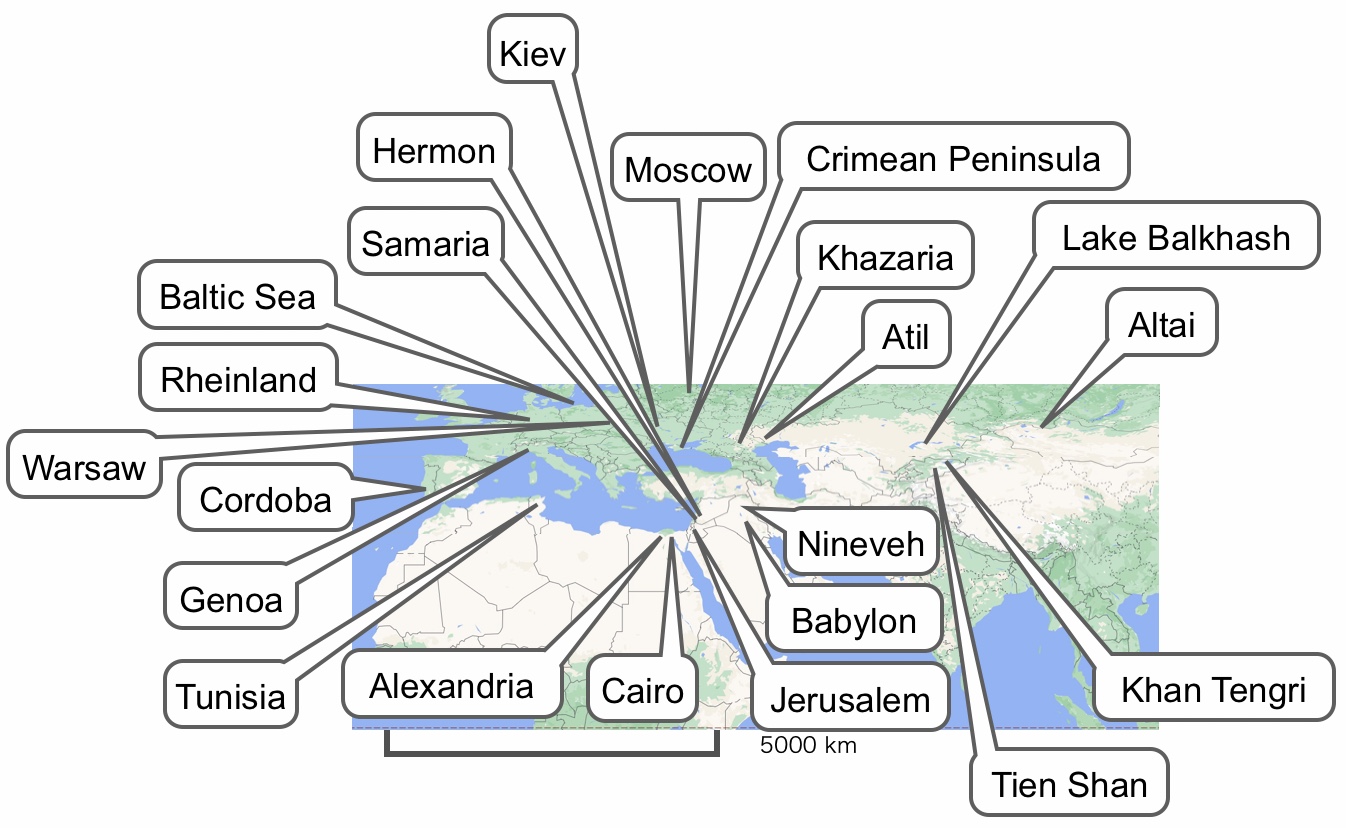
The Gokturk (Turkic) people originated from the Ashina clan in the Altai Mountains,
roughly 1,500 km to the east of Lake Balkhash (Altai is about 1,500 km to the
northeast of Tian Shan). The Ashina clan is said to have been a mixed tribe, which
included Xiongnu people (originally Mongoloids). The Gokturks are believed to be mixed
Eurasians.
The religion of the Gokturks was Tengrism, associated with Khan Tengri Mountain in
Tian Shan. (As mentioned later in reference to Judaism and Japanese religion Shinto, both
Judaism and Nestorianism might be associated with Tengrism, and a small group
descending from Judah who moved eastward might be linked to Tengrism.)
*
"Gokturks on Wikipedia"
http://en.wikipedia.org/wiki/G%C3%B6kt%C3%BCrks
*
"Altai Mountains on Wikipedia"
http://en.wikipedia.org/wiki/Altai_Mountains
*
"Lake Balkhash on Wikipedia"
http://en.wikipedia.org/wiki/Lake_Balkhash
*
"Tian Shan on Wikipedia"
http://en.wikipedia.org/wiki/Tian_Shan
*
"Tengrism on Wikipedia"
http://en.wikipedia.org/wiki/Tengrism
*
"Tengri on Wikipedia"
http://en.wikipedia.org/wiki/Tengri
*Attribution:
https://www.atlist.com/showcase/world-map-with-no-labels
After the fall of the Gokturks, Khazaria dominated the Caucasus (between the Black Sea
and the Caspian Sea)
and its northern area (present-day Ulyanovsk Oblast of Russia, east of present-day
Ukraine (as of 2020 CE),
and so on).
The capital of Khazaria was Atil located on the north-northwest of the Caspian Sea.
People of Khazaria were called Khazars.
Khazars are said to have originally practiced Turkic Tengrism.
(Tengrism is said to have been possibly associated with Judaism or Nestorianism.)
It is said that a considerable number of East Slavic population on the northwest
adjacent to Khazaria were captured and
sold as slaves to the Islamic world at that time
by Khazar people. (Islam was not negative as to slavery.)
*Details of the East Slavic population at that time are unclear, since little
literature on the East Slavic population at the time is seen.
They seem rather undeveloped.
The origin of the Slavic population including the East Slavic population
is controversial,
while theories wonder around the northwestern area of the Black Sea,
present-day Ukraine (as of 2020 CE).
*
"Slavic Peoples on Wikipedia"
http://en.wikipedia.org/wiki/Slavic_peoples#Origins
On the other hand, some Jewish people in present-day Lithuania trading among
the Baltic Sea and present-day Poland in the 8th century CE are
said to have been reported.
*
"History of the Jews in Lithuania on Wikipedia"
http://en.wikipedia.org/wiki/History_of_the_Jews_in_Lithuania
The origin and the tribe of Khazaria are unclear.
Theories would be
(i) Uyghur Turkics (supposedly mixed Eurasians),
(ii) Huns (supposedly Mongoloids from east; possibly mixed Turkic Eurasians),
(iii) Transoxiana Turkics (present-day Uzbekistan, Kazakhstan etc; supposedly mixed Eurasian)
(iv) North Caucasian,
(v) Emperors of Khazaria are descendants of the Ashina clan (Turkic) of the Gokturks.
This theory (v) is based on the assumption that statement in "Hudud al-'Alam" (The Regions of the World: Persian geography book of the 10th century CE), "Khagan (emperor) of Khazaria is the descendant of Ansa' ast" ( از فرزندان انسا است: az farzandān-i Ansā' ast), could be interpreted as "the descendants of Ashina."
(vi) The Lost Tribes of Israel from Nineveh.
*
"Khazars on Wikipedia"
http://en.wikipedia.org/wiki/Khazars
*
"Caucasus on Wikipedia"
http://en.wikipedia.org/wiki/Caucasus
*
"Ulyanovsk on Wikipedia"
http://en.wikipedia.org/wiki/Ulyanovsk
*
"Ukraine on Wikipedia"
http://en.wikipedia.org/wiki/Ukraine
*
"History of Khazaria"
http://www.khazaria.com/khazar-history.html
It is known that the primary religion of Khazaria was Judaism, at least by around 900 CE.
There are 3 theories regarding the Ashkenazi Jewish population, which was primarily located around the Polish-Lithuanian Commonwealth around 1750 CE, in the region between the Baltic Sea and the Crimean Peninsula in the Black Sea, covering present-day Poland, Ukraine, Belarus, Lithuania, Latvia, and Estonia (as of 2020 CE).
(A) Khazars are not associated with the Ashkenazi Jewish population around the Polish-Lithuanian Commonwealth in 1750 CE. This is the secular theory regarding the Ashkenazi Jewish population. It suggests that the Ashkenazi Jews in this region descend from the migration of Jewish populations from present-day England, France, Germany, and other areas, which began around 1100 CE.
(B) Some of the Children of Israel moved to the northern region of the Caucasus. Their religion was originally Judaism, they became Khazars, and they became part of the Ashkenazi Jewish population around the Polish-Lithuanian Commonwealth in 1750 CE. As mentioned above, the religion of the Gokturks and the Western Gokturks was Tengrism, and, as discussed later, Tengrism may have been associated with Judaism or Nestorianism, with a small group descending from Judah moving eastward. This situation might support theory (B).
(C) Khazars were originally a semi-nomadic Turkic people from the east. Turkic peoples are thought to have originally been Mongoloid (with round faces and narrow eyes). They established Khazaria around 650 CE and became more Caucasoid (Eurasians) through intermingling with indigenous peoples. Their original religion was Tengrism, but they converted to Judaism sometime between 740 and 850 CE. After the fall of Khazaria, they became the primary members of the Ashkenazi Jewish population in the Polish-Lithuanian Commonwealth around 1750 CE.

European Countries as of 2020 CE
*Attribution:
"Europe on Wikipedia"
https://en.wikipedia.org/wiki/Europe
Consequently, historical materials and the Elohim's disclosure strongly support theory (C).
Furthermore, there are 2 theories about the date of the conversion and
the motive, while the correct one is unclear.
Theory (C)-1 attributes the date to around 850 CE and the motive to reduce
competing pressures from the Islamic power (Abbasid Caliphate) and the Christian
power (Byzantine Empire) at the time accepting convenient religion to both
Islam and Orthodox Christianity.
Theory (C)-2 attributes the date to around 740 CE and the motive to angelic
recommendation to the king.
Evidence of Khazaria's adherence to Judaism includes the following.
Christian of Stavelot in his Expositio in Matthaeum Evangelistam (around 860 - 870s CE) refers to Gazari, (presumably Khazars) as living in the lands of Gog and Magog, who were circumcised and observation of all the laws of Judaism.
Evidence of the Khazars' conversion also appears in several historical records:
Persian historian ibn al-Faqih (alive in 902 CE) wrote that "all the Khazars are Jews, but they have been Judaized recently."
Ibn Fadlan (a member of an embassy of the Abbasid caliph), based on his Caliphal mission (921 - 922 CE) to the Volga Bulğars (Turkic state about 1,500 km to the north of the Caspian Sea), reported that "the core element of the state, the Khazars, were Judaized."
Ḥasdai ibn Shaprūṭ (a physician and a Jewish foreign secretary of the Caliph of Cordoba), wrote a letter of inquiry addressed to the ruler of Khazaria around 960 CE from the Iberian Peninsula, and received a reply from King Joseph of Khazaria. The exchange of this Khazar Correspondence might be an evidence of the conversion, while there would be 2 versions and the credibility is controversial.
According to the correspondence, King Bulan (in the reign of 740 - 786 CE) of Khazaria is said to have driven out the wizards and idolaters, spontaneously examined the true religion, Bulan is then said to have held a royal debate between representatives of the three Abrahamic religions. He decided to convert when he was convinced of Judaism's superiority. Many scholars date this around 740 CE.
Otherwise, the other version claims that an angel appeared in King Bulan's dream, encouraged him to convert to Judaism. Accompanied by his high official, he travelled to desert mountains of Warsān on a seashore, where he came across a cave rising from the plain of Tiyul (hiking) in which Jews used to celebrate the Sabbath. Here he was circumcised. Bulan is then said to have held a royal debate between representatives of the three Abrahamic religions. He decided to convert when he was convinced of Judaism's superiority.
*
"Khazar Correspondence on Wikipedia"
https://en.wikipedia.org/wiki/Khazar_Correspondence
*
"Cultural and Secular Jewish Organization the Khazar"
https://www.csjo.org/resources/essays/the-khazars-by-peter-wolfe-and-jeff-zolitor/
*
"Khazar Hypothesis of Ashkenazi Ancestry on Wikipedia"
https://en.wikipedia.org/wiki/Khazar_hypothesis_of_Ashkenazi_ancestry"
2.3.4.7 Frank
On the other hand, it is said that a significant Jewish population lived in present-day France (as of 2020 CE)
during the reign of Charlemagne (around 800 CE), the King of the Franks, who also ruled over present-day Germany.
During this time, Jewish communities were established in the Rhineland region (in the western part of present-day Germany), particularly in Mainz, Worms, and Speyer. These communities may have included descendants of converts to Judaism.
The Rhineland settlements are considered the historical heart of the Ashkenazi Jewish population. They serve as an important clue to understanding the complex origins of Ashkenazi Jews.
In addition to Mainz, Worms, and Speyer, Cologne (then Colonia) also became a significant center for Jewish settlement.
It is also noteworthy that the Rothschild and Rockefeller families, prominent in later history, originated from Frankfurt am Main.
*
"Cologne on Wikipedia"
http://en.wikipedia.org/wiki/Cologne
*
"Mainz on Wikipedia"
http://en.wikipedia.org/wiki/Mainz
*
"Worms on Wikipedia"
http://en.wikipedia.org/wiki/Worms,_Germany
*
"Speyer on Wikipedia"
http://en.wikipedia.org/wiki/Speyer
*
"Frankfurt am Main on Wikipedia"
http://en.wikipedia.org/wiki/Frankfurt
2.3.4.8 Cordoba
On the other hand, it is said that around 40,000 Jewish people lived peacefully alongside Muslims in Baghdad (approximately 85 km north of Babylon) as of 900 CE.
Hasdai ibn Shaprut was a prominent Jewish figure in Cordoba around 960 CE. He is said to have corresponded with scholars in Babylonia and played a key role in transferring the center of Jewish theological study from Babylon to Cordoba. At that time, Cordoba was the primary center of Jewish life.
Jewish people were generally proficient in commerce, including the slave trade, due to the extensive Jewish information networks that spanned a vast region. It should be noted that the slave trade was a widespread practice throughout world history.
*
"Hasdai ibn Shaprut on Wikipedia"
http://en.wikipedia.org/wiki/Hasdai_ibn_Shaprut
*
"Jewish Encyclopedia Slave Trade"
http://www.jewishencyclopedia.com/articles/13798-slave-trade
*
"History of Slavery on Wikipedia"
http://en.wikipedia.org/wiki/History_of_slavery#The_Vikings_and_Scandinavia
2.3.4.9 Kievan Rus' and Fall of Khazaria
The East Slavic population around Kiev suffered from nearby powers. They then allied with the
Varangian people (a group of Viking raiders) from the Scandinavian Peninsula. The
Varangians merged with the East Slavic population, and this Viking-influenced group
established the state of Kievan Rus' around 882 CE near present-day
Kiev (as of 2020 CE), west of Khazaria.
*
"Varangians on Wikipedia"
https://en.wikipedia.org/wiki/Varangians
*
"Kievan Rus' on Wikipedia"
https://en.wikipedia.org/wiki/Kievan_Rus%27
Khazaria collapsed at the hands of Kievan Rus' in 965 CE. However, people of the
Jewish faith seem to have continued living in the region formerly part of Khazaria.
The following entry from the Encyclopaedia Judaica lists Jewish individuals and towns
around Kiev after the fall of Khazaria. One character, called "Ephraim son," appears in a
document and may evoke associations with the Lost Tribes of Israel,
though it could simply have been a common Jewish name like Jacobson.
*
"Jewish Virtual Library Kiev"
http://www.jewishvirtuallibrary.org/jsource/judaica/ ejud_0002_0012_0_11117.html

Territory of Kievan Rus' as of 1000 CE
*Attribution:
https://en.wikipedia.org/wiki/File:KievanRus1000.png
In 988 CE, Grand Prince Vladimir I of Kievan Rus' marched toward Constantinople to threaten the Byzantine Empire. However, he converted to the Orthodox Christian Church of the Byzantine Empire and withdrew his troops.
Additionally, it is said that a certain number of Jewish people from Khazaria migrated
northwestward to Kievan Rus'.
2.3.4.10 Persecution in Western-Central Europe and Refuge to Poland from 1098 CE
Persecution of the Jewish population in what is now France (as of 2020 CE), under the Capetian dynasty (987 - 1328 CE), is believed to have begun in 1010 CE by the Catholic bishop Alduin. On the other hand, the prominent Rabbi Rashi emerged in northeastern France around 1100 CE. He also taught in Worms and Mainz, cities in what is now Germany, then part of the Holy Roman Empire (962 - 1806 CE).
During the First Crusade, many Jewish communities in present-day Germany were massacred. For example, the Jewish population in Mainz and other communities along the Rhine is said to have represented only about 3% of the total Jewish population in the 11th century CE. These Rhineland communities were only a small part of a much larger Jewish presence that extended across Europe, the northern coast of Africa, and Central Asia at the time.
In contrast to the persecution in Western Europe, Bolesław III of Poland (who allied with Lithuania) is said to have invited Jewish people for commercial reasons. As a result, the first wave of Jewish migration to Poland is said to have taken place in 1098 CE. The territory of Poland at that time was roughly similar to that of modern-day Poland (as of 2020 CE).
2.3.4.11 The Mongol Empire's Invasion of Kievan Rus' around 1240 CE and the Persecution
The Mongol Empire's westward invasion began around 1236 CE. People of the Jewish faith, believed to be descendants of Khazaria, are said to have fled northwestward to Kievan Rus' and the region of present-day Poland (as of 2020 CE). Kievan Rus' was defeated by the Mongols in 1240 CE, after which its Viking-influenced East Slavic population migrated northeast toward the area near present-day Moscow.
Poland resisted the Mongol invasion and survived, maintaining its alliance with Lithuania.
Meanwhile, Jews in Western Europe and Germany continued to face persecution. In present-day Germany, they were allegedly accused of collaborating with the Mongol invasion around 1240 CE.
In England, King Edward I expelled all Jews (approximately 16,000 people) in 1290 CE. During the Black Death (1348 - 1350 CE), Jewish people across Western Europe were widely accused of causing the plague. In 1394 CE, Charles VI of France (from the Valois dynasty), during the era of the Hundred Years' War and the Black Death, expelled Jewish people from his territories, reportedly to eliminate Christian debts.
A considerable number of these Jewish people may have migrated to Poland during this time.
2.3.4.12 The Fall of the Mongol Empire around 1480 CE
The Mongol Empire declined around 1480 CE. Following its decline, the Grand Duchy of
Moscow, inhabited by the Viking-influenced East Slavic population, began expanding its power.

Territory of the Grand Duchy of Moscow around 1500 CE
*Attribution:
https://en.wikipedia.org/wiki/File:Moscow1500.png
2.3.4.13 Expulsion from the Iberian Peninsula and the Age of Discovery
The Iberian Peninsula was ruled by Islamic powers, and this period was generally peaceful from the Jewish perspective. However, as the Christian kingdoms gradually reconquered the region (the Reconquista), the situation changed. Ferdinand II of Aragon and Isabella I of Castile married, uniting their kingdoms to form the Kingdom of Spain. They began expelling Jewish people and Muslims from the Iberian Peninsula through actions such as the Spanish Inquisition (starting in 1480 CE) and the Alhambra Decree (1492 CE). As a result, approximately 300,000 Jewish people fled to various regions, including North Africa, Asia Minor, the Balkans, Italy, London, and especially Amsterdam.
Around the same time, the explorer Christopher Columbus—who is believed to have come from Genoa, in present-day Italy—convinced Queen Isabella I to support his voyage westward in search of a sea route to East Asia and India. These regions were economically promising, but the overland routes had been hindered by the expansion of the Ottoman Empire. In 1492 CE, Columbus reached the New World aboard the Santa María, a ship bearing red crosses. The ethnic background of Columbus remains a topic of debate; some theories suggest he may have had Jewish ancestry.

Model of Santa Maria
*Attribution:
https://en.wikipedia.org/wiki/File:Fort_San_Crist%C3%B3bal_(Puerto_Rico)_-_IMG_0207.JPG
*
"Origin Theories of Christopher Columbus on Wikipedia"
http://en.wikipedia.org/wiki/Origin_theories_of_Christopher_Columbus
Genoa was home to a significant Jewish population. Additionally, Luis de Santángel, Chancellor of the Royal Household, Gabriel Sánchez, the Treasurer of Aragon, and Juan Cabrero, Sánchez’s assistant, advised Queen Isabella I to support Columbus. They were all of Jewish origin. Luis de Torres, an interpreter; Mastre Bernal, a physician; Marco, a surgeon; Alfonso de la Calle; and Rodrigo Sánchez accompanied Columbus on his voyage. They were also of Jewish origin.
Meanwhile, Jewish people who had moved to Amsterdam invested in the
Dutch East India Company, founded in 1602 CE. The Company expanded into
Java and became heavily involved in the spice trade.
*
"Dutch East India Company on Wikipedia"
http://en.wikipedia.org/wiki/Dutch_East_India_Company
At that time, the Netherlands and England were frequently in conflict, notably during the
Anglo-Dutch Wars. The Dutch East India Company and the English East India Company
were typically seen as rivals.
*
"Anglo-Dutch Wars on Wikipedia"
http://en.wikipedia.org/wiki/Anglo-Dutch_Wars
However, the two countries signed a treaty in 1619 CE regarding trade in
India and East Asia. Despite the incident known as the Amboyna Massacre in 1623 CE,
the two companies divided their spheres of influence: India for the English East India
Company and Java and nearby regions for the Dutch East India Company.
*
"English East India Company on Wikipedia"
http://en.wikipedia.org/wiki/East_India_Company
*
"Amboyna Massacre on Wikipedia"
http://en.wikipedia.org/wiki/Amboyna_massacre
The English East India Company and the Rothschild family in Frankfurt am Main at that time appear to have had no connection.
2.3.4.14 Foundation of the Polish-Lithuanian Commonwealth in 1569 CE
The Polish-Lithuanian Commonwealth was a federation of Poland and Lithuania established in 1569 CE, ruled by a single monarch. As previously mentioned, Jewish populations from both the west and the east-southeast migrated to the Polish-Lithuanian Commonwealth.

Territory of Polish-Lithuanian Commonwealth as of 1620 CE
*Attribution:
https://en.wikipedia.org/wiki/File:Rzeczpospolita_1619_-_1621.png
2.3.4.15 Migration from Western Europe
The Dutch East India Company was seeking new merchandise in America and found beavers for their fur along the Hudson River, discovered in 1609 CE. The river was named after Henry Hudson, who explored it under both the Dutch East India Company and the English East India Company.
*
"Henry Hudson on Wikipedia"
http://en.wikipedia.org/wiki/Henry_Hudson
Pilgrims from England migrated to New England (such as present-day Massachusetts) in 1620 CE.
In 1625 CE, the Dutch East India Company settled on an island and named it “New Amsterdam” (present-day New York).
*
"New Amsterdam on Wikipedia"
http://en.wikipedia.org/wiki/New_Amsterdam
New Amsterdam was renamed New York in 1664 CE.
Subsequently, many Sephardic Jewish people migrated to North America around 1700 CE and found success. The Sephardic Jewish community became relatively wealthy.
*
"Early American Jews"
http://www.loeb-tourovisitorscenter.org/jll_jews.shtml
By the way, the flag of England was the Cross of St George. England (the Anglo-Saxon southern part of the island of Britain, including Celtic Wales in the southwestern part) and Scotland (the Celtic northern part of the island) were unified through the Acts of Union in 1707 CE to form the United Kingdom of Great Britain. The Cross of St George and the Cross of St Andrew of Scotland were then combined.
The flag of the English East India Company at that time (before 1707 CE) consisted of the
Cross of St George in the upper-left quarter (canton) and red-and-white stripes.

Flag of the English East India Company as of 1685 CE
*Attribution:
"http://en.wikipedia.org/wiki/File:British_East_India_Company_Flag_from_Downman.jpg"

Flag of the English East India Company as of 1700 CE
*Attribution:
"http://en.wikipedia.org/wiki/File:British_East_India_Company_Flag_from_Lens.jpg"
*
"British East India Company on Wikipedia"
http://en.wikipedia.org/wiki/East_India_Company#Flags
*
"St Geroge's Cross on Wikipedia"
http://en.wikipedia.org/wiki/St_George's_Cross
*
"Flag of Scotland (St Andrew's Cross) on Wikipedia"
http://en.wikipedia.org/wiki/Flag_of_Scotland
*
"Acts of Union 1707 on Wikipedia"
http://en.wikipedia.org/wiki/Acts_of_Union_1707
The "Committee of 300" is said to have originated from the British East India
Company (formerly the English East India Company) in 1727 CE.
*
"Committee of 300 on Wikipedia"
http://en.wikipedia.org/wiki/Committee_of_300
The Boston Tea Party occurred in December 1773 CE. According to the accepted account, the British government, in alliance with the British East India Company, imposed a tax on tea monopolized by the company. In response, American colonists opposed to British rule threw shipments of the British East India Company's tea into Boston Harbor. This event led to the American Revolutionary War of Independence (1775 - 1783 CE).
George Washington secured American independence in 1781 CE. The flag of the British East India Company is said to have influenced the design of the flag of the United States, which was adopted in 1777 CE.
The total population of the United States in 1776 CE was approximately 3,000,000,
while the Jewish population at that time is estimated to have been around 2,500.
*
"Flag of the United States on Wikipedia"
http://en.wikipedia.org/wiki/Flag_of_the_United_States
2.3.4.16 Partitions of the Polish-Lithuanian Commonwealth
As of 1772 CE, the Polish-Lithuanian Commonwealth included present-day Belarus
and present-day western Ukraine (as of 2020 CE).
It is estimated that around 10% of the population was Jewish. According to the traditional
theory, the Jewish population in the Commonwealth descended exclusively from
Western Europe, such as the Rhineland. In contrast, another theory—supported by
the "Elohim's disclosure"—claims that most Jews in the Commonwealth descended
from the Khazar Empire in the east-southeast.
*
"Polish-Lithuanian Commonwealth on Wikipedia"
https://en.wikipedia.org/wiki/Polish–Lithuanian_Commonwealth
*
"Belarus on Wikipedia"
http://en.wikipedia.org/wiki/Belarus
*
"Ukraine on Wikipedia"
http://en.wikipedia.org/wiki/Ukraine
However, the Polish-Lithuanian Commonwealth was partitioned by the Russian Empire, the Kingdom of Prussia, and Habsburg Austria, and it ceased to exist in 1795 CE. After this, the so-called "Claimed Descendants through Central-Eastern Europe" in areas such as Poland and Lithuania (including present-day Belarus and western Ukraine) lost their safe refuge.
Because the Russian Empire followed the Orthodox Church, it was unfavorable toward the Jewish population and sought to exclude them. In 1791 CE, Catherine the Great established the "Pale of Settlement" (which lasted until 1917 CE), where Jews were confined to a designated region between the Baltic Sea and the Crimean Peninsula. This area was marked by poverty and restrictions.
It is said that the Jewish population in the Russian Empire—referred to here as "Claimed
Descendants through Central-Eastern Europe"—reached approximately 1,600,000 by 1820 CE.
*
"Pale of Settlement on Wikipedia"
http://en.wikipedia.org/wiki/Pale_of_Settlement

Region of the Pale of Settlement with the percentages of Jewish population c. 1905 CE
At the time, the region was dominated by the East Slavic population with
Viking admixture, governed by the Russian Empire. The Ukrainian East Slavic population,
in some cases aligned with Russian authorities, often found themselves in conflict
with the Jewish communities.
2.3.4.17 Migration from Western-Central Europe
Approximately 250,000 "Descendants through the Rhineland" migrated from the
Rhineland to the United States between 1820 and 1870 CE. Many of them emigrated around 1850 CE following the failure of the Revolution of 1848 in the German states. These emigrants were known as the "Forty-Eighters."
*
"Revolution of 1848 in Germany on Wikipedia"
http://en.wikipedia.org/wiki/Revolutions_of_1848_in_the_German_states
These individuals are said to have descended from medieval Jewish communities along the Rhine, such as those in Mainz (in present-day Germany). Many of them faced financial difficulties. Some became involved in peddling, retail, finance, investment, and other related fields. A major financial institution for these migrants was Kuhn, Loeb & Co., founded in 1867 CE with connections to the Rothschild family.
*
"Kuhn, Loeb & Co. on Wikipedia"
http://en.wikipedia.org/wiki/Kuhn,_Loeb_%26_Co.
The Forty-Eighters, as "Descendants through the Rhineland," prospered in part due to support from the Rothschilds through Kuhn, Loeb & Co.
Marcus Goldman, who emigrated from Germany to the United States in 1848 CE, began as a peddler and later established the investment banking firm Goldman Sachs.
*
"Marcus Goldman on Wikipedia"
http://en.wikipedia.org/wiki/Marcus_Goldman
In later years, notable Jewish-founded or Jewish-associated enterprises in the U.S. included Macy's , Bloomingdale's, The New York Times, NBC, CBS, ABC, Disney, Paramount, Levi's, Ralph Lauren, Estée Lauder, Revlon, and Rockefeller-related businesses.
The population of "Descendants through the Rhineland" in the USA is said to be 230,000
as of 1880 CE.
Many of them tended to downplay their
Jewish identity and assimilated into broader American society.
On a different note, Karl Marx—a Jewish scholar and also a "Descendant through the Rhineland"—published Capital, Volume I in 1867 CE.
*
"Karl Marx on Wikipedia"
http://en.wikipedia.org/wiki/Karl_Marx
2.3.4.18 Pogroms and 3 Jewish Movements after 1881 CE
After the defeat of Russia in the Crimean War 1856 CE,
population of former Polish-Lithuanian Commonwealth attempted independence against Russia
(January Uprising in 1863 CE).
*
"January Uprising on Wikipedia"
http://en.wikipedia.org/wiki/January_Uprising
However, the uprising collapsed and people (Polish and Jewish) were all the more persecuted.
Tsar Alexander II of the Russian Empire was assassinated in 1881 CE.
Jewish power in the region between the Baltic Sea and the Crimean Peninsula
was condemned for the assassination.
Pogroms, massacres of Jewish people, started on the north of the Black Sea.
Pogroms continued mostly in present-day Ukraine (as of 2020 CE).
Pogroms induced 3 Jewish movements.
(Ι) Migration from Central-Eastern Europe
(II) Revolution in Russia
(III) Zionism establishing Jewish state in Canaan (Palestine)
*
"Pogrom on Wikipedia"
https://en.wikipedia.org/wiki/Pogrom
Subsequently, 2,800,000 of "Claimed Descendants through Central-Eastern Europe"
migrated to the USA during 1880 - 1924 CE.
(The USA restricted migration in 1924 CE.)
On the other hand for example, the population of "Claimed Descendants through
Central-Eastern Europe"
in Russia (mostly in the Pale of Settlement) as of 1897 CE is
said to be some 5,200,000
despite the migration,
though the population of "Claimed Descendants through Central-Eastern Europe"
in Russia (in the Pale of Settlement)
as of 1820 CE is said to be some 1,600,000.
This growth of population is said to be accounted for by high birthrate.
Other than that, Vladimur Lenin, a Jewish politician in a sense,
and his Jewish colleagues of "Claimed Descendants through Central-Eastern Europe"
remained in Russia
made the October Revolution in 1917 CE.
The Romanov family of Tsar Nicholas II of Russia and their associates were executed in 1918 CE.
However, a few children such as Anastasia purportedly escaped execution.
The Jewish power founded the Jewish Empire, the USSR, in 1922 CE.
Lenin (1870 - 1924 CE) was born in Ulyanovsk.
Trotsky (1879 - 1940 CE) was born in South Ukraine.
Djugashvili, also known as Stalin (1878 - 1953 CE), was born in Georgia of Caucasus in 1878 CE.
(The meaning of "Djugashvili" in old Georgian language is controversial
whether "son of Jew (Jewison)" or not.)
The former 2 Jewish politicians allied, while Stalin supposedly aware of
Jewish politicians' intention opposed them.
On the other hand, Stalin married a former clerk of Lenin, Nadezhda Alliluyeva (1901 - 1932 CE),
possibly a Jewish woman.
The birth places of these politicians are all in the area of former Khazaria.
*
"Nicholas II of Russia on Wikipedia"
https://en.wikipedia.org/wiki/Nicholas_II_of_Russia
*
"Grand Duchess Anastasia Nikolaevna of Russia on Wikipedia"
https://en.wikipedia.org/wiki/Grand_Duchess_Anastasia_Nikolaevna_of_Russia
*
"Vladimir Lenin on Wikipedia"
http://en.wikipedia.org/wiki/Vladimir_Lenin
*
"Stalin on Wikipedia"
http://en.wikipedia.org/wiki/Joseph_Stalin
Lenin died in 1924 CE.
Trotsky was expelled by Stalin in 1929 CE.
The Jewish power in the USSR to a certain extent started to decline since then.
Leon Pinsker was a Jewish physician born in the Kingdom of Poland, and
educated in Odessa on the
north of the Black Sea,
he encountered the Odessa Pogroms in 1881 CE.
Pinsker became active in the Hibbat Zion, a Zionist organization founded
in 1881 CE, in response to these pogroms. He was the founder and leader of the Hovevei
Zion, also known as Hibbat Zion (Hebrew: חיבת ציון; Lovers of Zion) movement.
*
"Leon Pinsker on Wikipedia"
https://en.wikipedia.org/wiki/Leon_Pinsker
It is said that the Jewish population as of 1929 CE is as follows,
while it might have included descendants of converts to Judaism.
The total Jewish population as of 1929 CE is said to be 15,460,000.
(The world population as of 1929 CE is said to be 2,000,000,000.)
The populations by region were as follows.
The Jewish population in Europe was 10,900,000.
The Jewish population in Asia was 570,000.
The Jewish population in Africa was 390,000.
The Jewish population in America was 3,570,000.
The Jewish population in Australia was 19,000.
The Jewish populations by country were as follows.
Poland 3,720,000 (including Warsaw's 300,000).
The USA 3,300,000 (including New York's 1,500,000).
The USSR 2,970,000 (including Moscow's 300,000).
Romania 950,000 (including Bucharest's 42,000).
Germany 540,000 (including Berlin's 142,000).
Hungary 500,000 (including Budapest's 200,000).
Austria 380,000.
England 300,000.
Turkey 160,000.
France 150,000.
The Netherlands 106,000.
Italy 57,000.
The Jewish population of Central-Eastern Europe was substantial,
including those who emigrated to the United States from Central-Eastern Europe.
Stalin's 2nd wife Alliluyeva died in 1932 CE.
Migration from Central-Eastern Europe and so on to the USA resumed in 1933 CE
including Albert Einstein due to rise of Nazi.
Facing the assassination of Kirov, Stalin held hegemony as of 1934 CE
and persecuted the Jewish power taking precautions against assassinations.
*
"Sergey Kirov on Wikipedia"
http://en.wikipedia.org/wiki/Sergey_Kirov
The Jewish population in Poland as of 1939 CE (supposedly mostly
"Claimed Descendants through Central-Eastern Europe") is
said to be 3,300,000.
3,000,000 of the 3,300,000 are said to have been executed the Holocaust.
The Jewish population in the USSR as of 1939 CE (supposedly mostly
"Claimed Descendants through Central-Eastern Europe")
is said to be 3,000,000.
1,300,000 of the 3,000,000 are said to have been executed the Holocaust.
(Although Hitler's true assignment was to fight the USSR
securing the collected Jewish population
(mostly "Claimed Descendants through Central-Eastern Europe")
claiming their migration to the east.)
*
"The Holocaust on Wikipedia"
http://en.wikipedia.org/wiki/The_Holocaust#Victims_and_death_toll
The Jewish population in the USA including above various categories
amounted to 4,800,000 as of 1940 CE.
On the other hand, Rosa Kaganovich could be the 3rd secret wife of Stalin around 1945 CE.
Then Stalin could be assassinated by her brother Lazar Kaganovich and his cousin
Lavrentiy Beria in 1953 CE.
("Kaganovich" means "son of emperor (of Khazaria or Gokturk),"
since Khagan means "emperor (of Khazaria or Gokturk).")
However, Georgy Zhukov made a prompt counterattack against Beria
and defeated the Jewish power.
*
"Lavrentiy Beria on Wikipedia"
http://en.wikipedia.org/wiki/Lavrentiy_Beria
The Russian power was succeeded by Nikita Khrushchev (1894 - 1971 CE),
Leonid Brezhnev (1906 - 1982 CE), Yuri Andropov (1914 - 1984 CE), and Konstantin
Chernenko (1911 - 1985 CE).
Migrants from the USSR and Russia to Israel after WWII are numerous as well.
For instance, migrants to Israel during 1948 - 1957 CE were 900,000.
Then Mikhail Gorbachev was elected General Secretary 1985 CE and collapsed the USSR.
Russian alcoholic Boris Yeltsin's Jewish wife Naina,
daughter Tatyana, and their
Jewish colleagues including Jeffery Sachs
raised the Jewish power in Russia.
*
"Naina Yeltsina on Wikipedia"
https://en.wikipedia.org/wiki/Naina_Yeltsina
*
"Tatyana Yumasheva on Wikipedia"
https://en.wikipedia.org/wiki/Tatyana_Yumasheva
There were 1,450,000 Jewish population (possibly mostly
"Claimed Descendants through Central-Eastern Europe")
in the USSR as of 1989 CE.
Migrants to Israel during 1990 - 1999 CE were 950,000.
Some 40% of migrants to Israel were from the USSR and Russia.
From Argentina and Ethiopia folllow.
Eventually, suffering from alcoholism,
Russia's first president realized the Jewish context and allied with Vladimir Putin in 1999 CE.
Vladimir Putin, who is a grandson of Stalin's cook and familiar with the context through the KGB,
recovered the
Russian power.
Return to the Home Page