Disclaimer: This is Untrue.
2.3.8 The 10 Lost Tribes of Israel
2.3.8.1 Background
As mentioned above, present-day DNA science has not been able to reach a decisive conclusion. Therefore, literal and cultural aspects still serve as valuable clues. However, such approaches tend to fall into the realm of speculation.
To avoid dogmatism and bias, it is important to first understand the traditional and widely accepted views regarding the Ten Lost Tribes.
*
"Ten Lost Tribes on Wikipedia"
http://en.wikipedia.org/wiki/Ten_Lost_Tribes
2.3.8.2 Details
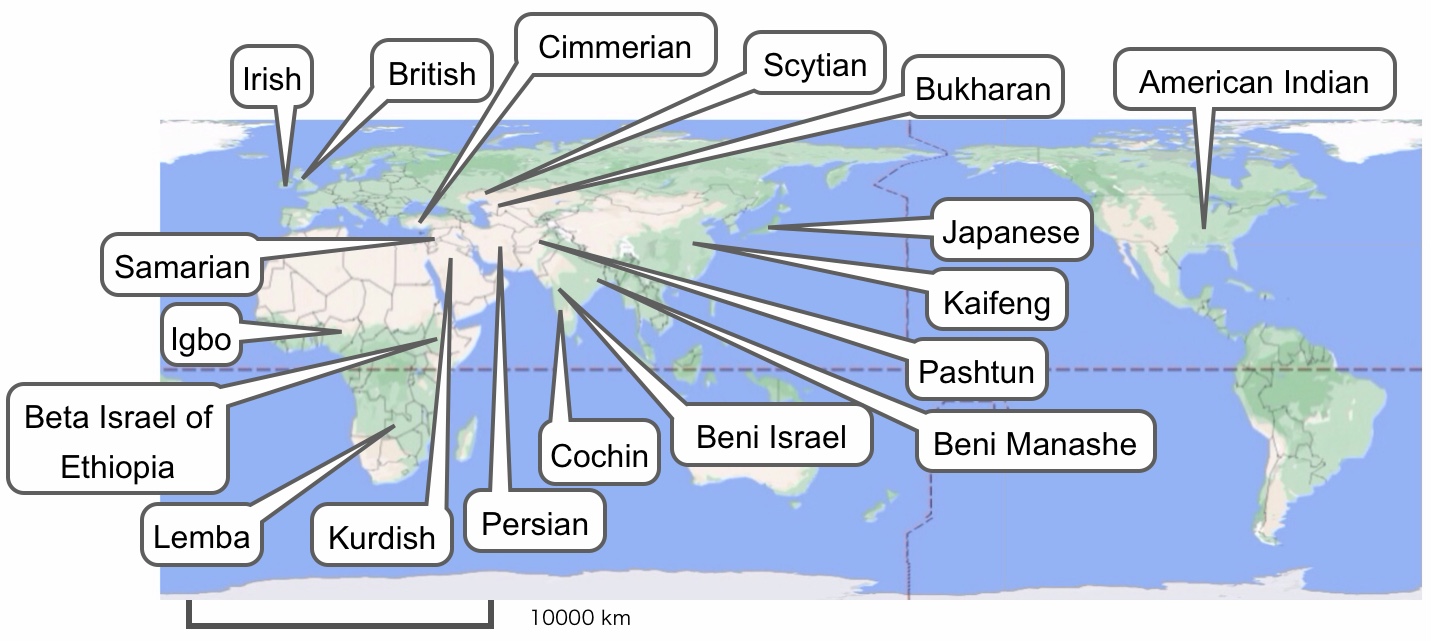
*Attribution:
https://www.atlist.com/showcase/world-map-with-no-labels
2.3.8.2.1 Kurdish Jewish Population in Northern Iraq
The Kurds are an ethnic group in northern Iraq. According to their tradition, they are descended from the Ten Lost Tribes who were relocated during the Assyrian Captivity. Most of them immigrated to Israel around 1950 CE. As of 2012 CE, the Kurdish Jewish population numbered around 150,000, primarily residing in Israel.
Nineveh is located on the northeastern bank of the upper Tigris River, opposite present-day Mosul. Both Nineveh and Mosul are adjacent to Erbil (also known as Arbil), the capital of present-day Iraqi Kurdistan, which was home to a Kurdish Jewish population.
This population is believed to have originated from Israelites who arrived during the Assyrian conquest of the Northern Kingdom of Israel. Therefore, they could be considered, in a sense, part of the Ten Lost Tribes of Israel. (Although they are commonly referred to as Kurdish "Jews," it is worth noting that most members of the Northern Kingdom of Israel were not originally "Jews" in the strict sense, as that term historically referred to those from the Southern Kingdom of Judah. They might more accurately be called "Kurdish Israelites.")
2.3.8.2.2 Samaritans in the Middle East
The Samaritans are an ethnic group in the Middle East living near the Mediterranean Sea. As of 2007 CE, their population was approximately 700. The origin of the Samaritans is debated. They claim descent directly from the tribes of Ephraim and Manasseh of the Northern Kingdom of Israel. Alternatively, they may have descended from Assyrians who were resettled in place of the exiled Israelites by the Neo-Assyrian Empire. Another theory is that they are a mixed population of Assyrians and remaining Israelites in the Northern Kingdom.
Their religion, Samaritanism, shares similarities with Judaism but also has notable differences. The Samaritans are said to have had tensions with the Jewish population, possibly due to religious differences or the historical divide between the Northern Kingdom of Israel and the Southern Kingdom of Judah. For instance, according to the Gospel of Luke, Jesus told the Parable of the Good Samaritan, highlighting the complex social dynamics of the time.
2.3.8.2.3 Beta Israel of Ethiopia
Beta Israel is a Jewish community from Ethiopia, also known as the Ethiopian Jewish population. The Beta Israel had lived in Ethiopia for centuries and mostly immigrated to present-day Israel after World War II through Israel's Law of Return. As of 2010 CE, the population of Beta Israel was approximately 130,000, mostly residing in Israel.
The origin of Beta Israel is controversial.
One tradition claims that their ancestry is associated with Menelik I, who is said to be the son of King Solomon and the Queen of Sheba. According to legend, the Queen of Sheba (Makeda) visited King Solomon, bore his son, and later gave birth to Menelik I. Menelik I is said to have once visited Jerusalem, returned to the south, and founded what would become the Ethiopian Empire. According to this tradition, Beta Israel are descended from Israelites who followed Menelik I from the United Monarchy of Israel.
However, this may be a legend created to legitimize the authority of the Ethiopian imperial family.
Another theory is linked to Eldad ha-Dani, a mysterious Jewish traveler (possibly a merchant) who visited Babylonia, Spain, and other places from Africa in the 9th century CE. He reportedly spoke an unknown dialect of Hebrew and possessed a unique version of Halakha (Jewish law), along with extensive knowledge of Judaism, which impressed his contemporaries. According to his account, there were various communities of Israelite descendants in East Africa. Their ancestors had allegedly fled from the civil war between Rehoboam (son of Solomon) and Jeroboam, during the division of the United Monarchy. Eldad claimed to be from the Tribe of Dan in Ethiopia.
2.3.8.2.4 Lemba People in South Africa
The Lemba people are an ethnic group found mainly in South Africa and Zimbabwe. As of 2010 CE, their population was estimated at around 70,000.
The Lemba claim that their male ancestors left Israel around 500 BCE, migrated to what is now Yemen, and eventually settled in Africa. According to their tradition, their group later split into two: one part remained in Ethiopia, while the other moved further south to present-day South Africa and Zimbabwe.
2.3.8.2.5 Igbo Jewish People of Nigeria (West Central Africa)
The Igbo Jewish people are a subgroup of the Igbo ethnic group in Nigeria (West Central Africa). As of 2010 CE, their population was estimated at about 40,000. They practice Judaism and claim that their ancestors were Israelites who had Syrian, Portuguese, and Libyan origins.
2.3.8.2.6 British Israelism
British Israelism is a belief that the British people and their descendants—such as
those in the USA, Canada, Australia, and other English-speaking nations—are descended from
the Ten Lost Tribes of Israel.
The total population of people of British descent was estimated to be
about 140 million (140,000,000)
as of 2010 CE. (In 2010, the population of the United Kingdom
was approximately 62 million (62,000,000); the USA, about 40 million (40,000,000);
Canada, about 12 million (12,000,000); and Australia, about 10 million (10,000,000).)
British Israelism also claims that the British Royal Family descends from King David.
This theory is not based on any ancient legend but began to emerge around the 1500s CE. The main basis of the theory appears to be the "Israelite-Scythian-Cimmerian nomadic theory" and a supposed linguistic analogy between English and Hebrew.
The primary argument of British Israelism seems to rely on linguistic similarities. However, the English alphabet (a form of the Latin alphabet) shares origins with the Hebrew alefbet, as do many Indo-European writing systems. All are ultimately derived from the Semitic Phoenician alphabet. Therefore, any resemblance between English and Hebrew is likely due to historical transmission of alphabets, not blood relation.
British Israelism also incorporates the "Israelite-Scythian-Cimmerian nomadic theory" of origin. According to this view, the Ten Lost Tribes of Israel became Scythians, Cimmerians, or other horse-riding nomads around the Black Sea or Caspian Sea, as these groups are known to have appeared historically around that time.
It is then claimed as follows:
Some of these nomadic Israelites moved into present-day Germany and became the Celts.
These Celtic Israelites migrated to the British Isles.
Other nomadic Israelites in Germany became the Saxons or Angles in regions like Saxony or Angeln.
These groups later migrated to the British Isles as the Anglo-Saxons.
However, there is no significant historical or archaeological evidence supporting this theory. The Israeli-Scythian-Cimmerian nomadic theory will be discussed in more detail later.
2.3.8.2.7 Irish
Some claim that the Irish are descendants of the Ten Lost Tribes of Israel.
This theory is considered a variation of British Israelism. The population of
Ireland was approximately 4.6 million (4,600,000) as of 2011 CE.
2.3.8.2.8 Scythians
As mentioned above, some claim that the Scythians were descendants of the Ten Lost
Tribes of Israel. The Scythians were a horse-riding nomadic people who appeared
in the northern regions of the Black Sea and Caspian Sea around 680 BCE.
The Israeli-Scythian-Cimmerian nomadic theory presents the following claims:
(1) The Scythians emerged in the northern Black Sea and Caspian Sea regions
around 680 BCE, shortly after the Assyrian Captivity (740 - 722 BCE).
(2) The Scythians are said to be identical to the Cimmerians, and the
name "Cimmeria" is thought to resemble "Samaria." Therefore, it is claimed
that the Scythians originated from Samaria, the capital of the Northern Kingdom of Israel.
According to the Behistun Inscription (present-day Iran), the
Scythians (called Saka in Old Persian) were
translated as Cimmerian ("Gimirri") in Babylonian language.
(For example, Column One - Introduction (6).)
*
"Full translation of the Behistun Inscription on Wikipedia"
http://en.wikipedia.org/wiki/Full_translation_of_the_Behistun_Inscription
Cimmerians were referred to as Gimirri in Akkadian, the language of the Assyrians
and Babylonians.
*
"Cimmerians on Wikipedia" http://en.wikipedia.org/wiki/Cimmerians
(3) Royal figures from both the Northern Kingdom of Israel and the Scythians (Saka)
were depicted wearing pointed hats.
The captive Scythian king wearing such a hat appears at the far right of the Behistun Inscription.
*
"Saka on Wikipedia" http://en.wikipedia.org/wiki/Saka
*
"Behistun Inscription on Wikipedia"
http://en.wikipedia.org/wiki/Behistun_Inscription
*
"Pointy Hat Saka King in the Behistum Inscription" http://upload.wikimedia.org/wikipedia/commons/0/04/Darius_I_the_Great%27s_inscription.jpg
Similarly, Jehu, son of King Omri (6th king of the Northern Kingdom), is depicted kneeling before Shalmaneser III on the Black Obelisk, wearing a similar pointed headdress.
*
"Black Obelisk of Shalmeneser III on Wikipedia"
http://en.wikipedia.org/wiki/Black_Obelisk_of_Shalmaneser_III
(4) The House of Israel was called "Khumri" by the Assyrians after King Omri. This name is thought to resemble Gimirri.
(5) name Scythian was rendered as Iskuzai or Ashguzai in Akkadian. These names may be linked to Ashkenaz, a descendant of Japheth (Noah's son) mentioned in the Bible.
*
"Ashkenaz on Wikipedia"
http://en.wikipedia.org/wiki/Ashkenaz
Despite these linguistic and visual associations, there is little substantial evidence to support the idea that the Scythians were identical to the Lost Tribes of Israel.
Manstream historical theories claim as follows:
Cimmerians first appeared in Assyrian records around 714 BCE in the northern Black Sea region.
The Scythians, a formidable nomadic group, appeared later and displaced the Cimmerians.
As the Cimmerians were pushed southward through the Caucasus, they adopted Scythian military tactics and were sometimes confused with them.
The Cimmerians eventually turned westward and invaded Lydia in western Asia Minor but were defeated around 626 BCE.
The Scythians are believed to have originated in Central Asia, including the Altai Mountains and parts of modern-day Iran. They are commonly classified as an Iranian tribe.
The Neo-Assyrian Empire, under rulers like Tiglath-Pileser III, Shalmaneser V, and Sargon II, conducted the Assyrian Captivity between 740 and 722 BCE.
Babylonia, once ruled by the Assyrians, rebelled in 627 BCE, and in 612 BCE the Neo-Assyrian Empire fell to an alliance of the Neo-Babylonian Empire, Scythians, and Medes (from northern Iran).
The Neo-Babylonian Empire initiated the Babylonian Captivity around 588 BCE.
The Achaemenid Persian Empire, which arose in 550 BCE, conquered the Medes, Neo-Babylonian Empire, and Lydia, and referred to both Scythians and Cimmerians as Saka.
In conclusion, the Israeli-Scythian-Cimmerian nomadic theory appears to be largely speculative and based on superficial linguistic coincidences and visual analogies rather than solid historical evidence.
2.3.8.2.9 Persian Jewish Population
The Persian Jews are a Jewish population historically residing in what is now Iran. As of 2012 CE, the total number of Persian Jews was estimated at around 300,000. However, by that time, most of them had already migrated to Israel.
The origins of the Persian Jewish population date back to the release from the Babylonian Captivity by the Achaemenid Persian king Cyrus the Great in 538 BCE. As described in the Book of Esther, many Jews were living in Persia and received support from the Persian king.
The Persian Jewish community likely consists of descendants from the Southern Kingdom of Judah. Therefore, they would not be considered part of the Ten Lost Tribes of Israel.
2.3.8.2.10 Pashtuns of Afghanistan and Pakistan
The Pashtuns are an Islamic ethnic group living in present-day Afghanistan and Pakistan. According to their tradition, they claim descent from the Israelites. As of 2011 CE, the Pashtun population was estimated at approximately 50 million (50,000,000) (about 29 million in Pakistan and 13 million in Afghanistan).
A social process known as Pashtunization—the adoption of Pashtun language and culture by other groups—has also been reported.
The exact origin of the Pashtuns is unclear, but there are 3 theories regarding a possible Israelite origin.
(1) Persian Historical Reference in Tabaqat-i-Nasiri
According to the Tabaqat-i-Nasiri, a Persian history book written by Minhaj-i-Siraj in 1259 CE, it is said that:
"In the time of the Shansbani dynasty, there were people called Bani Israel living in Ghor,"
and
"some of them were extensively engaged in trade with neighboring countries."
*
"Tabaqat-i Nasiri on Wikipedia"
https://en.wikipedia.org/wiki/Tabaqat-i_Nasiri
(2) Biblical Connection to the Ten Lost Tribes
Another theory connects the Pashtuns to the Ten Lost Tribes of Israel, particularly the tribes of Reuben, Gad, and Manasseh, who were exiled during the Assyrian Captivity. The Bible describes their deportation to Halah, Habor, Hara, and the River of Gozan:
"Now the king of Assyria went throughout all the land, and went up to Samaria and besieged it for three years. In the ninth year of Hoshea, the king of Assyria took Samaria and carried Israel away to Assyria, and placed them in Halah and by the Habor, the River of Gozan, and in the cities of the Medes"
(2 Kings 17:5-6).
"So the God of Israel stirred up the spirit of Pul king of Assyria, that is, Tiglath-Pileser king of Assyria. He carried the Reubenites, the Gadites, and the half-tribe of Manasseh into captivity. He took them to Halah, Habor, Hara, and the River of Gozan, to this day"
(1 Chronicles 5:26).
These locations are believed to correspond to modern regions as follows:
River of Gozan: present-day Amu Darya (Afghanistan and Kazakhstan).
Halah: possibly Balkh, Afghanistan.
Habor: possibly Peshawar, northern Pakistan.
Hara: possibly Herat, Afghanistan.
*
"Amu Darya on Wikipedia"
http://en.wikipedia.org/wiki/Amu_Darya
*
"Balkh on Wikipedia"
http://en.wikipedia.org/wiki/Balkh
*
"Peshawar on Wikipedia"
http://en.wikipedia.org/wiki/Peshawar
*
"Herat on Wikipedia"
http://en.wikipedia.org/wiki/Herat
In addition, the Yusufzai, one of the largest Pashtun tribes, may support this theory.
The name "Yusufzai" means "sons of Joseph," which aligns with the biblical narrative in
which Manasseh, son of Joseph, was among those exiled to Gozan, Halah, and related areas.
The Yusufzai are also described in the Makhzan-i-Afghani, a collection of oral traditions
compiled in 1635 CE under the Mughal Empire.
*
"Yusufzai on Wikipedia"
http://en.wikipedia.org/wiki/Yousafzai
*
"Nimat Allah al-Harawi, Makhzan-i-Afghani on Wikipedia"
http://en.wikipedia.org/wiki/Makhzan-i-Afghani
(3) Biblical Connection to Afghana
(Tribe of Benjamin)
This theory proposes that the Pashtuns are descended from Afghana, a grandson of King Saul (from the tribe of Benjamin).
This is also based on oral tradition found in the Makhzan-i-Afghani.
This tradition claims as follows:
Afghana was raised in the palaces of King David and King Solomon.
His grandmother was Michal, daughter of King Saul and wife of David, who once saved David's life from Saul's assassination attempt.
The descendants of Afghana remained part of the Southern Kingdom of Judah, but eventually fled to what is now Afghanistan, possibly around 590 BCE, shortly before the Babylonian Captivity.
*
"Afghan on Wikipedia"
https://en.wikipedia.org/wiki/Afghan_(tribal_chief)
2.3.8.2.11 Bukharan Jewish People
The Bukharan Jewish people (also spelled Bukharian) are a Jewish ethnic group historically residing in Uzbekistan and Kazakhstan, east of the Caspian Sea. They claim descent from the Israelites. As of 2011 CE, most have emigrated to Israel and the United States.
The total Bukharan Jewish population was estimated to be around 150,000–200,000 as of 2011 CE, with approximately 100,000 in Israel and 50,000 in the USA.
There appear to be 3 theories regarding their Israelite origin:
(1) Their ancestors may have traveled to Central Asia during the time of King David.
(2) Their ancestors may have escaped from the Assyrian Captivity.
(3) Their ancestors may have migrated after the Babylonian Captivity.
*
"Bukharan Jews on Wikipedia"
http://en.wikipedia.org/wiki/Bukharian_Jews
2.3.8.2.12 Bene Israel of Mumbai, West India
The Bene Israel were a Jewish ethnic group historically living around Mumbai in western India. According to their tradition, their ancestors arrived near Mumbai from Judea following a shipwreck around 100 BCE.
They established synagogues, including one in Ahmedabad. As of 2005 CE, the Bene Israel population was estimated at around 65,000, though most had already migrated to Israel.
Since their origin is traced back to Judea, they would not be considered part of the Ten Lost Tribes of Israel.
2.3.8.2.13 Cochin Jewish People of South India
The Cochin Jewish people were a Jewish community centered in Cochin, southern India. According to their tradition, they descended from Jews who migrated from the Southern Kingdom of Judah and Judea.
The population of Cochin Jews was estimated at around 8,500 as of 2010 CE, though most have since moved to Israel.
Tradition holds that traders from Judea arrived in Cochin around 562 BCE, and additional Jewish immigrants came after the destruction of the Second Temple in 70 CE. Therefore, they are not considered part of the Ten Lost Tribes of Israel.
2.3.8.2.14 Bnei Menashe in East India
The Bnei Menashe are an ethnic group from northeastern India who began to claim descent from the tribe of Manasseh around 1970 CE.
As of 2010 CE, their population was estimated at around 9,000, of whom approximately 1,700 had migrated to Israel.
The origin of this claim is said to trace back to a dream in 1951 CE, in which a man reportedly received a divine instruction to return to Israel. As a result, the legitimacy of the Bnei Menashe’s claim remains controversial.
2.3.8.2.15 Kaifeng Jewish People in East China
Kaifeng Jewish people are an ethnic group in Kaifeng,
east China, some 600 km to the south of Beijing.
The Kaifeng Jewish population is possibly over 400 as of 2010,
while the accurate population might be rather numerous.
The accurate population seems unclear due to political or social reason.
According to historical records on Kaifeng Jewish people,
a Jewish
community of Kaifeng would date back to
around 1000 - 1200 CE and possibly to around 700 - 900 CE.
It is said that they had maintained Jewish traditions, while their origin is unclear.
They started to lose Jewish characteristics since the 17th century CE.
The Kaifeng Jewish communities have reduced as of 2010 CE anyway.
2.3.8.2.16 Japanese Population
Japanese population is the predominant ethnic group of Japan.
As mentioned later, Japanese population would be the
mainstream of the 10 Lost Tribes of Israel
descended from Ephraim.
The Japanese population would be some 130,000,000 as of 2010 CE.
The term "Japanese people" commonly includes "Ainu people" mostly
in Hokkaido and "Ryukyuan/Okinawan" mostly in Okinawa.
2.3.8.2.17 American Indians
American Indians are the aggregation of native ethnic groups of present-day USA.
Mordecai Manuel Noah claimed American Indians descended from the 10 Lost Tribes of Israel.
The population of American Indians is some 2,500,000 - 4,000,000 as of 2011 CE.
The Book of Mormon claims Lehi, a descendant of Manasseh, and his friends left Jerusalem and
reached present-day USA around 600 BCE before the Babylonian Captivity.
Then the Book of Mormon claims American Indians include descendants
of the Israelites including Manasseh.
Return to the Home Page