Disclaimer: This is Untrue.
2.3.9.2.2 Old Testament and Kojiki
2.3.9.2.2.1 Introduction
The two major sacred texts of Shinto are "the Kojiki" (古事記; literally: Record of Ancient Matters) and "the Nihon Shoki" (日本書紀; literally: Japanese Book of Narrative or the Chronicles of Japan). It is said that the Kojiki was compiled in 712 CE, and the Nihon Shoki in 720 CE.
These texts share largely similar narratives. The Kojiki is considered the domestic version, while the Nihon Shoki includes additional accounts and is regarded as either an expanded or diplomatic version of the Kojiki.
Shinto is based on these texts, just as Judaism, Christianity, and Islam are founded upon the Old Testament, the New Testament, and the Quran.
Traditional explanations of the Kojiki and the Nihon Shoki—Japanese mythological texts—can be found in various sources, such as Wikipedia. However, some scholars have identified numerous intriguing parallels between the Kojiki (and the Nihon Shoki) and the Old Testament.
The following are nearly complete translations of the Kojiki and the Nihon Shoki.
* "Kojiki Sacred Texts" http://www.sacred-texts.com/shi/kj/index.htm
* "Nihon Shoki Wikidot" http://nihonshoki.wikidot.com/
2.3.9.2.2.2 From Abraham to Moses
Abraham and Sarah once lived in Tagarma Harran (Harran in Tagarma, located in present-day Turkey as of 2020 CE). Their son was Isaac. Isaac and Rebecca had two sons: Esau, the elder, and Jacob, the younger. Initially, Esau was expected to inherit Isaac's legacy, but Jacob ultimately became the successor through a series of events.
Jacob fled to Harran (Rebecca's hometown) out of fear of Esau's anger stemming from the events.
Jacob wished to marry Rachel (his uncle Laban's daughter), but Laban required him to marry both Rachel and her less favored sister Leah.
Jacob and his family later moved from Tagarma Harran to Canaan.
On the journey to Canaan, Jacob wrestled with a divine being and was given the name "Israel" as a sign of divine approval.
He arrived in Canaan, and Esau departed peacefully. (Esau's descendants settled in the region of Edom.) Jacob (Israel) had many sons through Leah and her handmaids. Rachel bore Joseph as her first son, and later gave birth to Benjamin, her second son, but died young due to complications from childbirth.
Joseph was mistreated by his brothers and ended up going to Egypt.
There, he married the daughter of a high-ranking official and rose to prominence. Later, his brothers in Canaan suffered from famine. Joseph reconciled with them and provided aid.
Joseph's sons were Manasseh and Ephraim. Jacob (Israel) gave a special blessing to Ephraim, the younger. Ephraim's sons were Shuthelah, Ezer, Elead, and Beriah (1Ch 7). Ezer and Elead died young. Joshua, Moses' successor, descended from Beriah. (Jeroboam, the first king of the Northern Kingdom of Israel, also descended from Ephraim.)
On the other hand, according to the Kojiki, the deity Su-sa-no-o (須佐之男; formal name: Take-haya-su-sa-no-o-no-mikoto: 建速須佐之男命) and the goddess Ama-terasu-oo-mi-kami (天照大御神) ruled Tak-ama-ga-hara (高天原; literally: the Plain of High Heaven). As a result of their oath, five male deities—including Ame-no-oshi-ho-mimi-no-mikoto (天忍穂耳命)—and three female deities were born.
*"The Kojiki" is the oldest surviving historical text of Japan. The original versions of the Kojiki and the Nihon Shoki were written using Chinese characters. Although Japan had its own spoken language, it lacked a native writing system at the time. Thus, both texts were written using Chinese characters primarily for their phonetic value. In most cases, the characters used in the Kojiki and the Nihon Shoki do not carry semantic meaning, but rather serve as phonetic representations—similar to how "for you" might be written as "4 u" in modern shorthand. In essence, these texts are transliterations using Chinese script. Additionally, the meanings of many proper names in the Kojiki and the Nihon Shoki remain unknown.
*"Ama-terasu" may be translated as "the Heaven-Shining-Great-August-Deity," since "Ama" means heaven and "terasu" means to shine.
*According to Shinto belief, the Japanese Imperial Family is considered noble because they descend from the goddess Amaterasu.
*The meaning of "(Take-haya-)su-sa-no-o(-no-mikoto)" is unclear, though it may be literally rendered as "His (Brave-Swift-)impetuous-Male(-Augustness)," without conveying specific meaning.
*The meaning of "(Ame-no-)oshi-ho-mimi(-no-mikoto)" is also unclear, though it may be translated as "His Augustness Truly-Conquer-I-Conqueror-Conquering-Swift-Heavenly-Great-Great-Ears," again without inherent meaning.
* "Kojiki the Oath Sacred Texts" http://www.sacred-texts.com/shi/kj/kj020.htm

Goddess Amaterasu
*Attribution: "Amaterasu on Wikipedia" https://en.wikipedia.org/wiki/Amaterasu
The sons of God Oshi-ho-mimi and Goddess Toyo-aki-tsu-shi-hime(-no-mikoto) (豊秋津師比売命) are
Ho-akari (formal name: Ame-no-ho-akari-no-mikoto: 天火明命) the elder
and Ni-ni-gi (邇邇芸; strict formal name:
Ame-ni-gi-shi-kuni-ni-gi-shi-ama-tsu-hi-ko-hi-ko-ho-no-ni-ni-gi-no-mikoto:
天邇岐志国邇岐志天津日高日子番能邇邇芸命) the younger.
At the beginning, Ashi-hara-naka-tsu-kuni (葦原中国; literally: "Central Land of Reed Plain" or
"Reed Plain Central Country";
defined as the land of humankind) was ruled by Oo-kuni-nushi (another name: Oonamuchi).
However, as a result of the wrestling between Take-mi-kazuchi and Take-mi-na-kata,
Oo-kuni-nushi peacefully abdicated.
*The meanings of Take-mi-kazuchi and Take-mi-na-kata are unclear, while they might be
literally translated as
"the Brave-Awful-Possessing-Male-Deity" and "the Deity-Brave-August-Name-Firm,"
though with no clear inherent meaning.
*
"Kojiki Abdication of the Master of the Great Land Sacred Texts" http://www.sacred-texts.com/shi/kj/kj039.htm
*The meaning of "Oo-kuni-nushi" is "Master of the Great Land."
Ni-ni-gi was authorized to rule Ashi-hara-naka-tsu-kuni, and he came from Tak-ama-ga-hara,
though he was the younger. (His elder brother is Ho-akari.)
*The strict formal name of Ni-ni-gi is “Ame-ni-gi-shi-kuni-ni-gi-shi-ama-tsu-hi-ko-hi-ko-ho-no-
ni-ni-gi-no-mikoto”
or
“Ame-ni-ki-shi-kuni-ni-ki-shi-ama-tsu-hi-taka-hi-ko-ho-no-ni-ni-gi-no-mikoto”:
“天邇岐志国邇岐志天津日高日子番能邇邇芸命.”
*The meaning of “Ni-ni-gi” is unknown, while it might be literally translated as “His August
ness Heaven-Plenty-Earth-Plenty-Heaven’s-Sun-Height-Prince-Rice-ear-Ruddy-Plenty”
or “His Augustness Prince-Rice-ear-Ruddy-Plenty,” with no clear inherent meaning.
*“ame” and “ama” mean “heaven.” “kuni” means “country.”
“taka-hi-ko” means “high-sun-child.”
*The meaning of “Ho-akari” is also unknown, while it might be literally translated as
“His Augustness-Heavenly-Rice-ear-Ruddy,” with no clear inherent meaning.
*
"Kojiki the August Descent Sacred Texts" http://www.sacred-texts.com/shi/kj/kj040.htm
*
"Kojiki the August Reign Sacred Texts" http://www.sacred-texts.com/shi/kj/kj041.htm
Oo-kuni-nushi peacefully left Ashi-hara-naka-tsu-kuni and received a large palace in another location, Izu-mo.
(Canaan is spelled KNEN (kaf-nun-ayin-nun) and reed is spelled QNH (qof-nun-he) in Hebrew.)
Ni-ni-gi met a beautiful girl, Kono-hana-saku-ya-hime, and intended to marry her.
However, her father Oo-yama-tsu-mi requested Ni-ni-gi to
marry both the beautiful Kono-hana-saku-ya-hime and her elder, disadvantageous (homely)
sister Iwa-naga-hime.
Humans were cursed to live short lives because Ni-ni-gi rejected Iwa-naga-hime.
Thus, Kono-hana-saku-ya-hime is the symbol of short life.
Kono-hana-saku-ya-hime became pregnant.
However, she was suspected of adultery by Ni-ni-gi.
So she bore 3 children under difficult circumstances (in fire) to testify to her innocence.
According to the Kojiki, their first son is Ho-deri. The second son is Ho-su-se-ri.
The third and youngest son is Ho-o-ri.
*"Kono-hana-saku-ya-hime" may be translated as
"Princess-Blossoming-Brilliantly-Like-the-Flowers-of-the-Trees."
*"Iwa-naga-hime" may be translated as "Princess-Long-as-the-Rocks."
*"Oo-yama-tsu-mi" may be translated as "The Deity-Great-Mountain-Possessor."
*"Kojiki the Curse of the Deity Great Mountain Possessor Sacred Texts"
http://www.sacred-texts.com/shi/kj/kj044.htm
*"Kojiki the August Child Bearing of
Princess Blossoming Sacred Texts" http://www.sacred-texts.com/shi/kj/kj045.htm
Hoori was bullied by his elder brother Hoderi and exiled to another country.
Yet Hoori married Toyotama-hime, the daughter of the Deity.
Subsequently, Hoderi suffered from poverty; Hoori helped Hoderi, and Hoderi submitted to Hoori.
The son of Hoori is U-ga-ya-fuki-ae-zu (U-ka-ya-fuki-ae-zu).
*The meaning of Ugayafukiaezu is unknown, while it might be literally translated as
“His Augustness Heaven’s-Sun-Height-Prince-Wave-limit-Brave-
Cormorant-Thatch-Meeting-Incompletely,” with no clear inherent meaning.
The four sons of Ugayafukiaezu are Itsuse, Inahi, Mikenu,
and Waka-mikenu (later Kamu-yamato-ihare-biko: Emperor Jimmu).
*The meaning of “Itsuse” is unknown, while it might be literally translated as
“His Augustness Five-Reaches.”
*The meaning of “Inahi” is unknown, while it might be literally translated as
“His Augustness Boiled-Rice,”
with no clear inherent meaning.
*The meaning of “Mikenu” is unknown, while it might be literally
translated as “His Augustness August-Food-Master,”
with no clear inherent meaning.
*“Waka-mikenu” may be translated as “His Augustness Young-August-Food-Master,” with no clear inherent meaning.
*The meaning of the other name of Waka-mikenu, “Kamu-yamato-ihare-biko-sumera-mikoto,” is
unknown in Japanese, while it might be literally translated as
“His Augustness Divine-Yamato-Ihare-Prince.”
*
"Kojiki the August Exchange of Luck Sacred Texts" http://www.sacred-texts.com/shi/kj/kj046.htm
*
"Kojiki the Palace of the Ocean Possessor Sacred Texts" http://www.sacred-texts.com/shi/kj/kj047.htm
*
"Kojiki Submission of His Augustness Fire-Shine Sacred Texts"
http://www.sacred-texts.com/shi/kj/kj048.htm
*
"Kojiki the Parturition-House of Cormorant's Feathers Sacred Texts"
http://www.sacred-texts.com/shi/kj/kj049.htm
*
"Kojiki the August Children of His Augustness Cormorant-Thatch-Meeting-Invompletely"
http://www.sacred-texts.com/shi/kj/kj050.htm
2.3.9.2.2.3 From Moses to Joshua
On the other hand, Moses is one of the most important figures in the Old Testament.
Moses's mother was Moses's father's aunt.
Moses chose his wife from 7 girls.
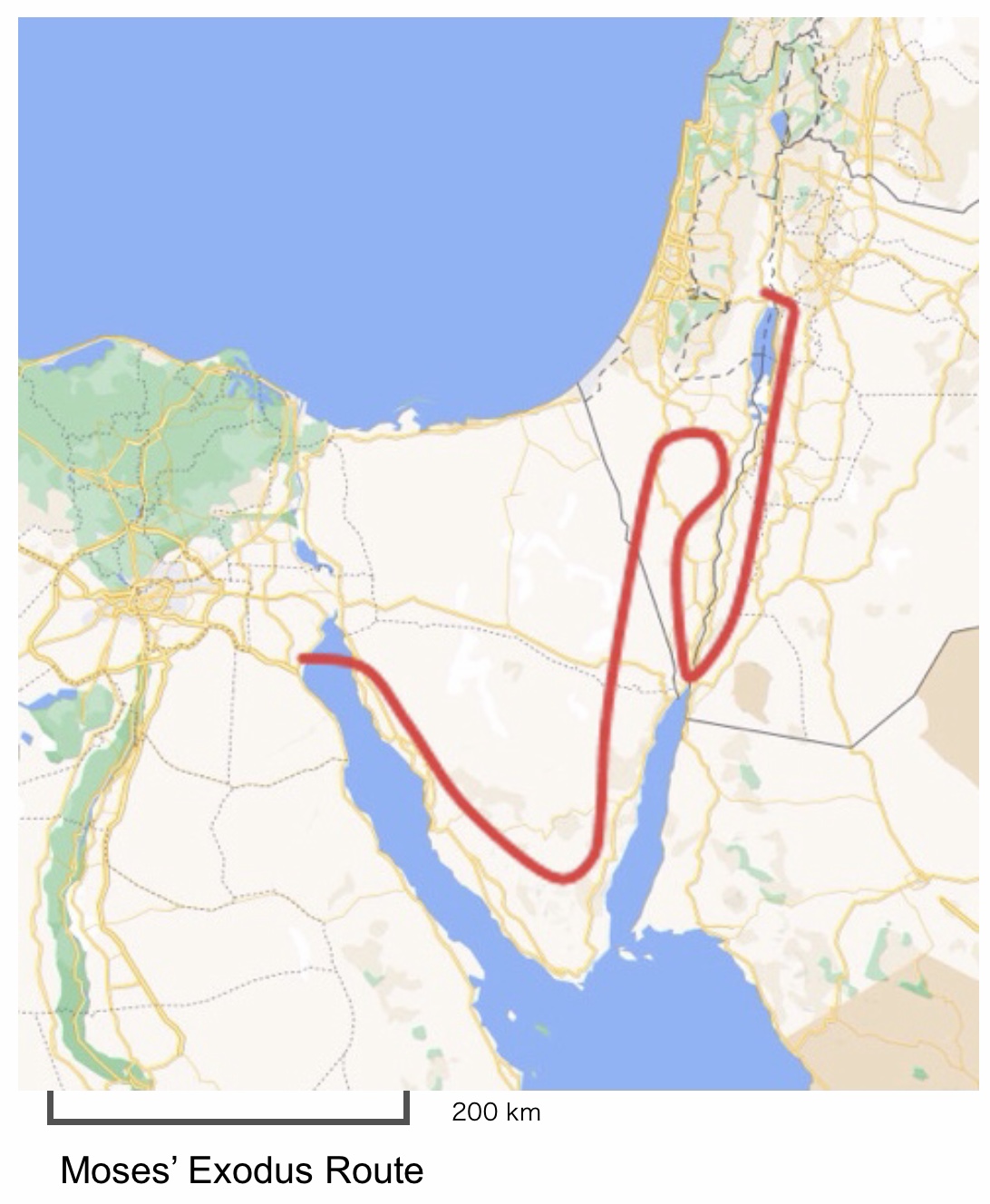
Moses advanced to the northeast with his elder brother Aaron
and colleagues for many years.
They detoured (at “Kadesh”) to the southeast just before the destination, and his elder brother died due to
his unfaithfulness to God.
Subsequently, they advanced to the north, met animals (serpents), many soldiers fell down,
but recovered with something like a stick.
The new leader Joshua was designated.
They reached the destination and defeated many enemies.
*"Now Moses sent messengers from Kadesh to the king of Edom.
'Thus says your brother Israel:
"You know all the hardship that has befallen us, "'" (Num 20:14).
*"'Please let us pass through your country. We will not pass through fields or vineyards,
nor will we drink water from wells; we will go along the King's Highway; we will not turn aside to
the right hand or to
the left until we have passed through your territory'" (Num 20:17).
*"Thus Edom refused to give Israel passage through his territory;
so Israel turned away from him" (Num 20:21).
*The accurate route of Exodus and locations are not specified. Some theories are suggested,
while Edom is on the south of the Dead Sea anyway.
*Attribution:
https://www.atlist.com/showcase/world-map-with-no-labels
*
"Ancient Exodus" http://www.ancientexodus.com/
*
"The Exodus Route"
http://www.bible.ca/archeology/bible-archeology-exodus-route-travel-times-distances-days.htm
*"Now the children of Israel, the whole congregation, journeyed from Kadesh and came to Mount Hor.
And the Lord spoke to Moses and Aaron in Mount Hor by the border of the land of Edom,
saying:
'Aaron shall be gathered to his people, for he shall not enter the land which I have given to the children of Israel,
because you rebelled against My word at the water of Meribah'" (Num 20:22-24).
*"Moses stripped Aaron of his garments and put them on Eleazar his son;
and Aaron died there on the top of the mountain.
Then Moses and Eleazar came down from the mountain" (Num 20:28).
*"Then they journeyed from Mount Hor by the Way of the Red Sea,
to go around the land of Edom; and the soul of the people became
very discouraged on the way. And the people spoke against God and
against Moses: 'Why have you brought us up out of Egypt to die in the
wilderness? For there is no food and no water, and our soul loathes this
worthless bread.' So the Lord sent fiery serpents among the people, and
they bit the people; and many of the people of Israel died.
Therefore the people came to Moses, and said, 'We have sinned, for we
have spoken against the Lord and against you; pray to the Lord that He
take away the serpents from us.' So Moses prayed for the people.
Then the Lord said to Moses, 'Make a fiery serpent, and set it on a pole;
and it shall be that everyone who is bitten, when he looks at it, shall live.'
So Moses made a bronze serpent, and put it on a pole; and so it was,
if a serpent had bitten anyone, when he looked at the bronze serpent,
he lived" (Num 21:4-9).
*"Now the children of Israel moved on and camped in Oboth. And they journeyed from
Oboth and camped at Ije Abarim, in the wilderness which is east of Moab, toward the sunrise.
From there they moved and camped in the Valley of Zered.
From there they moved and camped on the other side of the Arnon, which is in the
wilderness that extends from the border of the Amorites;
for the Arnon is the border of Moab, between Moab and the Amorites" (Num 21:10-13).
*Moab is on the east of the Dead Sea.
*"Then the children of Israel moved, and camped in the plains of
Moab on the side of the Jordan across from Jericho" (Num 22:1).
*"So Moses did as the Lord commanded him.
He took Joshua and set him before Eleazar the priest and before all the congregation.
And he laid his hands on him and inaugurated him,
just as the Lord commanded by the hand of Moses" (Num 27:22-23).
On the other hand, Waka-mikenu (later Emperor Jimmu) is one of the central figures in the Kojiki.
Waka-mikenu (Jimmu)'s mother was his father's aunt.
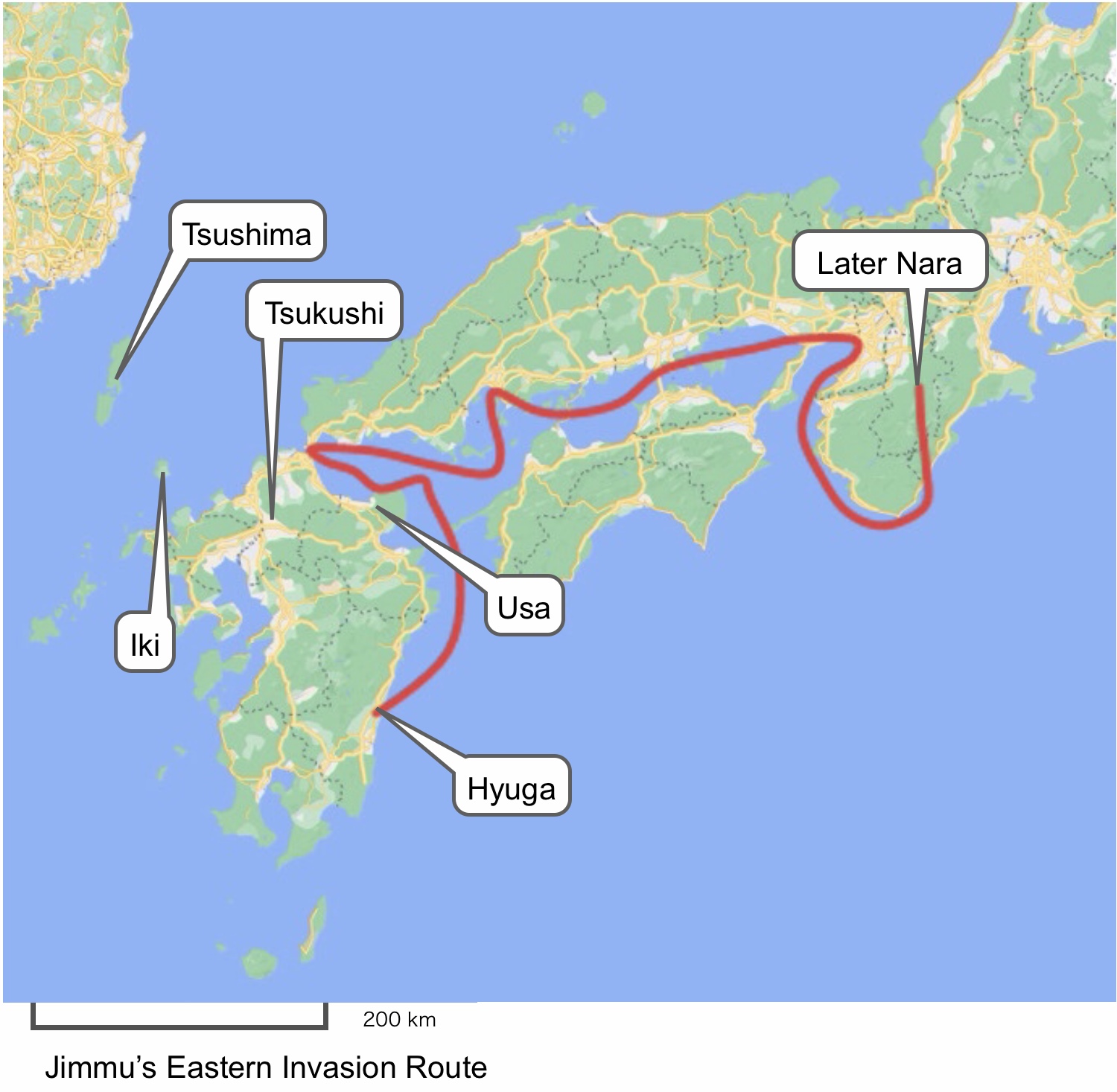
Waka-mikenu (Jimmu) advanced to the northeast (from present-day Miyazaki to Yamato,
present-day Nara of Japan)
with his elder brother Itsuse and colleagues
for many years.
They detoured to the southeast just before the destination
(from present-day Osaka to present-day Kumano between Wakayama and Mie prefecture), and his elder brother died due to
his unfaithfulness to God.
Subsequently, they advanced to the north, met an animal (a bear), many soldiers fell down,
but recovered with something like a stick.
The new leader (a crow or a raven: Yatagarasu) was designated.
They reached the destination (present Nara) and defeated many enemies.
Waka-mikenu (Jimmu) chose his wife (I-suke-yori-hime) from 7 girls.
*
"Kojiki Reign of the Emperor Jimmu 1 Sacred Texts" http://www.sacred-texts.com/shi/kj/kj051.htm
*
"Kojiki Emperor Jimmu 2 Sacred Texts" http://www.sacred-texts.com/shi/kj/kj052.htm
*
"Kojiki Emperor Jimmu 3 Sacred Texts" http://www.sacred-texts.com/shi/kj/kj053.htm
*
"Kojiki Emperor Jimmu 8 He Weds I-suke-yori-hime Sacred Texts" http://www.sacred-texts.com/shi/kj/kj058.htm
*
"King Jimmu to Eastern Invasion" http://www.furutasigaku.jp/efuruta/jimmue/jimmue.html
(The accurate start point according to the Kojiki is
near Hyuga rather than Tsukushi (Chikushi)
in this map. )
*Attribution:
https://www.atlist.com/showcase/world-map-with-no-labels
2.3.9.2.2.4 From the Judges to Solomon
After the era of the Judges, the Israelites designated tall and handsome Saul the first king of ancient Israel.
But Saul became unfaithful, listened to the harp of David in the palace, and died in battle.
The Israelites designated David the second king of ancient Israel.
David took a census after 3 years’ famine, defeated many other tribes, and battled at Edom and Mount Seir.
*"And so it was, whenever the spirit from God was upon Saul, that David would take a harp and play
it with his hand. Then Saul would become refreshed and well,
and the distressing spirit would depart from him" (1Sa 16:23).
*"And David made himself a name when he returned from killing eighteen thousand Syrians in
the Valley of Salt.
He also put garrisons in Edom; throughout all Edom he put garrisons,
and all the Edomites became David's servants.
And the Lord preserved David wherever he went" (2Sa 8:13-14). .
*"Then Esau took his wives, his sons, his daughters, and all the persons of his household,
his cattle and all his animals, and all his goods which he had gained in the land of Canaan,
and went to a country away from the presence of his brother Jacob.
For their possessions were too great for them to dwell together,
and the land where they were strangers could not support them because of their livestock.
So Esau dwelt in Mount Seir. Esau is Edom.
And this is the genealogy of Esau the father of the Edomites in Mount Seir" (Gen 36:6-9).
The third king Solomon, the son of David, founded Solomon’s temple in Jerusalem and dug ponds.
He had a dream that God promised long life if he keeps the commandments.
*"Now Solomon began to build the house of the Lord at Jerusalem on Mount Moriah,
where the Lord had appeared to his father David,
at the place that David had prepared on the threshing floor of Ornan the Jebusite" (2Ch 3:1).
*"I made myself water pools from which to water the growing trees of the grove" (Ecc 2:6).
*"The speech pleased the Lord, that Solomon had asked this thing.
Then God said to him: 'Because you have asked this thing, and have not asked
long life for yourself, nor have asked riches for yourself, nor have asked the life of your enemies,
but have asked for yourself understanding to discern justice, behold,
I have done according to your words; see, I have given you a wise and understanding heart,
so that there has not been anyone like you before you, nor shall any like you arise after you.
And I have also given you what you have not asked: both riches and honor,
so that there shall not be anyone like you among the kings all your days.
So if you walk in My ways, to keep My statutes and My commandments, as your father
David walked,
then I will lengthen your days.'
Then Solomon awoke; and indeed it had been a dream.
And he came to Jerusalem and stood before the ark of the covenant of the Lord,
offered up burnt offerings,
offered peace offerings, and made a feast for all his servants" (1Ki 3:10-15).
On the other hand, descriptions in the Kojiki from the 2nd through 9th Emperors
(, which might correspond to the Judges) are simplified.
The 10th Emperor Sujin took a census after 3 years’ disaster (according to the Nihon Shoki) and battled at “mountain Shiro (Yamashiro)”
and “Idomi (Idzumi).”
The 11th Emperor Suinin made his son, Inishi-no-iri, dig many pools, and his daughter Yamato-Hime
found the first temple at Ise, and (according to the Nihon Shoki) had the divine message
(from the God Yamato) to
promise his long lifespan if he keeps the commandments.
The 14th Emperor Chuai was tall and handsome.
However, he didn’t believe the divine messages and suddenly died playing the harp (lute).
*
"Kojiki Emperor Sujin Sacred Texts" http://www.sacred-texts.com/shi/kj/kj073.htm
*
"Nihon Shoki Emperor Sujin Wikidot" http://nihonshoki.wikidot.com/scroll-5-sujin
*
"Kojiki Emperor Sui-nin Sacred Texts" http://www.sacred-texts.com/shi/kj/kj076.htm
*
"Nihon Shoki Emperir Suinin Wikidot" http://nihonshoki.wikidot.com/6-suinin
*
"Kojiki Emperor Chiu-ai Sacred Texts" http://www.sacred-texts.com/shi/kj/kj103.htm
2.3.9.2.2.5 Genesis
A scholar claims 5 Deities at the beginning of the Kojiki correspond to various
designations of Yahweh in the Bible.
Ame-no-mi-naka-nushi-no-kami corresponds to the God of Abraham.
Taka-mi-mu-su-hi-no-kami corresponds to the God of Isaac.
Kami-mu-su-hi-no-kami to the God of Israel (Jacob) (Exo 3:6).
U-ma-shi-a-shi-ka-bi-hi-ko-ji-no-kami to God of Canaan (Gen 17:8).
Ame-no-toko-tachi-no-kami to “I AM WHO I AM” (Exo 3:14) or “Who was and is and is to come” (Rev 4:8).
*"Moreover He said, 'I am the God of your father- the God of Abraham,
the God of Isaac, and the God of Jacob.'
And Moses hid his face, for he was afraid to look upon God" (Exo 3:6).
*"Also I give to you and your descendants after you the land in which you are a stranger,
all the land of Canaan,
as an everlasting possession; and I will be their God" (Gen 17:8).
*"The four living creatures, each having six wings, were full of eyes around and within.
And they do not rest day or night, saying:
'Holy, holy, holy,
Lord God Almighty,
Who was and is and is to come!'" (Rev 4:8).
*"Amenominakanushinokami" may be translated as "the Deity Master-of-the-August-Centre-of-
Heaven."
*"Takamimusuhinokami" may be translated as "the High-August-Producing-Wondrous Deity."
*"Kamimusuhinokami" may be translated as "the Divine-Producing-Wondrous-Deity."
*"Umashiashikabihikojinokami" may be translated as "the Pleasant-Reed-Shoot-Prince-Elder Deity,"
since "ashi" is "reed." (QNH is reed in Hebrew while Canaan is KN'N in Hebrew.)
*"Amenotokotachinokami" may be translated as "the Heavenly-Eternally-Standing-Deity."
*
"Kojiki the Beginning of Heaven and Earth Sacred Texts" http://www.sacred-texts.com/shi/kj/kj008.htm
The succeeding 7 generations correspond to the 7 days of the creation.
*
"Kojiki the Seven Divine Generations Sacred Texts" http://www.sacred-texts.com/shi/kj/kj009.htm
"I-za-na-gi" and "I-za-na-mi" correspond to Adam and Eve.
"They were not good because the woman spoke first,"
which the Heavenly Deities said,
corresponds to Eve's suggestion.
*"Izanagi" might be translated as "His Augustness the Male-Who-Invites."
*"Izanami" might be translated as "Her Augustness the Female-Who-Invites."
*
"Kojiki Birth of the Eight Islands Sacred Texts" http://www.sacred-texts.com/shi/kj/kj012.htm
2.3.9.2.2.6 Crucifixion
By the way, “Amaterasu” hid in a cave, shut with a rock, and the land got dark.
But afterward the cave opened.
This corresponds to the description of the Crucifixion, which made the land dark as in Matthew 27:45,
the cave where Christ was buried was
shut with a rock, but opened afterward.
*"Now from the sixth hour until the ninth hour there was darkness over all the land" (Mat 27:45).
*“Now from the sixth hour until the ninth hour there was darkness over all the land” (Mat 27:45).
*“Now when the sixth hour had come, there was darkness over the whole land until the ninth hour”
(Mar 15:33).
*"Now when the sixth hour had come, there was darkness over the whole land until the ninth hour"
(Mar 15:33).
*"Now it was about the sixth hour, and there was darkness over all the earth until the ninth hour"
(Luk 23:44).
*"and laid it in his new tomb which he had hewn out of the rock;
and he rolled a large stone against the door of the tomb, and departed" (Mat 27:60).
*
"Kojiki the Door of the Heavenly Rock-Dwelling Sacred Texts" http://www.sacred-texts.com/shi/kj/kj023.htm
Return to the Home Page