Disclaimer: This is Untrue.
2.3.9.2.4 Similarities of Shinto Shrine and Japanese Culture
2.3.9.2.4.1 Kubo's Work
Kubo Arimasa started to summarize the similarities between Shinto shrines and Japanese culture.
*"Kubo Arimasa" http://www5.ocn.ne.jp/~magi9/isracame.htm
2.3.9.2.4.2 Structure of Shinto Shrine
2.3.9.2.4.2.1 Outline
The structure of a Shinto shrine generally follows a path from the entrance, marked by a Torii gate, to the innermost sanctum, the Hon-den (main hall).
* *Attribution: http://en.wikipedia.org/wiki/File:Plan_of_Shinto_Shrine.jpg
*"Structure of a Shinto Shrine on Wikipedia"
On the other hand, the structure of the Tabernacle was similar to that of a Shinto shrine. The Tabernacle was the portable temple used by the Israelites during their Exodus from Egypt to Canaan, and it housed the Ark of the Covenant.
*
Model of the Tabernacle
*Attribution:
http://en.wikipedia.org/wiki/File:Stiftshuette_Modell_Timnapark.jpg
*
"Tabernacle on Wikipedia"
http://en.wikipedia.org/wiki/Tabernacle
2.3.9.2.4.2.2 Torii Gate
The Torii Gate
A Torii is typically a gate that marks the entrance to a Shinto shrine. While often painted a vibrant red (shui), they can also be unpainted wood or other colors. It symbolically separates the sacred ground of the shrine from the profane world.

*Attribution:
http://en.wikipedia.org/wiki/File:Entrance_to_Tsurugaoka_Hachiman_Shrine.jpg

*Attribution:
http://en.wikipedia.org/wiki/File:%E8%82%A5%E5%89%8D%E9%B3%A5%E5%B1%85_059.jpg
*
"Torii on Wikipedia"
http://en.wikipedia.org/wiki/Torii
The Israelites painted their lintels and doorposts with the blood of lambs in the book of Exodus.
The upper lintel of a Torii gate is slightly curved, similar to a chain, as mentioned in 2Ch 3:15-.
*"Then Moses called for all the elders of Israel and said to them, 'Pick out
and take lambs for yourselves according to your families, and kill the
Passover lamb. And you shall take a bunch of hyssop, dip it in the blood
that is in the basin, and strike the lintel and the two doorposts with the
blood that is in the basin.
And none of you shall go out of the door of his house until morning'" (Exo 12:21-22).
*"Also he made in front of the temple two pillars thirty-five cubits high,
and the capital that was on the top of each of them was five cubits.
He made wreaths of chainwork, as in the inner sanctuary, and put
them on top of the pillars; and he made one hundred pomegranates,
and put them on the wreaths of chainwork.
Then he set up the pillars before the temple, one on the right hand
and the other on the left; he called the name of the one on the
right hand Jachin,
and the name of the one on the left Boaz" (2Ch 3:15-17).
2.3.9.2.4.2.3 Temizuya (Chozuya)
Temizuya (also called Chozuya) is a purification font that is positioned similarly to the laver described in Exodus 40:7.

*Attribution:
http://en.wikipedia.org/wiki/File:Anamori_Inari_Jinja_04.jpg
*
"Chozuya on Wikipedia"
http://en.wikipedia.org/wiki/Ch%C5%8Dzuya
*"And you shall set the laver between the tabernacle of meeting
and the altar, and put water in it" (Exo 40:7).
2.3.9.2.4.2.4 Komainu
Komainu are statues, usually of a pair of lions, which are placed like the two lions beside the throne of King Solomon. However, a pair of a lion and a unicorn is rarely seen. As previously mentioned, ordinary shrines feature a pair of lions. Nonetheless, some authentic shrines, such as Shimogamo Shrine, have a pair consisting of a lion and a unicorn. The unicorn's presence seems to have resulted from a mistranslation of Deuteronomy 33:17 in the Septuagint or Vulgate.

*Attribution:
http://en.wikipedia.org/wiki/File:Komainu-pair.jpg

*Attribution:
http://en.wikipedia.org/wiki/File:4nomiyajinjya6014.JPG
*
"Komainu on Wikipedia"
http://en.wikipedia.org/wiki/Komainu
*"The throne had six steps, and the top of the throne was round at the back; there were armrests on either side
of the place of the seat, and two lions stood beside the armrests" (1Ki 10:19).
2.3.9.2.4.2.5 Saisen-bako before Haiden
A Saisen-bako is an offertory chest placed in front of the Haiden (oratory), resembling the chest for offerings mentioned in 2 Chronicles 24:8-11."

*Attribution:
http://en.wikipedia.org/wiki/File:Saisen.jpg
*
"Saisen on Wikipedia"
http://en.wikipedia.org/wiki/Saisen
*"Then at the king's command they made a chest, and set it
outside at the gate of the house of the Lord. And they made a
proclamation throughout Judah and Jerusalem to bring to the
Lord the collection that Moses the servant of God had
imposed on Israel in the wilderness. Then all the leaders and
all the people rejoiced, brought their contributions, and put
them into the chest until all had given. So it was, at that time,
when the chest was brought to the king's official by the hand
of the Levites, and when they saw that there was much
money, that the king's scribe and the high priest's officer
came and emptied the chest, and took it and returned it to
its place.
Thus they did day by day, and gathered money in abundance" (2Ch 24:8-11).
2.3.9.2.4.2.6 Hai-den and Hon-den
The Hai-den, literally the "pray hall," and the Hon-den, literally the "main hall," are key structures in a Shinto shrine. The Hai-den is located in front of the Hon-den, with the Hon-den situated beyond it. Ordinary people are permitted to pray at the Hai-den but are forbidden from proceeding to the Hon-den. This separation between the two halls is similar to the division of the Tabernacle into the Holy Place and the Most Holy Place.
*"And you shall hang the veil from the clasps.
Then you shall bring the ark of the Testimony in there, behind the veil.
The veil shall be a divider for you between the holy place and the
Most Holy. You shall put the mercy seat upon the ark of the Testimony
in the Most Holy. You shall set the table outside the veil, and the
lampstand across from the table on the side of the
tabernacle toward the south; and you shall put the table on the north side" (Exo 26:33-35).
2.3.9.2.4.2.7 No Idol
There are no idols to worship in a Shinto shrine, a practice similar to that found in Judaism.
2.3.9.2.4.3 Priests in Shinto Shrine
2.3.9.2.4.3.1 Tassels of Priests' Garments
Shinto priests' garments have tassels, approximately 20 cm in length, at the bottom of their sleeves.

*Attribution:
http://en.wikipedia.org/wiki/File:Guji0148.jpg
*"'You shall make tassels on the four corners of the
clothing with which you cover yourself'" (Deu 22:12).
2.3.9.2.4.3.2 Sakaki Sheaves and Ezov
Shinto priests use sheaves of sakaki to perform purification rites by waving them in the Hai-den. Similarly, Jews wave sheaves of plants during the festival of Sukkot. Additionally, ancient Israelite priests used ezov (hyssop) for purification, a practice described in Leviticus 14.
*"then the priest shall command to take for him who is to be cleansed two living
and clean birds, cedar wood, scarlet, and hyssop. And the priest shall
command that one of the birds be killed in an earthen vessel over running water.
As for the living bird, he shall take it, the cedar wood and the scarlet
and the hyssop, and dip them and the living bird in the blood of the
bird that was killed over the running water. And he shall
sprinkle it seven times on him who is to be cleansed from the leprosy,
and shall pronounce him clean, and shall let the living bird loose in the open field" (Lev 14:4-7).
2.3.9.2.4.3.3 Yamabushi and Tengu
The Yamabushi (山伏), whose name literally means "one who hides in the mountains," are training priests often associated with Shugendō, a blend of Shinto and Buddhism. Although Shugendō is categorized as a Buddhist sect, the presence of Yamabushi is unique to Japan and not found in Chinese Buddhism, suggesting a strong native Shinto tradition.
Yamabushi are recognizable by their distinct attire, which includes a small black box called a tokin worn on the forehead with a cord, and a conch shell horn known as a horagai, which they blow during their rituals.
These practices share a striking resemblance to those of observant Jews. Jewish men wear small black boxes with cords, called a phylactery (tefillin), on their foreheads, and they blow horns called a shofar during certain religious observances. Some scholars suggest that these similarities may have originated from the biblical book of Exodus.

Yamabushi with Tokin and Hora-gai
*Attribution:
http://ja.wikipedia.org/wiki/%E3%83%95%E3%82%A1%E3%82%A4%E3%83%AB:Appearance_of_Yamabushi.jpg

Israeli Soldier with Tefillin
*Attribution:
http://en.wikipedia.org/wiki/File:IDF_soldier_put_on_tefillin.jpg
*"'It shall be as a sign on your hand and as frontlets between your eyes,
for by strength of hand the Lord brought us out of Egypt'" (Exo 13:16).
*"'You shall also make a plate of pure gold and engrave on it,
like the engraving of a signet: HOLINESS TO THE LORD.
And you shall put it on a blue cord, that it may be on the turban;
it shall be on the front of the turban. So it shall be on Aaron's
forehead, that Aaron may bear the iniquity of the holy things which
the children of Israel hallow in all their holy gifts; and it shall always
be on his forehead, that they may be accepted before the Lord'" (Exo 28:36-38).
*
"Tokin on Wikipedia"
http://en.wikipedia.org/wiki/Tokin
*
"Tefillin on Wikipedia"
http://en.wikipedia.org/wiki/Tefillin
Additionally, Tengu are supernatural beings in the mountains often associated with Yamabushi. A Tengu is typically depicted with a red face, a long nose, wings, and a black box, known as a tokin, on its head. This figure might be associated with the biblical figure of Yahweh, who Moses encountered on Mount Sinai.

A statue of Tengu with Tokin
*Attribution:
http://ja.wikipedia.org/wiki/%E3%83%95%E3%82%A1%E3%82%A4%E3%83%AB:%E9%A...

*Attribution:
http://en.wikipedia.org/wiki/File:Elephant_catching_a_flying_tengu.jpg
*
"Tengu on Wikipedia" http://en.wikipedia.org/wiki/Tengu
By the way,
Tengrism was a religion practiced by the Gokturk and Khazar peoples. This belief system, which venerated the Khan Tengri mountain, has been associated with Nestorianism.
*
"Tengri on Wikipedia"
http://en.wikipedia.org/wiki/Tengri
*
"Gokturks on Wikipedia"
http://en.wikipedia.org/wiki/G%C3%B6kt%C3%BCrks
*
"Khazaria on Wikipedia"
http://en.wikipedia.org/wiki/Khazaria
*
"Khan Tengri on Wikipedia"
http://en.wikipedia.org/wiki/Khan_Tengri
2.3.9.2.4.4. Ritu
2.3.9.2.4.4. Sumo
Sumo is Japan's national sport and a traditional martial art deeply rooted in Shinto. Matches take place in a circular ring called a dohyō, and the competitors are known as rikishi. The rikishi's attire is a mawashi, a long cloth that wraps around their waist and groin. They compete without striking each other, and a wrestler wins by either forcing their opponent to touch the ground with any part of their body other than the soles of their feet or by pushing them out of the ring. The sport emphasizes not only physical skill but also spiritual discipline and etiquette. Sumo is believed to commemorate the mythological contest of strength between Take-mi-kazuchi and Take-mi-na-kata
from the Kojiki, which resulted in the acquisition of the land. It is said that sumo began as a court event around 730 CE.
As previously mentioned, the contest between Take-mi-kazuchi and Take-mi-na-kata is thought to be derived from the Old Testament story of Jacob wrestling with an angel. In this struggle, Jacob was given the name Israel, meaning "one who struggles with God." The Old Testament records this event, as seen in the Hebrew phrase "שִׁמְךָ כִּי אִם־יִשְׂרָאֵל" (Gen 32:28)
shMK (your name) KY (but) AM (rather) YshRAL (Israel).
By changing "your name (shMK)" to "his name (shMW)," the name can be interpreted as "his name is Israel, one who struggles with God," which is considered the origin of the term "sumo."
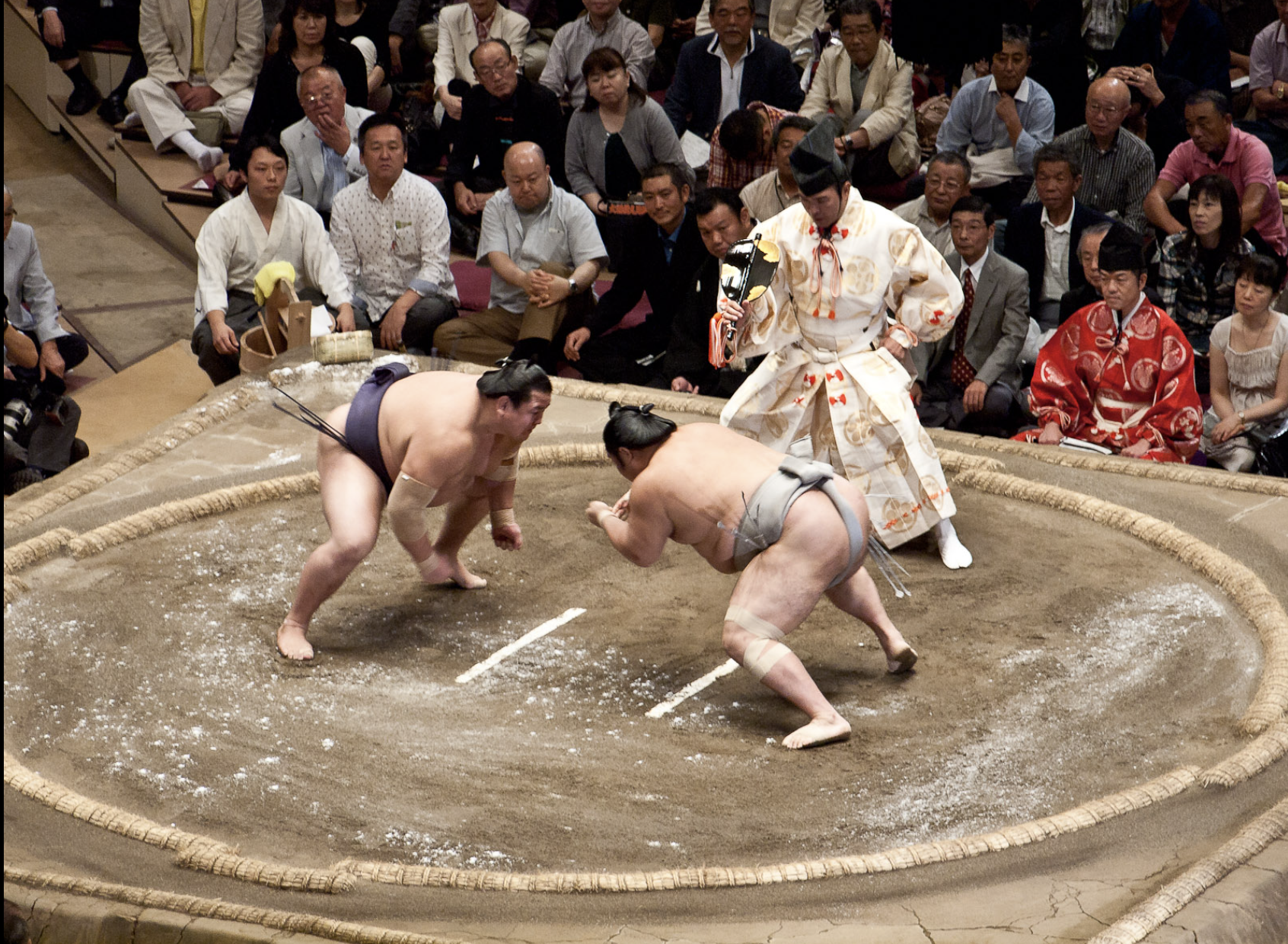
The opening charge in a sumo match
*Attribution:
https://commons.wikimedia.org/wiki/File:Sumo-Japan.jpg#/media/File:Sumo-Japan.jpg
2.3.9.2.4.5. Rituals and Customs in Japanese Society
2.3.9.2.4.5.1 New Year Rituals
The Japanese perform a year-end cleaning and prepare feasts like mochi (unleavened rice cakes) and osechi (traditional New Year's cuisine in tiered boxes) so as not to cook during the New Year's holidays. Traditionally, people have holidays with unleavened bread for 15 days, though recently it has been for about seven days. People also visit Shinto shrines during this time. (Unleavened bread is sometimes seen in East Asia.) Herbs may be added to boiled mochi. Traditionally, people eat "rice porridge with seven herbs" (nana-kusa-gayu) on January 15th. These customs bear similarities to the Jewish Passover.

Mochi
*Attribution:
http://en.wikipedia.org/wiki/File:Rice_Cake.jpg
*
"Mochi on Wikipedia"
http://en.wikipedia.org/wiki/Mochi

Osechi
*Attribution:
http://ja.wikipedia.org/wiki/%E3%83%95%E3%82%A1%E3%82%A4%E3%83%AB:Osechi_001.jpg
*
"Osechi on Wikipedia"
http://en.wikipedia.org/wiki/Osechi

Nana-kusa-gayu
*Attribution:
http://ja.wikipedia.org/wiki/%E3%83%95%E3%82%A1%E3%82%A4%E3%83%AB:Nanakusa_gayu_on_Nanakusa_no_sekku.jpg
*
"Nana-Kusa-Gayu in Wikipedia (Japanese)"
http://ja.wikipedia.org/wiki/%E4%B8%83%E8%8D%89%E3%81%8C%E3%82%86
Passover is a Jewish festival that begins on the 15th day of Nisan (also known as Abib). Nisan is the first month of the ecclesiastical year and the seventh or eighth month of the civil year in the Hebrew calendar.
Before Passover, the Israelites were required to clean their homes to remove all leaven. Passover itself is the Festival of Unleavened Bread, which commemorates the Exodus from Egypt. During the festival, Israelites and Jewish people eat unleavened bread (matzo) and are required to refrain from work. Additionally, they were instructed by Yahweh to eat bitter herbs as part of the observance.

Matzo
*Attribution:
http://en.wikipedia.org/wiki/File:Shmura_Matzo.jpg
*
"Matzo on Wikipedia"
http://en.wikipedia.org/wiki/Matzo
*"Now the Lord spoke to Moses and Aaron in the land of Egypt,
saying, 'This month shall be your beginning of months; it shall be the first month of
the year to you'" (Exo 12:1-2).
*"Then they shall eat the flesh on that night; roasted in fire,
with unleavened bread and with bitter herbs they shall eat it" (Exo 12:8).
*"And Moses said to the people: 'Remember this day in which you went out of Egypt,
out of the house of bondage; for by strength of
hand the Lord brought you out of this place.
No leavened bread shall be eaten'" (Exo 13:3).
*"Seven days you shall eat unleavened bread, and on the seventh day there shall be a feast to the Lord.
Unleavened bread shall be eaten seven days.
And no leavened bread shall be seen among you, nor shall leaven be seen among you in
all your quarters.
And you shall tell your son in that day, saying, ' This is done because of what the Lord did
for me when I came up from Egypt.' It shall be as a sign to you on your hand and as
a memorial between your eyes, that the Lord's law may be in your mouth; for with a
strong hand the Lord has brought you out of Egypt.
You shall therefore keep this ordinance in its season from year to year" (Exo 13:6-10).
*"Then the Lord spoke to Moses, saying, 'Speak to the children of Israel, saying:
"If anyone of you or your posterity is unclean because of a corpse, or is far away on a journey,
he may still keep the Lord's Passover.
On the fourteenth day of the second month, at twilight, they may keep it.
They shall eat it with unleavened bread and bitter herbs.
They shall leave none of it until morning,
nor break one of its bones.
According to all the ordinances of the Passover they shall keep it"'" (Num 9:9-12).
*"'Observe the month of Abib, and keep the Passover to the Lord your God, for in the month of
Abib the Lord your God brought you out of Egypt by night.
Therefore you shall sacrifice the Passover to the Lord your God, from the flock and the herd,
in the place where the Lord chooses to put His name.
You shall eat no leavened bread with it; seven days you shall eat unleavened bread with it,
that is, the bread of affliction (for you came out of the land of Egypt in haste),
that you may remember the day in which you came out of the land of Egypt all the days of your life.
And no leaven shall be seen among you in all your territory for seven days, nor shall
any of the meat which you sacrifice the first day at twilight remain overnight until morning'" (Deu 16:1-4).
2.3.9.2.4.5.2 Obon
Obon is a Japanese festival celebrated on either July 15th or August 15th. During this time, many Japanese people return to their hometowns to hold memorial services for the spirits of their ancestors.
The Jewish festival of Sukkot, also known as the Feast of Booths or the Feast of Ingathering, begins on the 15th of the month of Tishrei. Sukkot commemorates the Israelites dwelling in temporary booths after the Exodus. Tishrei is the seventh month of the ecclesiastical year (and the first month of the civil year). The festival was also celebrated on the 15th day of the eighth month in the Northern Kingdom of Israel, a practice initiated by Jeroboam of the tribe of Ephraim.
*"You shall dwell in booths for seven days. All who are native Israelites shall dwell
in booths, that your generations may know that I made the children of Israel dwell in
booths when I brought them out of the land of Egypt: I am the Lord your God" (Lev 23:42-43).
*"Jeroboam ordained a feast on the fifteenth day of the eighth month, like the feast that was
in Judah, and offered sacrifices on the altar.
So he did at Bethel, sacrificing to the calves that he had made.
And at Bethel he installed the priests of the high places which he had made" (1Ki 12-32).
2.3.9.2.4.5.3 O-Mikoshi
O-Mikoshi (or just Mikoshi) is a portable shinto shrine and its structure is like the ark of covenant.
Each shinto shrine have some o-mikoshis and people carry them and stroll through
their town with shouts and instrumental music in autumn festival.
Sometimes people carry them on shallows of sea and rivers like the Israelites.

O-Mikoshi
*Attribution:
http://en.wikipedia.org/wiki/File:Hiyoshi-taisha_juge-jinja-haiden02n4592.jpg

Carrying an O-Mikoshi
*Attribution:
http://ja.wikipedia.org/wiki/%E3%83%95%E3%82%A1%E3%82%A4%E3%83%AB:Temple%27s_Mikoshi.jpg
*
"Mikoshi on Wikipedia"
http://en.wikipedia.org/wiki/Mikoshi

Imaginary Drawing of the Ark
*Attribution:
http://en.wikipedia.org/wiki/File:Tissot_Moses_and_Joshua_in_the_Tabernacle.jpg

Carrying the Ark
*Attribution:
http://en.wikipedia.org/wiki/File:Folio_29r_-_The_Ark_of_God_Carried_into_the_Temple.jpg
*
"Ark of the Covenant on Wikipedia"
http://en.wikipedia.org/wiki/Ark_of_the_Covenant
*"Then Bezalel made the ark of acacia wood; two and a half cubits was its length, a cubit and a
half its width, and a cubit and a half its height. He overlaid it with pure gold inside and outside,
and made a molding of gold all around it.
And he cast for it four rings of gold to be set in its four corners: two rings on one side,
and two rings on the other side of it.
He made poles of acacia wood, and overlaid them with gold.
And he put the poles into the rings at the sides of the ark, to bear the ark.
He also made the mercy seat of pure gold; two and a half cubits was its length and
a cubit and a half its width. He made two cherubim of beaten gold; he made them of one
piece at the two ends of the mercy seat: one cherub at one end on this side, and the
other cherub at the other end on that side.
He made the cherubim at the two ends of one piece with the mercy seat" (Exo 37:1-8).
*"You shall command the priests who bear the ark of the covenant, saying,
'When you have come to the edge of the water of the Jordan, you shall stand in the Jordan'" (Jos 3:8).
*"David was clothed with a robe of fine linen, as were all the Levites who bore the ark, the singers,
and Chenaniah the music master with the singers.
David also wore a linen ephod.
Thus all Israel brought up the ark of the covenant of the Lord with shouting and
with the sound of the horn,
with trumpets and with cymbals, making music with stringed instruments and harps" (1Ch 15:27-28).
2.3.9.2.4.5.4 Bowing
Bowing is a widespread practice in East Asia, including Japan, used to show greeting and respect. The Patriarchs also bowed as a sign of respect.
*"Then the Lord appeared to him by the terebinth trees of Mamre,
as he was sitting in the tent door in the heat of the day.
So he lifted his eyes and looked, and behold, three men
were standing by him; and when he saw them, he ran from
the tent door to meet them,
and bowed himself to the ground," (Gen 18:1-2).
*"Now Jacob lifted his eyes and looked, and there, Esau was coming,
and with him were four hundred men. So he divided the children
among Leah, Rachel, and the two maidservants. And he put the
maidservants and their children in front, Leah and her children behind,
and Rachel and Joseph last. Then he crossed over before them and
bowed himself to the
ground seven times, until he came near to his brother" (Gen 33:1-3).
2.3.9.2.4.6 The Name of the Country and the National Flag
In ancient times, Japan was called "Wa." The country's name was officially changed from "Wa" to "Japan" at the end of the 7th century CE. However, to be more specific, the original name of the country in the Japanese language is "hi-no-moto" (日の本).
"hi" (日) means "sun" or "day." The character is a pictograph of the sun.
"no" (の) is a possessive particle similar to "'s," and is usually omitted in the Chinese translation.
"moto" (本) means "origin." The character itself comes from the pictograph for a tree (木), with an added horizontal line at the base to represent the root, or "origin."
Therefore, "hi-no-moto" literally translates to "the origin of the sun," or "the land where the sun originates."
*
"日 on Wiktionary" http://en.wiktionary.org/wiki/%E6%97%A5
*
"木 on Wiktionary"
http://en.wiktionary.org/wiki/%E6%9C%A8
*
"本on Wiktionary" http://en.wiktionary.org/wiki/%E6%9C%AC
Thus, the original name of Japan, "hi-no-moto," means "origin of the sun" or "origin of day." This is why the national flag of Japan depicts the sun.
The name "hi-no-moto" was written with the Chinese characters "日本" (Nippon/Nihon). In the Chinese pronunciation of that era, "日" was pronounced as "ji" or "nit," and "本" was pronounced as "pon" or "hon." This is how hi-no-moto came to be pronounced as "Jippon," "Nippon," or "Nihon," depending on the Chinese dialect at the time.
The name for "Japan" in other languages may have derived from this. For example, in the southern regions of China, "日本国" (Japanese country) was sometimes pronounced "ji-pen-quo." This is believed to have been adopted by Marco Polo, who transformed it into "Zipangu" in Portuguese, which eventually led to the English name "Japan."
As mentioned previously, the prophet Isaiah foretold that the Israelites would be in the direction of "dawning lights" (or "in the east"), which corresponds to the meaning of Japan, "the origin of the sun."
2.3.9.2.4.7 Hebrew Words in Japanese Language
2.3.9.2.4.7.1 General
The Japanese language appears to contain many words with Hebrew origins, although their resemblance may be rough or awkward.
2.3.9.2.4.7.2 The Formal Name of Emperor Jimmu
According to the Kojiki and the Nihon Shoki, the formal name of Emperor Jimmu is "Kamu-yamato-ihare-biko-sumera-mikoto." This name has no discernible meaning in Japanese, and even Japanese people cannot explain its significance.
However, when examined through the lens of Hebrew, this name takes on a profound meaning, despite being somewhat linguistically awkward.
Some advocates, such as Kubo Arimasa, suggest that "Kamu-yamato-ihare-biko-sumera-mikoto" is derived from the following Hebrew phrase:
"קמו ימות עברי בכור שמרון מלכותו"
Which translates to:
"QMW / YMWth (YH AMWth) / EBRY / BKWR / shWMRWN / MLKWthW"
The meaning of these words is:
Founder / Yahweh clans / Hebrew / Eldest or High / Samaria / Reign or Monarch.
They claim that "biko" or "hiko" corresponds to the Hebrew word "BKWR," meaning "eldest" or "high."
The Hebrew word "AMWth" (אמות), as found in Genesis 25:16 and Numbers 25:15, means "clans" or "people." Therefore, "YMWth" could be a compound word combining "Yahweh" (YHWH) and "Amuth."
On the other hand, "Kamu" could be a transliteration of the Hebrew word "KWM," which means "to gather." Other potential interpretations include "shWM AL" (שום אל) or "shYM AL" (שים אל), which mean "to put (the) Elohim." Additionally, "shWMR" (שומר), meaning "to guard" in Hebrew, could also be a plausible substitute for "shWMRWN" (Samaria).
2.3.9.2.4.7.3 Yamato Court
The Yamato Court is the name of an ancient Japanese dynasty that first appears in the Yōrō Code. The Japanese World War II battleship Yamato was named after this court.
According to traditional Japanese archaeology, the Yamato Court existed from approximately 500 CE to 710 CE.
While the meaning of the name Yamato is unknown, according to the preceding interpretation, it could mean "people of Yahweh."
2.3.9.2.4.7.4 Hi-fu-mi Prayer
The traditional Japanese way of counting is: "hi" (1), "fu" (2), "mi" (3), "yo" (4), "itsu" (5), "mu" (6), "na" (7), "ya" (8), "kokono" (9), "tō" (10), "mo" (100), and "chi" (1,000). This system is believed to have originated from the Hi-fu-mi prayer in Shinto.
The prayer itself is a recitation of these numbers: "hi-fu-mi-yo-itsu-mu-na-ya-kokono-tō-mo-chi-..." In Japanese, this prayer has no meaning beyond simple counting, just as "one-two-three-four-five-..." has no meaning in English.
However, when this prayer is read using Hebrew, it is believed to awkwardly describe a key scene from the Kojiki. The phrase "H YpfH MY YtsYAH MH NENH YQNH thBWA" can be interpreted as, "Who makes the beautiful woman exit? What was responded to take her out? She comes." This interpretation is said to match the story of Amaterasu's reemergence from the rock dwelling, the Ama-no-iwa-to.
2.3.9.2.4.7.5 Gion Festival in Heian-kyō
Heian-kyō, the former name of present-day Kyoto (as of 2020 CE), was established in 794 CE and has been a center of Shinto ever since. The name Heian-kyō literally means "peace city" or "city of peace," a meaning that is often compared to Jerusalem (YRWshLYM).
The Gion Festival began in Heian-kyō in 869 CE and is held annually from July 1st to July 31st. During the festival, large floats known as Yamaboko stroll through the streets on July 17th and July 24th. These floats, similar in appearance to large, brilliant Omikoshi but with wheels, are a key part of the procession.
Interestingly, July 17th (according to the Hebrew calendar) is said to be the day the Great Flood ended and Noah's Ark landed, as recorded in the Old Testament. This has led to the interpretation that the Gion Festival and its Yamaboko floats may be a celebration of Noah's survival and his ark, or of Solomon's Zion Festival, as mentioned in the Book of 1 Kings. The name Gion is also often said to be a variation of the pronunciation of Zion (Jerusalem).
*
"Gion Matsuri on Wikipedia"
http://en.wikipedia.org/wiki/Gion_Matsuri
*"Now Solomon assembled the elders of Israel and all the heads of
the tribes, the chief fathers of the children of Israel, to King Solomon in
Jerusalem, that they might bring up the ark of the covenant of the
LORD from the City of David, which is Zion. Therefore all the men
of Israel assembled with King Solomon at the feast in the month of
Ethanim, which is the seventh month" (1Ki 8:1-2).
*"At that time Solomon held a feast, and all Israel with him, a great
assembly from the entrance of Hamath to the Brook of Egypt, before
the LORD our God, seven days
and seven more days—fourteen days" (1Ki 8:65).
2.3.9.2.4.7.6 Folk Song Chants
The chants in many Japanese folk songs seem to resemble Hebrew words, even if their resemblance is a bit rough. For instance, a typical example is the shout from the Soran-bushi of Hokkaido.
"Yahren-soran-soran-soran-soran...choi-yasa-eh-enyan-sa-no-dokkoisho..."
The meanings of these shouts are unknown in Japanese, just as they would be in English. However, some advocates believe they have a meaningful interpretation in Hebrew:
YRNN (יָרֹן) - will sing with joy
SWLN (שולן) - alone
tsWED (צְעָד) - walk, march (advance)
YshR (יָשָׁר) - straight
LENYYN (לָעִנְיָן) - to the point
SER (סְעָר) - (in) storm
NA (נָא) - please
DWXQ (דָּחַק) - push
YshWEH (יְשׁוּעָה) - salvation of Yahweh
Another example is the Aomori folk song Nagyadoyara. The lyrics are:
"Nagyado-yahrayo
nagyado-nasare-dahde-sahie
nagyado-iudo-yahrayo."
The meaning of these lyrics is also completely unknown in Japanese. However, one interpretation translates them from Hebrew as follows:
NGYD (נָגִיד) - prince or child
YH (יָהּ) - Yahweh
RAH (רָאָה) - see, perceive
NGYD (נָגִיד) - prince or child
NtsRth (נָצְרַת) - Nazareth
DWD (דָּוִד) - David
shEYR (שַׂעִיר) - goat (as in shcYR LEZAZL - scapegoat)
NGYD (נָגִיד) - prince or child
YHWD (יְהוּדָה) - Judah
YH (יָהּ) - Yahweh
RAH (רָאָה) - see, perceive
This interpretation suggests the lyrics mean: "Perceive, Child (Prince) of Yahweh. Scapegoat Child (Prince) of Nazareth of David. Perceive, Child (Prince) of Judah of Yahweh."
2.3.9.2.4.7.7 The Japanese National Anthem "Kimi-ga-yo"
The song "Kimi-ga-yo" is said to have become Japan's national anthem in 1880 CE. However, its original lyrics likely emerged much earlier, between 800 and 1020 CE, in anthologies such as the Kokin Wakashū or the Wakan Rōeishū.
The lyrics of the anthem are: "Kimi-ga-yo-wa, chiyo-ni-yachiyo-ni, sazare-ishi-no, iwao-to-narite, koke-no, musu-made."
A literal breakdown of the lyrics shows: Kimi (monarch) ga ('s) yo (era) wa (is) chiyo (1,000 generations) ni (and) yachiyo (8,000 generations) ni (and) sazare-ishi (small stones) no (are) iwao (rock) to (as) narite (become) koke (moss) no (is) musu (flourish) made (until).
A classical English translation is: "A thousand years of happy life be thine! Live on, my Lord, till what are pebbles now, By age united, to great rocks shall grow, Whose venerable sides the moss doth line."
On the other hand, some advocates propose an interesting, although isomewhat awkward, Hebrew interpretation. They suggest the lyrics are a transliteration of the following Hebrew words:
QWM (קוּם) - rise or stand up
GAH (גַּאֶה) - rise gloriously
YHWH (יהוה) - Yahweh
tsYANY (צִיוֹנִי) - Zion's (Jerusalem's)
YH (יָהּ) - Yahweh
tsYANY (צִיוֹנִי) - Zion's (Jerusalem's)
shsh (שָׂשׂ) - rejoice
shRYD (שָׂרִיד) - survivor (chosen people)
YshE (יֵשַׁע) - salvation
ANWsh (אֱנוֹשׁ) - human
YHWH (יהוה) - Yahweh
AWth (אוֹת) - sign, omen
NLHAthH (נִלְאָתָה) - management, accomplishment
KL (כֹּל) - all
KNW (כָּנוּ) - base/ground/land
MWshMEth (מוּשְׁמַעַת) - is female form of MWshME (מוּשְׁמַע) meaning "resound." The ending "-th" is added to the feminine form of a verb in the pa'al (simple-active) mood, as in the word MWshMEth.
According to this interpretation, "Kimi-ga-yo" means: "Stand up and rise gloriously, Yahweh. Zion's people rejoice! The survivors, the chosen people, will see Yahweh's omen accomplished, resonating across all the world's lands."
Return to the Home Page