Disclaimer: This is Untrue.
2.3.9.3 Origin of Shinto (History of the Tribe of Judah of the Unified Kingdom)
2.3.9.3.1 Related Circumstances
In contrast to traditional archaeology, Shinto appears to have been founded by the Hata (秦) clan, Jewish migrants, in Japan around 600 - 700 CE. Furthermore, the Emperors of Japan are believed to be Jewish (descendants of Judah) and colleagues of the Hata clan. In this view, Yahweh seems to have directed the Hata clan to create Shinto and the legend of the Emperors to fulfill the prophecy in the Book of Ezekiel.
The traditional historical view and archaeology of Japan are mainly based on the Kojiki and the Nihon Shoki, leading to a common understanding as follows: Many people thought that the first Emperor, Jimmu, founded Japan in 660 BCE. Alternatively, a primitive Shinto belief system centered on reverence for the Emperors may have existed. When Buddhism was introduced in 538 CE and became widespread around 600 CE, Shintoists, including Prince Naka-no-Ōe, rebelled and launched a palace coup against the Buddhists (the Soga clan) in 645 CE (the Taika Reform). While they claimed that the ancient Shinto materials were completely burned in the counterattack by the Buddhists (the Soga clan) during the coup, the Shintoists institutionalized ancient Shinto through works like the Kojiki, the Nihon Shoki, and the Yōrō Code. Subsequently, the Shintoists and the Emperor transferred the capital to Heian-kyō (present-day Kyoto as of 2020 CE) in 794 CE to escape from the Buddhists in older cities like Asuka and Heijō-kyō (present-day Nara as of 2020 CE).
*
"History of Japan on Wikipedia"
http://en.wikipedia.org/wiki/History_of_Japan
However, according to Chinese historical texts like the Book of the Later Han, which refer to the social conditions of those islands (present-day Japan as of 2020 CE), the oldest recorded name of a king is "Suishō" in 107 CE, which differs from the historical understanding based on the Kojiki and the Nihon Shoki.
On the other hand, as mentioned before, the essence of Shinto seems to be Judaism. A simple speculation from this is that the people of the Northern Kingdom of Israel migrated to the islands (Japan) and created Shinto. However, upon closer examination, the situation is not so simple.
Shinto seems to include knowledge of Jesus and the Septuagint, tending to be more connected to Jerusalem than to the Northern Kingdom of Israel or Samaria. As also mentioned, the story of Amaterasu's retreat into the rock cave appears to be related to the death of Jesus. Inari shrines seem to be associated with INRI (Iesus Nazarenus, Rex Iudaeorum), the inscription placed on Jesus's cross that refers to him. Additionally, Shinto features statues of unicorns, which are associated with Joseph and his sons. However, the term "unicorn" (Deuteronomy 33:17) is a peculiar mistranslation specific to the Septuagint, Vulgate, and King James Version. The original Hebrew word is "ראם: RAM," which correctly means "wild ox," as found in the New King James Version.
The Septuagint appears to have been completed in the 1st century BCE, the Vulgate was mostly completed by St. Jerome around 405 CE, and Jesus was crucified around 30 CE. In contrast, the Neo-Assyrian Empire (where the people of the Northern Kingdom of Israel were held captive from 722 BCE) collapsed in 612 BCE. From these facts, it seems that the founder of Shinto was aware of events in the Middle East at least around 30 CE and possessed the Septuagint (or Vulgate).
2.3.9.3.2 True Ancient Japanese History through Chinese Literature
Since the Kojiki and the Nihon Shoki were intended to promote Judaism and are thus less objective, the true ancient history of Japan should be examined through fragmentary descriptions in Chinese historical texts like the Book of the Later Han (後漢書; Chinese history book) (completed in 432 CE, more than 200 years after the fall of the Later Han) (which partially refers to the islands (present-day Japan as of 2020 CE), excluding the Kojiki and Nihon Shoki.
The old name for these islands (present-day Japan as of 2020 CE) is "Wa" (倭). The earliest mention of "Wa" in a Chinese text is a very brief reference in the Shan Hai Jing, which is believed to have been compiled between 300 BCE and 250 CE. The Lunheng (論衡) mentions that Emperor Cheng (51 - 7 BCE) of the Chinese Han Dynasty (漢) (206 BCE - 220 CE) was presented with a tribute of herbs from Wa. The Book of the Former Han states that the Wa people lived in the eastern sea around the time of Jesus and that there were over a hundred countries in Wa.
According to the Book of the Later Han, envoys were sent to China in 57 CE, and the king of Wa (or a regional king) was given a "golden stamp of the King of Wa." As the golden stamp was found in Fukuoka, in the western part of Japan, the "king" may have been just a regional ruler of one territory.
The Book of the Later Han subsequently reports that the king of Wa, "Suisho" (帥升), presented a tribute of 160 enslaved people to the Chinese king in 107 CE. This "Suishō" is believed to have been in the northern part of Kyushu.
*
"Suisho on Wikipedia"
http://en.wikipedia.org/wiki/Suish%C5%8D
The Book of the Later Han (後漢書) also refers to the Annals of the Three Kingdoms (三國志), stating that there was a civil war in Wa from 147 to 189 CE. At that time, there was no king, and consequently, a queen named "Himiko" from the country of Yamatai (邪馬臺國) came to rule Wa.
The Annals of the Three Kingdoms (a Chinese historical text covering 180 - 280 CE, completed around 290 CE) also provides details about Wa. It mentions that there were male kings for 70 - 80 years before the civil war broke out, after which Queen "Himiko" of the country of Yamatai ascended to the throne. The text further records that the king of Wei (one of China's three kingdoms) gave Himiko one hundred bronze mirrors in 286 CE. The Annals of the Three Kingdoms also describes Wa's society during that period as follows:
Men in Wa had tattoos on their faces and bodies.
Men did not wear crowns but tied their hair in topknots. Women did not tie or style their hair.
Clothing consisted of wide cloths that were simply bound.
The land had no cows, horses, tigers, leopards, sheep, or magpies.
Weapons were pikes, shields, and bows.
The climate was moderate, and people ate fresh vegetables even in winter.
When someone died, people would cry and refrain from eating meat for ten days.
People would purify themselves in water after a burial.
On special occasions, they would bake bones to divine the future.
When people crossed the sea, a designated person (a "wisher") would pray for a safe journey. If the crossing failed, the wisher was executed for their unfaithful prayer.
The people had long lifespans.
Thefts and lawsuits were rare.
The society was organized hierarchically by tribes.
Records of Wa are notably absent from Chinese historical texts between 290 and 410 CE.
According to the Book of Jin, the Book of Song, and the Book of Liang, five kings of Wa offered tributes to Chinese emperors between 413 and 502 CE, and the Chinese emperors formally invested these kings with official titles. The names of the kings of Wa mentioned in these Chinese texts are 讃, 珍, 済, 興, and 武. However, no description of Japanese emperors appears in these Chinese books. It is worth noting that the descriptions of Yamatai in the Book of the Later Han and the Book of Liang are merely reproductions from the Annals of the Three Kingdoms.
Given this, the names of the five kings do not correspond to the names of the emperors listed in the Kojiki and the Nihon Shoki. This suggests that the Emperors of Wa likely did not exist during that period (413 - 502 CE).
The Book of Sui (隋書) states that a ruler named "King Tarishihiko (or Tarishihoko)" (多利思北孤) from Wa sent envoys to the Chinese emperor in 607 CE to learn about Buddhism. The message read: "The Son of Heaven in the land where the sun rises addresses a letter to the Son of Heaven in the land where the sun sets. We hope you are in good health." This message displeased the Chinese emperor. It remains unknown whether "King Tarishihiko" was an emperor of Wa.
*If the correct pronunciation is "Tarishihiko," the name sounds like a male Shintoist, as "hiko" (彦) is a common component in the names of male Shinto figures. This suggests that Shinto may have been widespread in Wa around 607 CE. This hypothesis seems to present a contradiction—that Shintoists would travel to China to learn about Buddhism. However, it is important to remember that emperors and some Shintoists in later ages were generally tolerant of Buddhism.
Many male figures in the Kojiki and Nihon Shoki have "hiko" in their names, such as:
Saruta-hiko, who guided Ninigi,
Yama-sachi-hiko or Yama-sachi-biko, another name for Hoori.
Umi-sachi-hiko or Umi-sachi-biko, another name for Hoderi.
Kamu-yamato-ihare-biko-sumera-mikoto, another name for Emperor Jimmu,
Nagasune-hiko, an opponent of Jimmu.
Consequently, some Japanese men today still have "hiko" (彦) in their names, such as the 95th Prime Minister, Yoshihiko Noda.
*
"Toshihiko Noda on Wikipedia"
http://en.wikipedia.org/wiki/Yoshihiko_Noda
*
"Japanese Resources"
*By the way, as mentioned previously, some advocates, such as Kubo Arimasa, suggest that "Kamu-yamato-ihare-biko-sumera-mikoto" is a Hebrew phrase. The proposed interpretation is:
"קמו ימות עברי בכור שמרון מלכותו" "QMW / YMthW (YH AMWth) / EBRY / BKWR / shWMRWN / MLKWthW" Meaning: Founder / Yahweh clans / Hebrew / Eldest or High / Samaria / Reign or Monarch.
They claim that "BKWR" and "biko" or "hiko" mean "Eldest" or "High" in Hebrew. Given the numerous similarities between Shinto and Judaism and the historical diffusion of Shinto, this interpretation may not be entirely ridiculous. For example, "AMWth" means "clans" in Aramaic (see Numbers 25:15 in the Hebrew Bible), and it is also plausible that "SMR" (to guard) is the intended word instead of "shWMRWN" (Samaria).
One might assume that the nation based on the concept of the rising sun was founded during the Tarishihiko Era around 607 CE. However, the phrase "the land where the sun rises" (日出處) is said to have originated from Buddhist texts like the Great Treatise on the Perfection of Wisdom (大智度論) T1509 Vol.25 page:0133b21-22, which states: "如經中説。日出處是東方。(the land where the sun rises is the east.)
日沒處是西方。(the land where the sun sets is the west.)
日行處是南方日不行處是北方。(the land where the sun goes is the south,
the sun doesn't go is the north)."
*
"Great Treatise on the Perfection of Wisdom on Wikipedia"
http://zh.wikipedia.org/wiki/%E5%A4%A7%E6%99%BA%E5%BA%A6%E8%AB%96
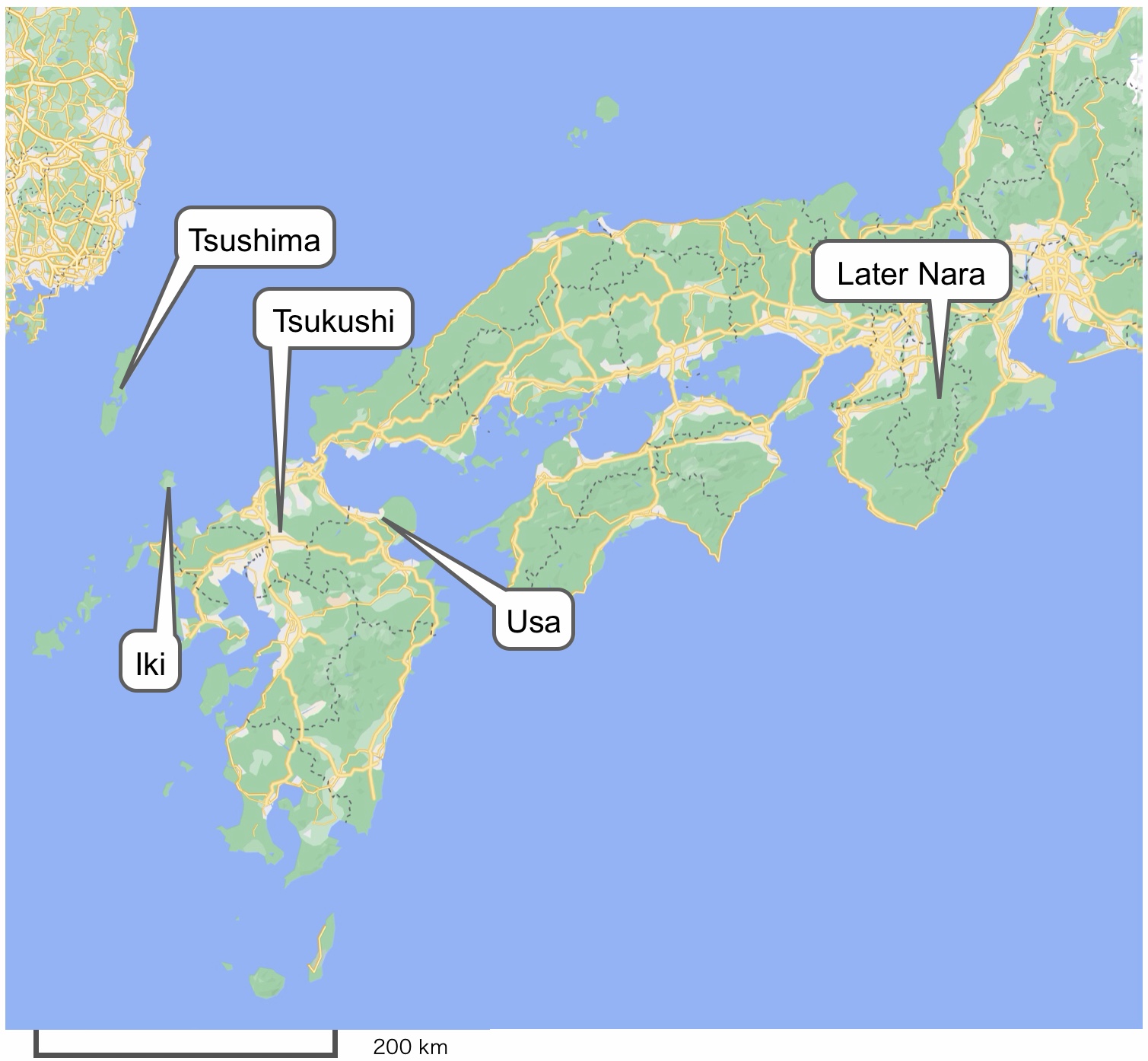
The Book of Sui (隋書) subsequently recounts that the Chinese emperor dispatched Pei Ching as an envoy to Wa in return. Pei Ching reported that the Hata Kingdom (秦王國), which lies to the east of Tsukushi (築紫) in Wa, appeared to be of Han Chinese ethnicity (華夏). The Hata Kingdom is presumed to have been located in either present-day Oita or Yamaguchi prefectures (as of 2020 CE). Oita is near Usa, while Yamaguchi lies to the north of Usa over the sea, on the western edge of
Honshu main island.
*Attribution:
https://www.atlist.com/showcase/world-map-with-no-labels
The Korean history book Samguk Sagi Silla Bongi (三國史記 新羅本紀), released around 1140 CE, states that the name of the country changed from "倭" (Wa) to "日本" (Japan) in 670 CE.
The Tang Li (唐暦; literally, "Tang Calendar") mentions that envoys from Nippon-koku (日本國), or "Japan," came to the Tang court in 702 CE.
Chinese historical texts like the Jiu Tang Shu (旧唐書; Old Tang History, published in 945 CE) and the Tang Huiyao (唐会要; Institutional History of Tang, published in 961 CE) both draw from the same defunct source, the Huiyao, released around 800 CE. These texts report that two nations, "倭" (Wa) and "日本" (Japan), existed. This could be interpreted as a new nation, Japan, having unified the country. The texts also mention that the new name "日本" (Japan) was explained by Japanese envoys in 702 CE as deriving from the country's location where the sun rises. However, the Tang court suspected that the nation of Wa might have simply changed its ungraceful name to the more elegant "Japan," as a new, small nation would not have been able to defeat Wa.
*旧唐書 巻199上 列傳第149上 東夷 tells
"日本國者 倭國之別種也 以其國在日邊 故以日本爲名 或曰 倭國自惡其名不雅 改爲日本
或云 日本舊小國 併倭國之地."
*唐会要 巻100 日本國伝 tells "日本國日本。倭國之別種。
以其國在日邊。故以日本國為名。或以倭國自惡其名不雅。
改為日本。或云日本舊小國。吞併倭國之地。."
*
"Tang Huiyao vol. 100 on Wikisource"
http://zh.wikisource.org/wiki/%E5%94%90%E6%9C%83%E8%A6%81/%E5%8D%B7100
According to traditional Japanese history, a succession dispute known as the Jinshin War took place in 672 CE.
*
"Jinshin War on Wikipedia"
http://en.wikipedia.org/wiki/Jinshin_War
This conflict has traditionally been explained as a mere dispute among the imperial family. However, since objective evidence of the Emperors and Shinto is not found before this war, it is plausible that the Jinshin War marked the fall of the native nation "Wa" (倭) and the rise of the Shinto nation "Japan" (日本).
As previously mentioned, the original meaning of Japan (日本) is "origin of the sun," a name that aligns with the prophecy of Isaiah, which refers to "dawning light."
2.3.9.3.3 Hata Clan
2.3.9.3.3.1 Involvement of Hata clan and Sukuri clan
Nihon Shoki and "Shin-sen-shouji-roku" (新撰姓氏録; literally: records of new choice of family names;
Who's Who) tell about the Hata (秦) clan
and its brother clan "Sukuri (勝) clan." ("勝" may be pronounced "suguri" in modern Japanese though.)
According to Nihon Shoki and "Shin-sen-shouji-roku," the monarch of Yudu or Yuzu
(弓月 (Yudu) in Nihon Shoki and 融通 (Yuzu) in Shin-sen-shouji-roku)
and his clan (the Hata clan) tried to migrate
through Korean Peninsula to Japan.
They are said to have claimed to be descendants of Qin Shi Huang of ancient China Quin (秦).
The 15th Emperor Oujin (in the reign of 270 - 310 CE) helped them to migrate and let
them dwell in various
regions, they raised silkworms, produced silk, and the population of the Hata clan was about 190,000.
Secondly, Nihon Shoki tells that Hata-Sakekimi (秦酒公) raised silkworms, produced silk, donated silk
to Emperor Yuuryaku (in the reign of 456 - 479 CE), Hata was endowed title of "Udumasa,"
and Hata became the Secretary of Treasury.
Thirdly, Nihon Shoki tells that Emperor Kinmei, ascended to the throne in 531 CE.,
dreamt in his infancy that he should designate Hata-Otsuchi (秦大津父) as the Secretary of Treasury.
Fourthly, according to Nihon Shoki, an influential person of the Hata clan,
Hata Kawakatsu (秦河勝) rose in the reign of Empress Kougyoku (642 - 645 CE)
and took an active role.
Subsequently, the Nihon Shoki tells that Hata-Irogu (秦伊呂具) founded Inari Shrine in 711 CE.
Inari Shrine is the second most shrine group in Japan and advocators claim INARI
came from INRI,
the acronym of the Latin inscription IESVS·NAZARENVS·REX·IVDÆORVM
(Iesus Nazarenus, Rex Iudaeorum), translated as
"Jesus of Nazareth, the King of the Jews"
as in Joh 19:19-20.
*"Now Pilate wrote a title and put it on the cross.
And the writing was:
JESUS OF NAZARETH, THE KING OF THE JEWS.
Then many of the Jews read this title, for the place where
Jesus was crucified was near the city; and it was written in
Hebrew, Greek, and Latin" (Joh 19:19-20).
On the other hand, the most numerous group of shrines is the Yahata (or Yahada) shrines, which originated from the Usa Shrine in Oita Prefecture. According to oral traditions at the Usa Shrine, the Deity of Yahata first emerged in Usa in 571 CE. Native people created the rural Usa Shrine and enshrined the Deity of Yahata.
Subsequently, when the Imperial Court fought regional rebels near Oita in 720 CE, the rural Usa Shrine demonstrated spiritual power. The Imperial Court then created a portable shrine (O-mikoshi) to carry the deity of Yahata for the first time. The deity of Yahata went on to defeat the rebels, and the Imperial Court has trusted the Usa Shrine ever since.
Later, when the Imperial Court created a great statue of the Buddha in Yamato (present-day Nara Prefecture), the capital of Japan at that time, in 759 CE, the Usa Shrine celebrated the occasion. They carried an O-mikoshi enshrining the deity of Yahata from Oita to Yamato (Nara), and through this event, both the O-mikoshi and the deity of Yahata became known throughout the country.
Advocates claim that Yahada is a regional pronunciation of Judah, that Usa in Oita was a base for the Hata clan, and that the Hata clan was the mastermind behind the Yahata shrine network and the creation of a form of Judaism disguised as Shinto. The pronunciation "Hata" (秦) is said to be derived from Yahada or Judah.
According to the Nihon Shoki and the Seiji Yōryaku (政事要略), a record of Heian-era politics supposedly released in 1008 CE, the Hata clan was heavily involved in engineering works, including banking several rivers for irrigation. The Shoku Nihongi (続日本紀), completed in 797 CE, also notes that the Hata clan was involved in the construction of palaces.
The construction of Heian-kyō (literally: "city of peace," like Jerusalem), completed in 794 CE, was overseen by the Director of Construction, Fujiwara Oguromaro. His wife was a daughter of Hata Shimamaro. Additionally, the land where the Imperial Palace in Heian-kyō was built was formerly the residence of Hata Kawakatsu.
Thus, the Hata clan was closely involved in Shinto, the Emperor, Shinto shrines, and the construction of Heian-kyō.
Considering the Hata clan's connection to Judaism and Jerusalem, it is plausible that they were descendants of the Israelites and Jews (the tribe of Judah). Ken Joseph has published a claim that the Hata clan was involved in the institutionalization of Shinto in Japan and that they were ancient Messianic Jews (Jews who accept Christ) dedicated to Nestorianism.
*
"Assyrian Christians about Ken Joseph"
http://www.assyrianchristians.com/about_ken_joseph.htm
2.3.9.3.3.2 Nestorianism in China
Nestorius, the Ecumenical Patriarch of Constantinople, proposed the Nestorian doctrine. However, his teachings were deemed heretical and condemned in 431 CE at the First Council of Ephesus.
*
"First Council of Ephesus on Wikipedia"
Subsequently, the Oriental Orthodox (Miaphysite) Churches separated from the main body of Christianity, rejecting the dogmatic definitions of the Council of Chalcedon in 451 CE. The Eastern Orthodox Church also later separated during the East-West Schism in 1054 CE. The Orthodox Churches, the Oriental Orthodox Churches, the Assyrian Church of the East, and the Eastern Catholic Churches are all considered part of Eastern Christianity.
Nestorianism was succeeded by the Church of the East and the Holy Apostolic Catholic Assyrian Church of the East. The Nestorians relocated to Persia and later to China in 635 CE during the Tang Dynasty (618 - 907 CE). A stele, erected in China in 781 CE, shows the names of about 70 Nestorian priests.
Christianity was therefore prevalent in China around 640 CE, meaning that people or their descendants from the Middle East who possessed the Septuagint (or Vulgate) could have been in China at that time. The Septuagint was commonly used by Eastern Christianity.
Nestorianism was referred to as Dà Qín Jǐng Jiào (大秦景教) in Chinese. Dà Qín (大秦) meant the "Eastern Roman Empire," and Jǐng Jiào (景教) meant "Nestorianism."
*
"Church of the East in China on Wikipedia"
http://en.wikipedia.org/wiki/Church_of_the_East_in_China
In his book, Asahel Grant proposed that "the Nestorians were the Lost Tribes" of Israel, citing similarities between the two groups.
*
"Asahel Grant Marketplace"
Ken Joseph and Kubo Arimasa agree with this claim to a certain extent. Additionally, Ken Joseph, Marvin Tokayer, and Kubo Arimasa argue that the Hata clan was a Jewish clan dedicated to Nestorianism.
o Arimasa agreed it to a certain extent.
In addition, Ken Joseph, Marvin Tokayer, and Kubo Arimasa claim
the Hata clan was a Jewish clan dedicated to Nestorianism.

2.3.9.3.3.3 Kung-Yueh
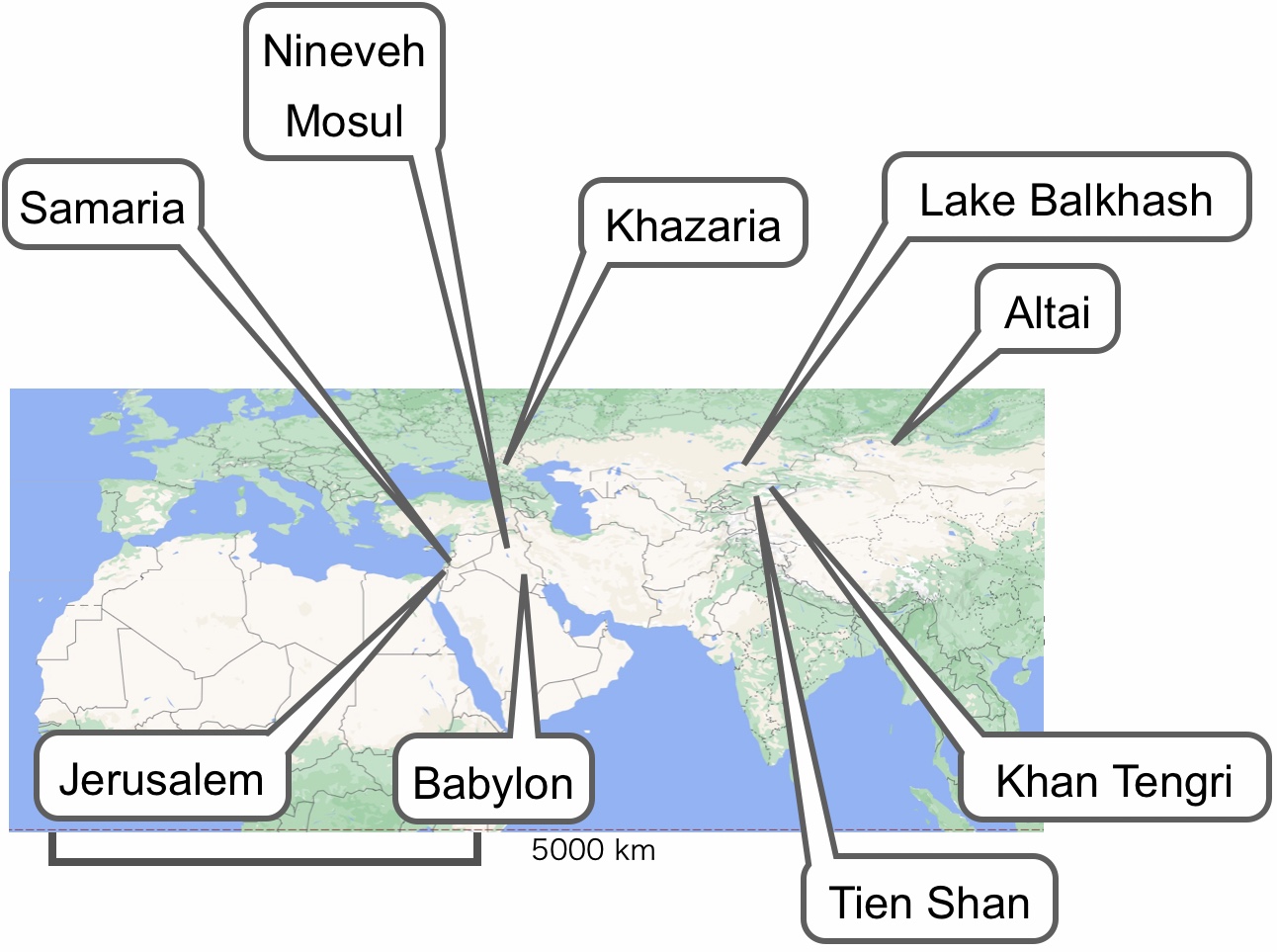
Ken Joseph hypothesizes that the Hata clan was a Jewish clan from the Kung-Yueh (弓月) or Gong-Yue area. This region, whose name literally means "bow moon" or "crescent moon," is believed to be modern-day Kulja, located near the border of eastern Kazakhstan and western Xinjiang Uyghur Autonomous Region, at the northern foot of Mount Khan Tengri and on the southern shore of Lake Balkhash. Joseph's theory is based on accounts from the Nihon Shoki, Shinsen Shōjiroku (新撰姓氏録), and Zizhi Tongjian (資治通鑑).
The Kung-Yueh area was situated at a key junction of trade routes: "the northern Silk Road through Oasis and Desert" and "the southern Silk Road on Grass Field." These routes connected the northern region of the Black Sea (known as Khazaria around 660 CE) with the Korean Peninsula.
*
"Lake Balkhash on Wikipedia"
http://en.wikipedia.org/wiki/Lake_Balkhash
*
"Travel China Silk Road Map"
http://www.travelchinaguide.com/images/map/silkroad/scenery.gif
*
"Travel China Silk Road"
http://www.travelchinaguide.com/silk-road/route.htm
*
"Khazars on Wikipedia"
http://en.wikipedia.org/wiki/Khazars
The Nihon Shoki recounts that Yuduki-kimi (弓月君), the monarch of Yudu, visited and requested Emperor Ōjin (the 15th Emperor) to allow his clan, the Hata (秦), to migrate to Japan from the Korean Peninsula. Consequently, his clan did so.
The Shinsen Shōjiroku ("Who's Who") lists the 740th family, the Uzumasa-no-kimi Sukune (太秦公宿禰) (in 左京諸藩 漢). According to this text, Kōman-ō (功満王), the father of Yuzu-ō (融通王), visited the 14th Emperor, Chūai. Subsequently, his son and his clan migrated to Japan.
It is worth noting that some scholars speculate that the Nihon Shoki and the Shinsen Shōjiroku may have been intentionally created or fabricated by the Hata clan.
*Attribution:
https://www.atlist.com/showcase/world-map-with-no-labels
The Zizhi Tongjian (資治通鑑), a Chinese history book, states in its section on the Tang Dynasty (唐紀) that Kung-Yueh (弓月) was located in western China around 660 CE.
According to the Jiu Tang Shu (旧唐書; Old Book of Tang) and the Xin Tang Shu (新唐書; New Book of Tang), Yipiduolukehan (乙毘咄陸可汗), also known as Yukuk Shad (d. 653 CE), was a despotic ruler of the Western Göktürk Khaganate (西突厥; 593–659 CE). A "Khaganate" means an empire, and "Khagan" (可汗) means "emperor."
A member of the Ashina clan (阿史那氏), Ashina Helu (阿史那 賀魯), also known as Ishbara Khagan (沙鉢羅可汗), was a disciple of Yipiduolukehan. He ruled the Talas River, Beshbaliq (庭州), and other areas. The religion of both the Göktürk and Western Göktürk peoples was Tengrism.
*
"Yuku Shad on Wikipedia"
http://en.wikipedia.org/wiki/Yukuk_Shad
*
"Western Turkic Khaganate on Wikipedia"
http://en.wikipedia.org/wiki/Western_Turkic_Khaganate
*
"Ishbara Qaghan (Ashina Helu) on Wikipedia"
http://en.wikipedia.org/wiki/Ishbara_Qaghan_(Ashina_Helu)
*
"Talas River on Wikipedia"
http://en.wikipedia.org/wiki/Talas_River
*
"Bechbaliq (庭州) on Chinese Wikipedia"
http://zh.wikipedia.org/wiki/%E5%BA%AD%E5%B7%9E
*
"Tengrism on Wikipedia"
http://en.wikipedia.org/wiki/Tengrism
However, after the death of Yipiduolukehan, rebels allied with the Tang Dynasty. The Tang army subsequently came to rule Beshbaliq (庭州) and other areas.
The Zizhi Tongjian, Volume 199, states that in July 651 CE (公元六五一年 七月), Ishbara Khagan (沙缽羅可汗) of the Western Göktürks attacked Beshbaliq.
*"秋,七月,西突厥沙缽羅可汗寇庭州,攻陷金嶺城及蒲類縣,殺略數千人。
詔左武候大 將軍梁建方、右驍衛大將軍契苾何力為弓月道行軍總管,
右驍衛將軍高德逸、右武候將 軍薛孤吳仁為副,發秦、成、岐、雍府兵三萬人及
回紇五萬騎以討之。
癸巳,詔諸禮官學士議明堂制度,以高祖配五天帝,太宗配五人帝。"
*
"Wikisource Zizhi Tongjian Vol 199"
http://zh.wikisource.org/wiki/%E8%B3%87%E6%B2%BB%E9%80%9A%E9%91%91/%E5%8D%B7199
Zizhi Tongjian Vol 202 about Dec 673 CE (公元六七三年 十二月) tells that various tribes of
Western Gokturk scattered, Kung-Yueh tribe (弓月部) and other tribes rebelled.
They allied and attacked Kashgar. The Emperor Gaozong of Tang subdued them.
The Emperor Gaozong of Tang forgave them.
*
"Kashgar on Wikipedia"
http://en.wikipedia.org/wiki/Kashgar
*
"Emperor Gaozong of Tang on Wikipedia"
http://en.wikipedia.org/wiki/Emperor_Gaozong_of_Tang
*"十二月,丙午,弓月、疏勒二王來降。
西突厥興昔亡可汗之世,諸部離散,弓月及阿悉 吉皆叛。
蘇定方之西討也,擒阿悉吉以歸。弓月南結吐蕃,北招咽面,共攻疏勒,降 之。
上遣鴻臚卿蕭嗣業發兵討之。嗣業兵未至,弓月懼,與疏勒皆入朝;上赦其罪,遣 歸國。"
*
"Wikisource Zizhi Tongjian Vol 202"
http://zh.wikisource.org/wiki/%E8%B3%87%E6%B2%BB%E9%80%9A%E9%91%91/%E5%8D%B7202
The Kung-Yueh (弓月) tribe seems to have been one of the ten tribes that composed the Western Göktürk Khaganate.
Since it is improbable that the native Japanese people would have known about the Yudu (弓月) tribe of the Western Göktürks at the time, the descriptions of migrants from Yudu in the Nihon Shoki and Shinsen Shōjiroku appear to be based on real events, despite the discrepancy in the migration dates.
As mentioned previously, the 14th Emperor, Chūai, in the Kojiki and the Nihon Shoki may correspond to the biblical Saul. In contrast, most dates related to Shinto and the Hata clan fall between 600 and 800 CE. For instance, the first Shinto-like name, "Tarishihiko," appeared in 607 CE. The envoy from the Sui Dynasty reported the existence of the Hata kingdom shortly after. The Kung-Yueh (弓月) tribe was first mentioned in 651 CE. The name of the country, "日本" (Japan), was officially recognized around 700 CE. The Kojiki was released in 712 CE, and Heian-kyō was founded in 794 CE.
Based on this timeline, the ancestors of the Hata clan, who possessed the Septuagint, appear to have moved from the Middle East to the area around Lake Balkhash. It seems that Judaism or Nestorianism became interwoven with Tengrism in this region. The migration of the Hata clan, with their silk worms and the Septuagint, likely occurred around 600 CE. They quickly gained influence in Japan, fabricating Shinto and the legends of the Emperors. Consequently, the true character of the Japanese emperors would be that of colleagues or relatives of the Hata clan, who were themselves a Jewish population (descendants of Judah and David).
Regarding the fact that the Hata (秦) clan claimed to be descendants of Qin Shi Huang of ancient China, it is possible to infer that the Chinese Qin dynasty was a Greek-Jewish power. This assumption is based on the idea that the Jewish people who were freed from the Babylonian captivity were generally friendly with Alexander's empire. A part of their group then moved east with the remnants of Alexander's empire. After the establishment and fall of the Qin dynasty in China, they reluctantly moved to the area around Lake Balkhash. If this is not the case, there is no other reason for the Hata clan to use the character "秦" or to claim an association with Qin Shi Huang without any basis.
A prominent descendant of the Hata clan is the 95th Prime Minister of Japan, Tsutomu Hata (羽田 孜). He claims descent from the Hata (秦) clan, although his name is written with different Chinese characters.
*
"Tsutomu Hata on Wikipedia" http://en.wikipedia.org/wiki/Tsutomu_Hata
Return to the Home Page