Disclaimer: This is Untrue.
2.3.9.4 Origin of the Jōmon People and Others (History of the Tribe of Ephraim of the Unified Kingdom and Others)
2.3.9.4.1 Outline of Japanese Ancient History
As mentioned previously, the other key group is the Jōmon people.
Traditionally, Japanese history is divided into three main eras. In chronological order, they are:
(1) The Paleolithic Period: This period is believed to have ended around 14,000 BCE with the end of the last ice age, during which stone tools were used.
(2) The Ancient Period: This cultural era is further divided into three speculative periods:
The Jōmon Period (c. 14000 – 300 BCE)
Yayoi Period (c. 300 BCE – 250 CE)
Kofun Period (c. 250 – 540 CE)
(3) The Classical Period: This era includes the Asuka (540 – 710 CE), Nara (710 – 793 CE), and Heian (794 – 1185 CE) periods.
*
"History of Japan on Wikipedia"
http://en.wikipedia.org/wiki/History_of_Japan
2.3.9.4.2 Jōmon and Yayoi
2.3.9.4.2.1 General
The term "Jōmon" (縄文), which literally means "rope pattern," comes from its distinctive rope-patterned pottery. This pottery is believed to be among the oldest in the world, with some examples dating back to around 13000 BCE. The Jōmon period is defined by both the Jōmon people and their characteristic pottery.
The subsequent Yayoi period is known for its Yayoi pottery, which was first excavated in modern-day Yayoi (弥生) Town in Tokyo. It is also distinguished by the introduction of ironware and the arrival of the Yayoi people.
*
"Jomon Period on Wikipedia"
http://en.wikipedia.org/wiki/J%C5%8Dmon_period
*
"Yayoi Period on Wikipedia"
http://en.wikipedia.org/wiki/Yayoi_period
2.3.9.4.2.2 The Dual Structure Model
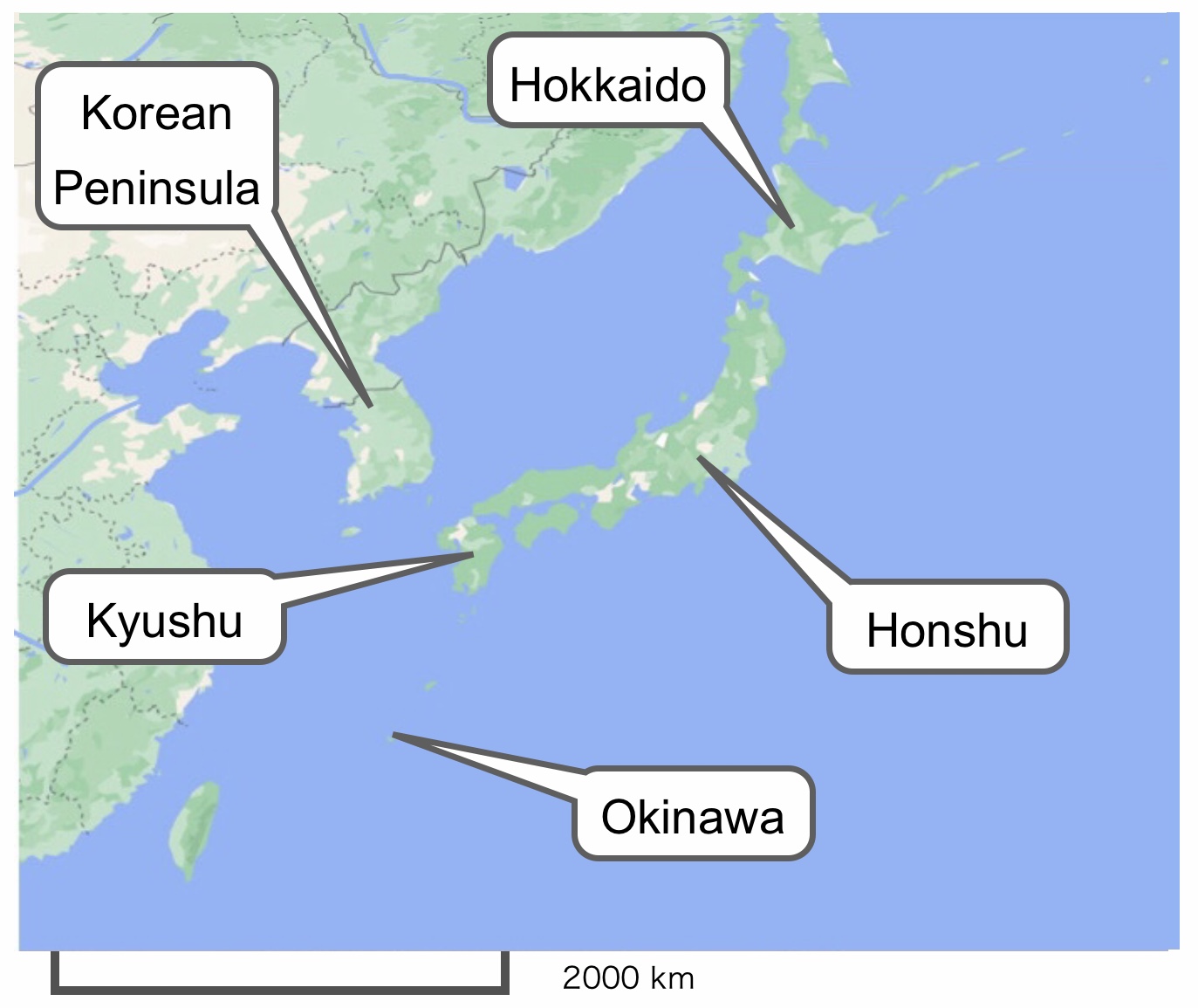
The origin of the Japanese population has been a subject of debate. However, the most widely accepted theory is Kazuo Hanihara's "Dual Structure Model." This theory posits that the Japanese archipelago was first predominantly settled by the Jōmon people from Southeast Asia. A second group, the Yayoi people, then migrated to the archipelago from Northeast Asia, primarily through the Korean Peninsula and Kyushu, starting around 300 BCE. (Kyushu is the southwesternmost of Japan's four main islands and is located near the Korean Peninsula.)
This theory is supported by several lines of evidence. First, skeletal analysis shows a clear difference between the two groups. Jōmon skulls (such as the fossils found at Tsukumo, Okayama) have wide faces, similar to those of people from southern China. In contrast, Yayoi skulls (like those from Doi-ga-hama, Yamaguchi) have long faces, resembling those from northern China.
Secondly, modern Japanese people can be broadly categorized into two physical types. One type is characterized by wide faces, most notably seen in the Ainu people of Hokkaido and the Okinawans (Ryukyuans) in Okinawa. (Hokkaido is the northeasternmost of the main islands, while Okinawa is a small island far to the southwest.) These people generally have wide, chiseled faces and stout, thickly haired bodies, including dense eyebrows and beards.
The second type is characterized by long faces, typically found in people from northern Kyushu and the western part of Honshu (the largest main island), such as Fukuoka and Hiroshima. These people generally have long, flat faces, single-edged eyelids, and slender, thinly haired bodies.
The Dual Structure Model claims that the wide-faced Jōmon people were the first to move to the Japanese archipelago from Southeast Asia. The long-faced Yayoi people, who brought ironware with them, then migrated from Northeast Asia around 300 BCE, dominating the western regions of Japan. As a result, the Jōmon people were pushed to the northeastern regions like Hokkaido or the southwestern regions like Okinawa.
*
"Jomon face (縄文顔) and Yayoi face (弥生顔)"
http://www.yoshinogari.jp/ym/episode03/img/img03.jpg
*
"Japanese People on Wikipedia"
http://en.wikipedia.org/wiki/Japanese_people
*
"Ainu People on Wikipedia"
http://en.wikipedia.org/wiki/Ainu_people
*
"Ryukyuan People on Wikipedia"
http://en.wikipedia.org/wiki/Ryukyuan_people
*Attribution:
https://www.atlist.com/showcase/world-map-with-no-labels
2.3.9.4.2.3 Genetic Examination
The theory that the earlier inhabitants, the Jōmon people, were expelled outward from Kyushu is strongly supported by Y-DNA genetic studies on males. The frequency of Y-DNA haplogroup D increases with distance from the Korean Peninsula and northern Kyushu. For instance, the frequency is as follows:
Korean Peninsula: 0–4%
Western Japan: 27%
Central-Eastern Japan (Kantō region): 48%
Okinawa (a southwestern island): 56%
Ainu in Hokkaido: 88%
On the other hand, the theory that the Jōmon people originated in Southeast Asia is not supported by Y-DNA studies. Y-DNA haplogroup D is exclusively absent in Central, Southern, Southeastern, Eastern, and Northeastern Asia, with the exceptions of Japan, Tibet, and the Andaman Islands (located between India and Myanmar). As mentioned previously, Y-DNA haplogroup D, or the YAP mutation, is specifically associated with populations in Tibet, the Andaman Islands, and the Middle East.
*
"Y-DNA Haplogroups by Populations of East and Southeast Asia in Wikipedia"
http://en.wikipedia.org/wiki/Y-DNA_haplogroups_by_populations_of_East_and_Southeast_Asia
Regarding females, the theory that the earlier inhabitants (Jōmon women) were expelled outward from Kyushu could not be confirmed by genetic studies. This is because the distribution of mtDNA haplogroups is not as distinct between the Ainu and other Japanese populations. For example, the composition of mtDNA haplogroups among the Ainu is quite similar to that of the average Japanese person. While 22% of Ainu have haplogroup Y, this can be accounted for by the 66% frequency of haplogroup Y found in the Nivkh people on Sakhalin Island, located north of Hokkaido.
2.3.9.4.5 A Possible Story
Then integrating various circumstances, the following story would emerge.
The Paleolithic period is uncertain.
Male ancestors of Jomon people with the YAP mutation, wide chiseled faces, stout thickly haired body,
thick eyebrows, and thick beards moved to eastern Asia
without female companions.
(It seems they were not accompanied by females, since present-day Japanese mtDNA is basically
eastern Asia origin and not
particularly associated with the west.) (It seems male ancestors quickly moved from the
west to eastern Asia.) (Y-DNA haplogroup D in Tibet and the Andaman Islands
might be branched groups on the way.)
Then the male ancestors picked up eastern Asian females and moved into the Japanese archipelago.
They are later called Jomon people and created Jomon culture BCE.
Subsequently, eastern Asian people (males and females) (without the YAP mutation)
with ironware, long flat faces,
single-edged eyelids, and slender thinly haired bodies moved to the Japanese archipelago
through the Korean Peninsula.
They are later called Yayoi people, expelled Jomon people far from Kyushu, and created Yayoi culture.
Jomon people were expelled to the northeast (Hokkaido and so on)
or southwest (Okinawa) from Kyushu.
Jomon people isolated in Hokkaido are later called Ainu people.
Jomon people somewhat isolated in Okinawa are later called Okinawan or Ryukyuan.
(On the other hand, some northern Nivkh people represented by mtDNA
haplogroup Y may have moved to Hokkaido and mixed with Ainu.)
Then Jewish Hata clan moved from central Asia to Kyushu around 600 CE.
As mentioned before, Book of Sui reports Hata kingdom (region) around Kyushu around 607 CE.
The Jewish group shortly took hegemony in Japan ("Wa" at that time), founded a new nation Japan,
and fabricated Shinto around 700 CE.
2.3.9.4.6 A Detailed Hypothetical History of Legitimate Bloodlines
Here is a more detailed and speculative history to trace a legitimate bloodline.
The premise of this theory is that DNA does not change by chance, and that
major haplogroup variants were created independently by Elohim.
According to Rael, as mentioned before, Kudaka-jima Island to the east of Okinawa is the site where a female Eloah (a female scientist from Elohim) first landed on Earth. The Elohim began genetic engineering experiments on Earth, eventually creating humans in Jerusalem. Subsequently, a female extraterrestrial gave birth to a child with a created human male in Hiroshima, Japan.
According to Rael, as implied by ancient Japanese narratives, the Japanese people are believed to be descendants of this lineage.
Under this theory, the female extraterrestrial's mitochondrial DNA haplogroup
could be M7a, as this haplogroup is found almost exclusively in Japan.
*
"Haplogroup C-M8 on Wikipedia"
https://en.wikipedia.org/wiki/Haplogroup_C-M8
The first human male's Y-DNA haplogroup could be C1a1, as it is also found almost exclusively in Japan.
This narrative continues with a major event: most life on Earth was annihilated by a nuclear missile. However, all kinds of DNA were preserved by Lucifer, and the project to repopulate Earth was restarted. All living things, including Noah's family, were relocated to their previous locations.
Subsequently, Jacob, the son of Yahweh and Rebekah, was born. It's theorized that Yahweh's sperm was modified by the insertion of an Alu element as a characteristic marker, impregnating Rebekah and resulting in Jacob's lineage being associated with Y-DNA haplogroup E.
When examining the major Y-DNA haplogroups around the Mediterranean Sea, certain patterns emerge:
J is more frequent among Arabian populations,
R1 is more frequent among European populations,
E1b1 is more frequent among Egyptian and Berber populations (Egypt being where Jacob's descendants stayed).
The composition of Jewish populations is not particularly different from that of Arabian populations.
Here are the major Y-DNA haplogroups:
Ashkenazi Jewish (in the Near East)
J (A>BT>CT>CF>F>IJK>IJ>J) (38%)
E1b1b (A>BT>CT>DE>E) (20%)
G (A>BT>CT>CF>F>G) (10%)
R1a (A>BT>CT>CF>F>IJK>K>MNOPS>P>R) (possibly some 10%)
Sephardi Jewish (in the Near East)
R1b (A>BT>CT>CF>F>IJK>K>MNOPS>P>R) (30%)
J (A>BT>CT>CF>F>IJK>IJ>J) (28%)
E1b1b (A>BT>CT>DE>E) (19%)
Kurdish Jewish
J (A>BT>CT>CF>F>IJK>IJ>J) (37%)
R1b (A>BT>CT>CF>F>IJK>K>MNOPS>P>R) (20%)
E1b1b (A>BT>CT>DE>E) (12%)
Arabian (in Saudi Arabia)
J (A>BT>CT>CF>F>IJK>IJ>J) (58%)
E1b1a (A>BT>CT>DE>E) (8%)
E1b1b (A>BT>CT>DE>E) (8%)
Palestinian (Arabian Palestine Muslim)
J (A>BT>CT>CF>F>IJK>IJ>J) (55%)
E1b1a (A>BT>CT>DE>E) (10%)
E1b1b (A>BT>CT>DE>E) (10%)
R1b (A>BT>CT>CF>F>IJK>K>MNOPS>P>R) (8%)
Arabian (in Israel)
J (A>BT>CT>CF>F>IJK>IJ>J) (55%)
E1b1b (A>BT>CT>DE>E) (20%)
R1b (A>BT>CT>CF>F>IJK>K>MNOPS>P>R) (8%)
Egyptian
E1b1b (A>BT>CT>DE>E) (some 42%)
J (A>BT>CT>CF>F>IJK>IJ>J) (some 21%)
G (A>BT>CT>CF>F>G) (some 12%)
R1b (A>BT>CT>CF>F>IJK>K>MNOPS>P>R) (some 11%)
South African (native)
E (A>BT>CT>DE>E) (65%)
A except BT (A>except BT) (30%)
Pygmy (Central Africa)
E (A>BT>CT>DE>E) (65%)
B (A>BT>B) (30%)
Berber (Morocco)
E1b1b (A>BT>CT>DE>E) (89%)
Spanish
R1b (A>BT>CT>CF>F>IJK>K>MNOPS>R) (65%)
E1b1b (A>BT>CT>DE>E) (10%)
French
R1b (A>BT>CT>CF>F>IJK>K>MNOPS>R) (52%)
I (A>BT>CT>CF>F>IJK>IJ>I) (17%)
German
R1b (A>BT>CT>CF>F>IJK>K>MNOPS>R) (30%)
I (A>BT>CT>CF>F>IJK>IJ>I) (27%)
R1a (A>BT>CT>CF>F>IJK>K>MNOPS>R) (20%)
*
"Alu Element on Wikipedia"
https://en.wikipedia.org/wiki/Alu_element
*
"List of Haplogroups of Historic People on Wikipedia"
https://en.wikipedia.org/wiki/List_of_haplogroups_of_historic_people
According to common theory, Ephraim is the son of Jacob's son Joseph and Asenath. However, the Bible states that Ephraim is Yahweh's firstborn:
*"'They shall come with weeping, And with supplications I will lead them.
I will cause them to walk by the rivers of waters, In a straight way in which they
shall not stumble; For I am a Father to Israel, And Ephraim is My firstborn'" (Jer 31:9).
Therefore, it can be argued that Ephraim was Yahweh's son, not Joseph's. It is hypothesized here that Yahweh's sperm was again modified by the insertion of an Alu element as a characteristic marker. However, unlike Y-DNA haplogroup E, Ephraim became associated with Y-DNA haplogroup D.
Subsequently, after the reigns of David and Solomon, the Ancient Kingdom of Israel (the united monarchy) split.
*
"Kingdom of Israel (United Monarchy) on Wikipedia"
https://en.wikipedia.org/wiki/Kingdom_of_Israel_(united_monarchy)
The northern Kingdom of Israel, belonging to Ephraim, was conquered by the Assyrian Empire in 722 BCE. The tribe of Ephraim and other tribes were taken to Assyria. The Assyrian Empire was destroyed in 609 BCE, but the history of the tribe of Ephraim and the other tribes was lost thereafter.
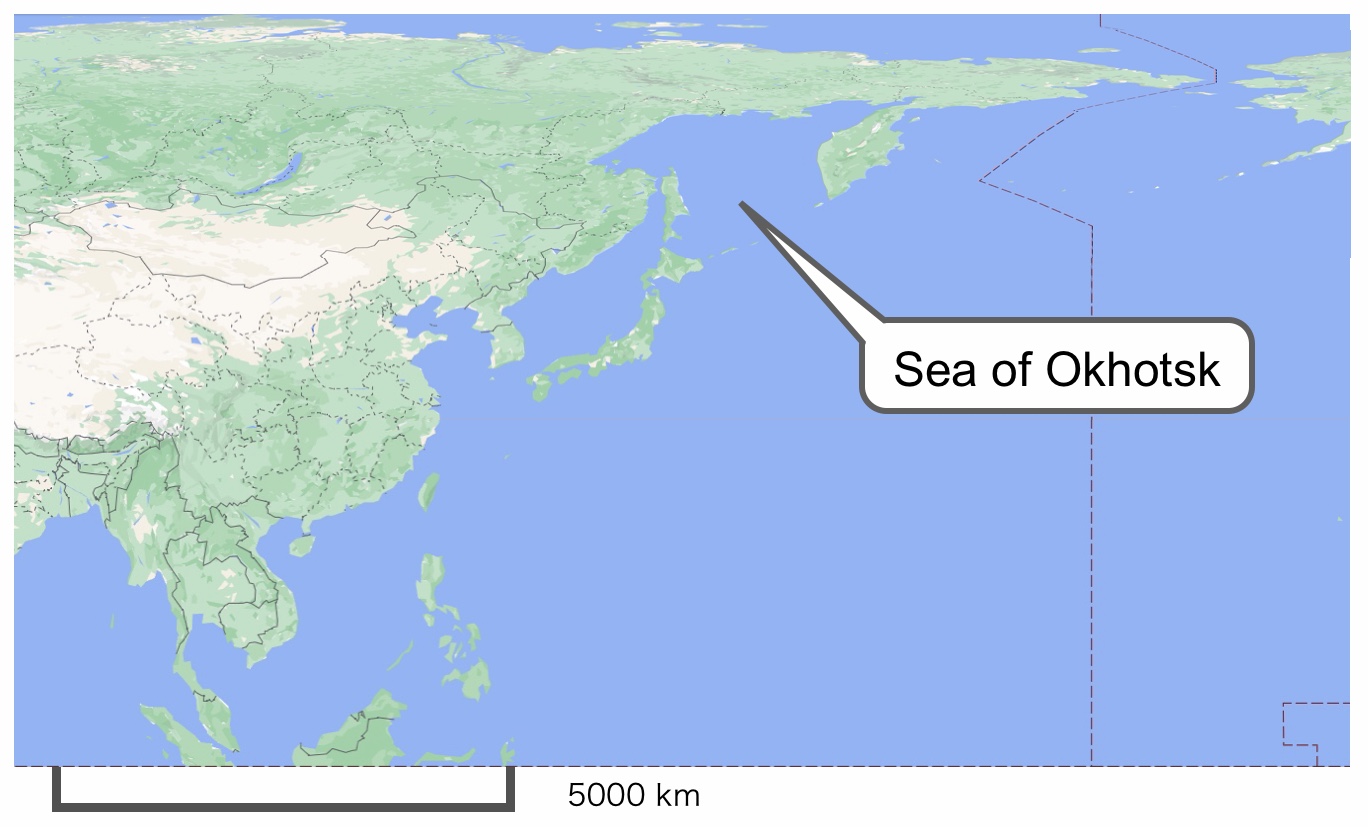
Nevertheless, a male group from the tribe of Ephraim, carrying Y-DNA haplogroup D is believed to have moved east. A portion of the group may have separated and traveled south to the Andaman Islands, while another part could have stayed in Tibet. The remainder of the group moved to the northeast of the Korean Peninsula and then to the west of Hokkaido. There, they assimilated with local women, resulting in a mixed lineage with mitochondrial haplogroups that were mostly local N9b, but also included Mongoloid D and G (from the Sea of Okhotsk region). This group is believed to have moved to Hokkaido around 600 BCE. At that time, the indigenous Japanese population in Honshu carried Y-DNA haplogroup C1a1 and mitochondrial haplogroup M7a.
The tribe of Ephraim then moved to Honshu, Kyushu, and Okinawa, where they mixed with the indigenous Japanese. This group became the Jōmon people. The part of the tribe of Ephraim that stayed in Hokkaido was later called the Ainu.
*Attribution:
https://www.atlist.com/showcase/world-map-with-no-labels
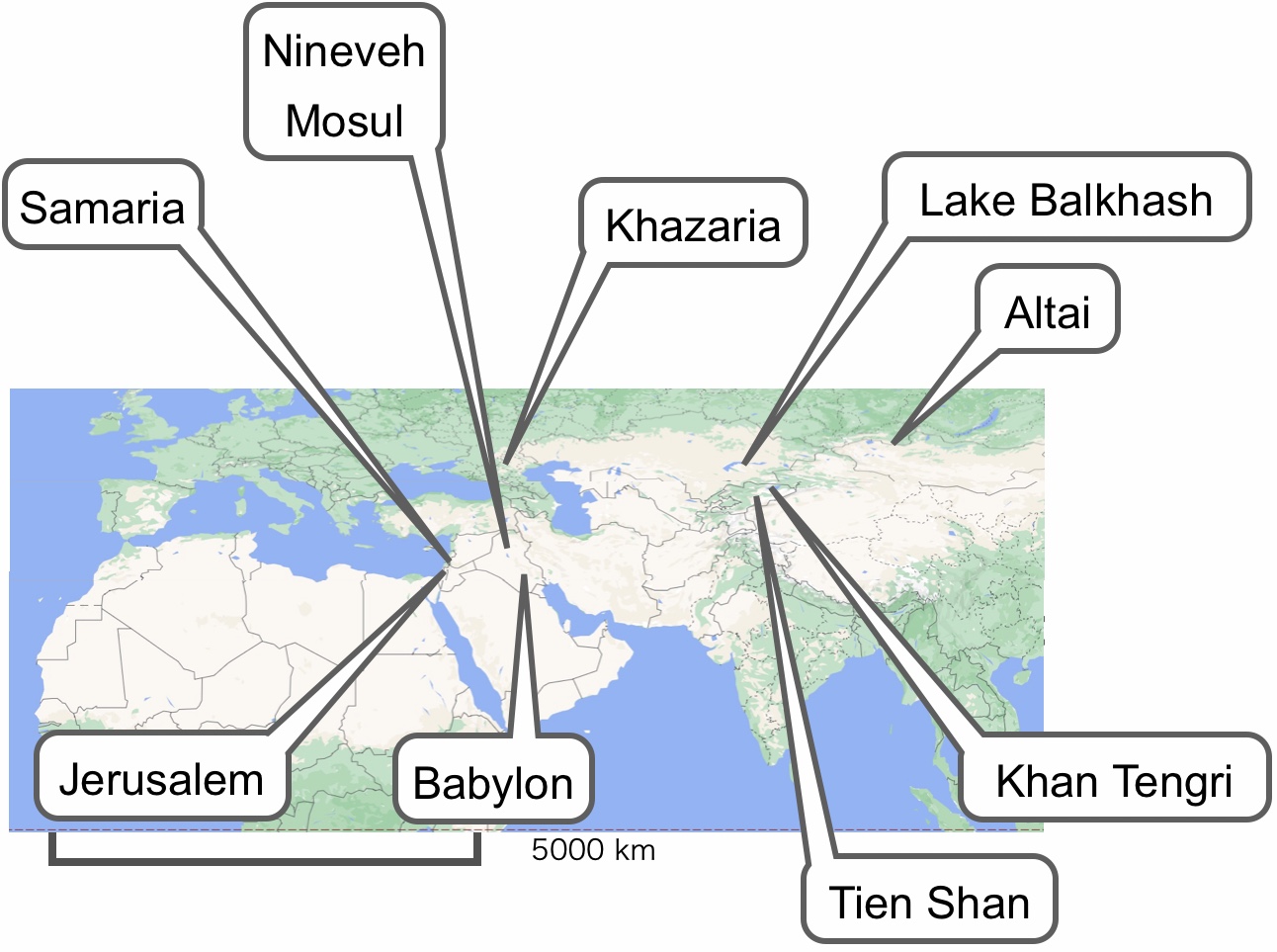
The Kingdom of Judah was destroyed by the Neo-Babylonian Empire in 586 BCE. The people of the Kingdom of Judah were taken to Babylon, but the Neo-Babylonian Empire was destroyed in 539 BCE. A portion of the people of the Kingdom of Judah returned to Jerusalem, while others remained in Babylon or migrated elsewhere.
Around 400 BCE, some tribes from northeastern Asia moved to Kyushu from mainland China and the Korean Peninsula. They came to dominate the western region of Japan and became the Yayoi people, with Y-DNA haplogroup O (mostly Chinese) and mitochondrial DNA haplogroups such as Mongoloid D, Southeast Asian F, and Philippine B4.
The Jōmon people were subsequently pushed into the northeastern regions, such as Hokkaido, or the southwestern regions, such as Okinawa. In the Ainu people of Hokkaido, the frequency of the mitochondrial haplogroup Y from the Sea of Okhotsk region increased, suggesting an increase in women from that area.
Meanwhile, a portion of the tribe of Judah from Babylon slowly moved east, preserving their knowledge of the Hebrew language. The translation of the Septuagint began around 250 BCE in Egypt, and Christianity emerged from 30 CE.
In 431 CE, the Eastern Roman emperor Theodosius II expelled the Nestorians, who opposed the Trinity, through the Council of Ephesus. The Nestorians were exiled to the area of former Assyria and Persia, where they propagated their teachings in China and became known as the Assyrian Church of the East. The Septuagint would have been used by the Nestorians.
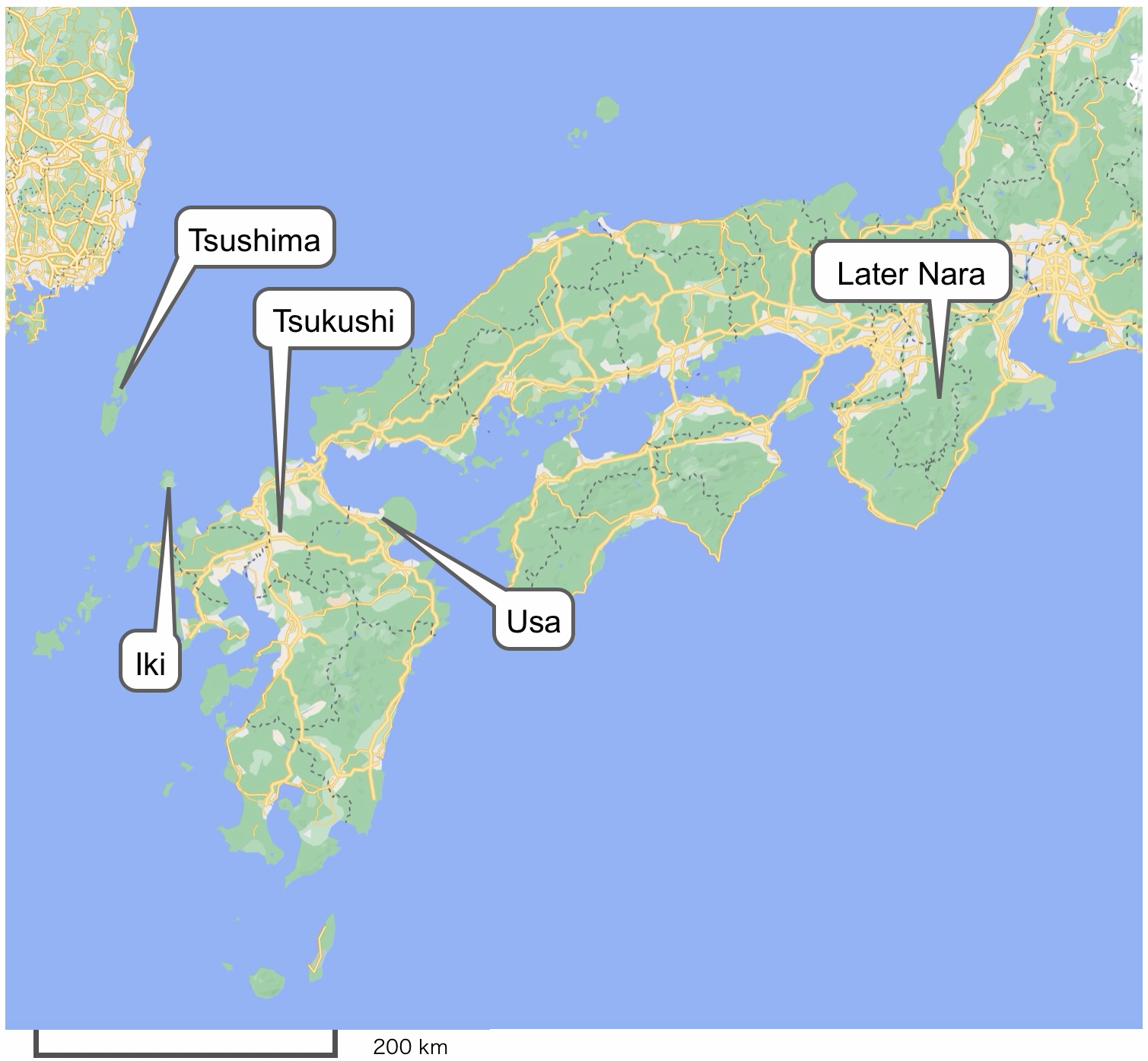
Buddhism was introduced to "Wa" (the country of the Japanese archipelago at the time) around 500 CE. A group from the tribe of Judah, near the Kung-Yueh (弓月) or Gong-Yue area (present-day Kulja as of 2020 CE), obtained the Septuagint, which included the New Testament. They moved slowly east through mainland China, mixing their blood with locals. They reached Usa in Kyushu and called themselves the Hata clan around 600 CE. (The Y-DNA haplogroup of the Hata clan is mostly Chinese O.)
In 607 CE, Tarishihiko of "Wa" sent envoys to the Chinese Emperor, though true identity of Tarishihiko is unclear. Following the envoys, from Tarishihiko, the Chinese emperor dispatched an envoy who reported on the Hata Kingdom around Kyushu around 607 CE. Tarishihiko could have been part of the Hata clan's power base.
*Attribution:
https://www.atlist.com/showcase/world-map-with-no-labels
According to this theory, the Hata clan later defeated "Wa" and founded the new country of Japan around 670 CE. They then created the Japanese religion of Shinto and the religious history book, the Kojiki, based on Judaism. They also established Shinto shrines resembling the Tabernacle. Drawing from the prophecy in Ezekiel 37, a lion representing the tribe of Judah and a unicorn representing the tribe of Ephraim were placed in the shrines. A colleague of the Hata clan was then made emperor.
Based on this historical narrative, the eligibility requirements for the Japanese Emperor could be as follows: the person should be a descendant of David. However, an extremely strict paternal lineage may not be required, as the prophecy in Ezekiel 37 does not explicitly specify a paternal line from David.
*"Again the word of the Lord came to me, saying, 'As for you, son of man, take a stick for
yourself and write on it: "For Judah and for the children of Israel, his
companions." Then take another stick and write on it, "For Joseph, the stick of Ephraim,
and for all the house of Israel, his companions." Then join them one to another for yourself into
one stick, and they will become one in your hand. And when the children of your people speak
to you, saying, "Will you not show us what you mean by these?"- say to them, "Thus says the
Lord God: 'Surely I will take the stick of Joseph, which is in the hand of Ephraim, and the tribes
of Israel, his companions; and I will join them with it, with the stick of Judah, and make them
one stick, and they will be one in My hand.' " And the sticks on which you write will be in your
hand before their eyes. Then say to them, "Thus says the Lord God: 'Surely I will take the
children of Israel from among the nations, wherever they have gone, and will gather them from
every side and bring them into their own land; and I will make them one nation in the land,
on the mountains of Israel; and one king shall be king over them all; they shall no longer be
two nations, nor shall they ever be divided into two kingdoms again. They shall not defile
themselves anymore with their idols, nor with their detestable things, nor with any of their
transgressions; but I will deliver them from all their dwelling places in which they have sinned,
and will cleanse them. Then they shall be My people, and I will be their God. David My servant
shall be king over them, and they shall all have one shepherd; they shall also walk in My
judgments and observe My statutes, and do them. Then they shall dwell in the land that I have
given to Jacob My servant, where your fathers dwelt; and they shall dwell there, they,
their children, and their children's children, forever; and My servant David shall be their prince
forever. Moreover I will make a covenant of peace with them, and it shall be an everlasting
covenant with them; I will establish them and multiply them, and I will set My sanctuary in
their midst forevermore. My tabernacle also shall be with them; indeed I will be their God, and
they shall be My people. The nations also will know that I, the Lord, sanctify Israel, when My
sanctuary is in their midst forevermore' " ' " (Eze 37:15-28).
In addition, for example, though 2 Samuel 7:12-17 predicts that Jesus would descend from David,
even Jesus was not paternal lineage of David,
because Jesus was Yahweh's son, not Joseph's.
Instead, Joachim, the father of Jesus' mother Mary, was purportedly a descendant of David.
*" ' " 'When your days are fulfilled and you rest with your fathers, I will set up your seed after you,
who will come from your body, and I will establish his kingdom.
He shall build a house for My name, and I will establish the throne of his kingdom forever.
I will be his Father, and he shall be My son. If he commits iniquity, I will chasten him with the
rod of men and with the blows of the sons of men.
But My mercy shall not depart from him, as I took it from Saul, whom I removed
from before you. And your house and your kingdom shall be established forever before you.
Your throne shall be established forever.' " '
According to all these words and according to all this vision, so Nathan spoke to David" (2Sa 7:12-17).
*
"Orthodix Church in America Joachim" https://www.oca.org/saints/lives/2020/09/09/102546-holy-and-righteous-ancestors-of-god-joachim-and-anna
Therefore, a requirement for the emperor's lineage would be descent from David, but not necessarily through the paternal line.
However, tracing David's lineage is quite difficult. First, David's Y-DNA haplogroup is hard to specify because, considering Yahweh's obsession with David despite his misdeeds, David could be Yahweh's son, whose Y-DNA haplogroup is unknown. Second, even if we assume David's Y-DNA haplogroup is E (as hypothesized for Jacob), haplogroup E is rarely found in the Japanese population. For these reasons, tracing David's lineage must be abandoned.
Instead, Y-DNA haplogroup D would be a preferable requirement, as it may show a direct association with the tribe of Ephraim.
Additionally, another requirement could be mitochondrial haplogroup M7a. According to Shinto, the Imperial Family is considered noble because they descend from the Shinto goddess Amaterasu. This theory suggests that Amaterasu corresponds to the female extraterrestrial (Eloha) who gave birth to a child with a human male in Hiroshima, Japan. Since mitochondrial haplogroup M7a is almost unique to Japan, it could be a marker of this female extraterrestrial.
*
"Amaterasu on Wikipedia"
https://en.wikipedia.org/wiki/Amaterasu
Return to the Home Page