Disclaimer: This is Untrue.
2.3.9.6 Replacement of the Emperor and Inconvenient Circumstances
2.3.9.6.1 Replacement of the Emperor
2.3.9.6.1.1 Southern Dynasty Toranosuke Theory
2.3.9.6.1.1.1 Background
As mentioned previously, the Japanese Imperial House could have a legitimate lineage descending from David, as prophesied in Ezekiel as the rulers of a unified kingdom. However, clear evidence of this bloodline is not readily available.
Additionally, a theory has been rumored that Emperor Meiji, who was enthroned in 1868 CE, may have been unrelated to the imperial bloodline. If this theory were true, the imperial succession of subsequent emperors (Taisho, Showa, Heisei, and Reiwa) would be considered baseless.
In contrast, another theory claims that Emperor Meiji was a deliberate fabrication—a "fake emperor" created by the real emperor to deceive foreign powers and protect both the genuine Japanese emperors and the Japanese religion of Shinto.
The context for this theory is as follows.
2.3.9.6.1.1.2 Chaos in the Last Days of the Tokugawa Shogunate
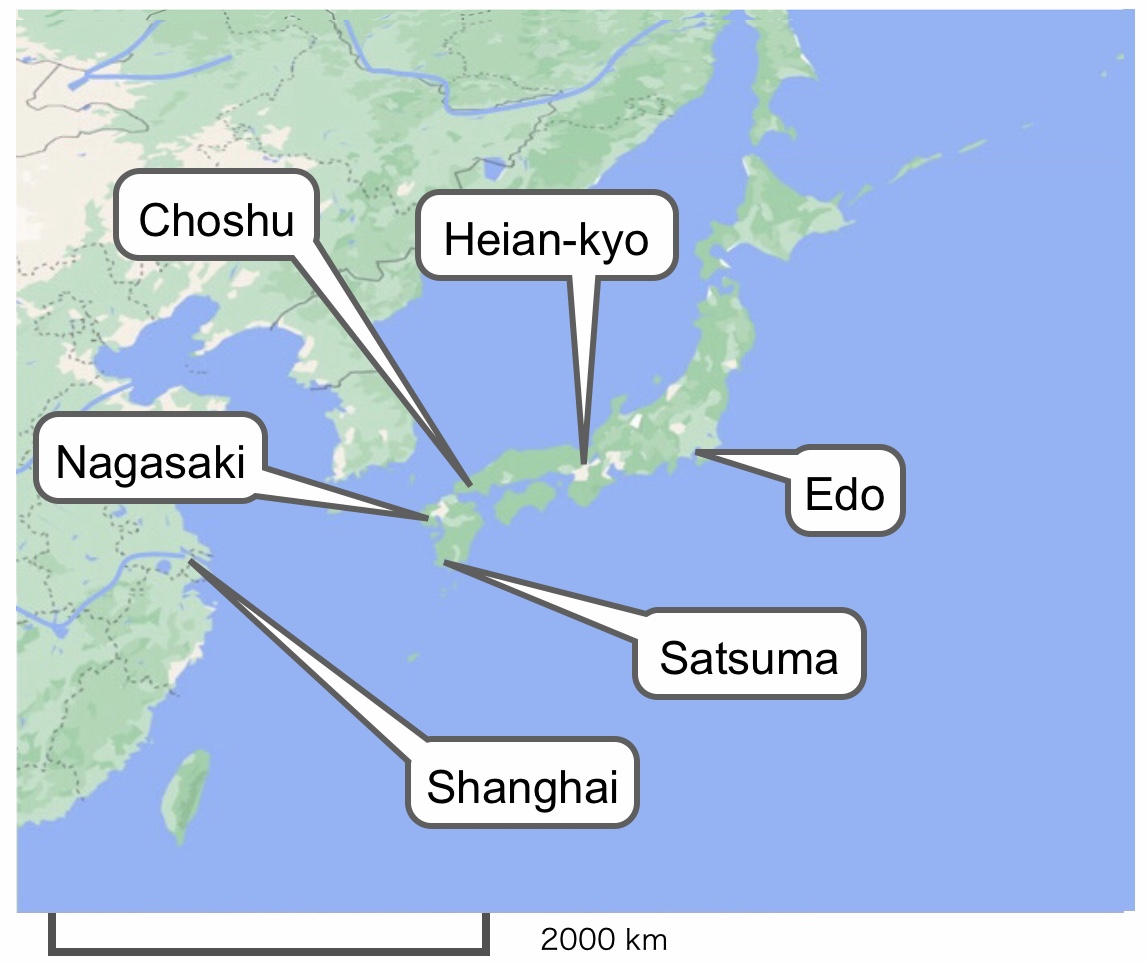
In Japanese history, the emperors and the imperial family are believed to have begun ruling Japan around 700 CE. Imperial power established the city of Heian-kyō (later known as Kyoto) in 794 CE and was based there. Over many years, however, the emperors and the imperial family became merely formal rulers (sovereigns) based on the Shinto religion, while military rulers, titled "Shogun," became the de facto rulers.
Before the reunification of 1603 CE by the Tokugawa clan, the clan served as the leader of the eastern powers, based in Edo (later Tokyo). The Mōri clan, a leader of the western powers, governed eight provinces from their base in Aki Province (later Hiroshima).
The eastern powers ultimately won the great battle, and the Tokugawa Shogunate began its rule from Edo in 1603 CE. Due to the Tokugawa clan's generosity, the Mōri clan survived but was confined to the Chōshū Domain (later Yamaguchi), which consisted of Nagato and Suō provinces. The Chōshū clan was treated with hostility by the Shogunate.
The Tokugawa Shogunate then adopted a closed-door policy, largely excluding guns and other weapons, except for swords, to prevent civil wars.
*Attribution:
https://www.atlist.com/showcase/world-map-with-no-labels

*Attribution:
https://en.wikipedia.org/wiki/Su%C5%8D_Province
However, in 1853 CE, Commodore Matthew C. Perry's fleet of the U.S. Navy, armed with 73 cannons, arrived near Edo. Perry demanded diplomatic and commercial relations, backed by military force. Recognizing the situation, the Tokugawa Shogunate agreed to the relations and a partial opening of the country, which was soon followed by other foreign powers like Britain.
Meanwhile, Emperor Kōmei (孝明) called for the expulsion of foreigners and opposed opening the country, leading to a conflict between the emperor and the Tokugawa clan.
Some warriors from the Chōshū Domain, who had been treated with hostility by the Tokugawa, seized this opportunity. Under the pretext of supporting the emperor and expelling the foreigners, they began to advocate for the emperor's authority, while in reality, they sought to increase their own power.
To reconcile the Imperial Court and the Shogunate, the Tokugawa clan pleaded with the emperor to allow his younger sister, Princess Kazu, to marry the 14th Shogun, Tokugawa Iemochi. Princess Kazu moved to Edo and married Iemochi in 1861 CE, beginning the reconciliation. However, Kōmei requested that the Tokugawa clan strengthen its military and begin expelling foreigners by 1863 CE. The Shogunate reluctantly agreed.


The political climate was ripe for conflict.
The Shimazu clan of the Satsuma Domain was originally a close ally of the Tokugawa clan; an adopted daughter of the Shimazu clan even became the queen consort of the 13th Shogun. However, when some Shimazu warriors accidentally provoked the British Navy, the British retaliated with a severe attack on the Satsuma Domain in 1863 CE. This incident made the Shimazu clan acutely aware of the power of foreign fleets.
Meanwhile, the Chōshū warriors continued to advocate for the expulsion of foreigners under the pretense of supporting the emperor. They even went so far as to attack foreign ships.
Gradually, Emperor Kōmei recognized the reality of the situation and agreed to a partial opening of the country. He subsequently allied with the Tokugawa and Satsuma clans, turning against the Chōshū warriors. The Chōshū warriors were then expelled from Heian-kyō by the combined forces of the Tokugawa and Satsuma clans, supported by the emperor. This put the Chōshū warriors at a disadvantage. Their domain was also attacked by foreign fleets in 1864 CE in retaliation for their earlier actions.
In the meantime, the American Civil War ended in 1865 CE, and surplus firearms were gathered in Shanghai by the Rothschilds' Jardine Matheson & Company. Both the Satsuma and Chōshū clans, now realizing that an alliance with foreign powers was necessary for their survival, allied with each other and purchased weapons from Jardine Matheson in Nagasaki.
On the other hand, Iwakura Tomomi, a court noble who was hostile to the Tokugawa clan, had been a key figure in Emperor Kōmei's court. When Emperor Kōmei sided with the Tokugawa, it put Iwakura in an unfavorable position. In 1867 CE, the seemingly healthy Emperor Kōmei suddenly died. His son, Mutsuhito (睦仁), was reportedly born in 1852 CE.
Ultimately, the Chōshū and Satsuma warriors, armed with new weapons from Jardine Matheson, raised an army in 1868 CE. Iwakura joined their cause, and they declared that the new 16-year-old emperor, Mutsuhito, was their ally and displayed an imperial flag. The Tokugawa clan abandoned the battle to avoid a civil war.
In 1868 CE, the Chōshū, Satsuma, and Iwakura Tomomi (who had once been a devoted servant to Emperor Kōmei) established a new government authorized by the new emperor, Emperor Meiji (Mutsuhito). The imperial residence was moved from Heian-kyō to Edo (Tokyo).
Later, Princess Kazu (by then a widow) sometimes requested to meet her nephew, Emperor Meiji, but the new government refused the meetings. Princess Kazu died in 1877 CE. Another account, however, rumored that the government eventually permitted her visit, but she was attacked and died on her way there.

Emperor Meiji
*
"Shogun on Wikipedia"
https://en.wikipedia.org/wiki/Shogun
*
"Tokugawa Shogunate on Wikipedia"
https://en.wikipedia.org/wiki/Tokugawa_shogunate
*
"Sakoku on Wikipedia"
https://en.wikipedia.org/wiki/Sakoku
*
"Perry Expedition on Wikipedia"
https://en.wikipedia.org/wiki/Perry_Expedition
*
"Emperor Komei on Wikipedia"
https://en.wikipedia.org/wiki/Emperor_Kōmei
*
"Princess Kazu on Wikipedia"
https://en.wikipedia.org/wiki/Princess_Kazu
*
"Tokugawa Iemochi on Wikipedia"
https://en.wikipedia.org/wiki/Tokugawa_Iemochi
*
"Tensho-in on Wikipedia"
https://en.wikipedia.org/wiki/Tenshō-in
2.3.9.6.1.1.3 Outline of the Southern Dynasty
Looking back on history, a plausible theory is that during the Meiji Restoration, a lineage from the Southern Dynasty of Japan was used to take control of the country. This theory suggests that Emperor Meiji was not the son of Emperor Kōmei, but rather a descendant of the Southern Dynasty.
The details of the Southern Dynasty can be explained as follows.
Successors to the Japanese throne were historically decided in various ways, such as by the will of the former emperor, or through succession by the eldest son, a younger brother, or another relative. However, the period from approximately 1336 to 1392 CE was particularly chaotic.
According to formal history, the 88th emperor was Go-Saga (後嵯峨; 1242 – 1246 CE). He was succeeded by his older son, the 89th emperor, Go-Fukakusa (後深草; 1246 – 1260 CE), and then by Go-Saga's younger son, the 90th emperor, Kameyama (亀山; 1260–1274 CE).
Descendants of Go-Fukakusa and Kameyama subsequently competed for the throne. The conflict escalated when Kameyama's grandson, the 96th emperor, Go-Daigo (後醍醐; 1318–1339 CE), declared that the throne should be succeeded exclusively by his descendants. Emperor Go-Daigo held the Sacred Treasures of Shinto.
At this time, the warrior Kusunoki Masashige (楠木 正成) was a staunch supporter of Go-Daigo, but he died in 1336 CE. With his military power weakened, Go-Daigo and his clan fled to a southern area known as Yoshino.
Meanwhile, Go-Fukakusa's descendants also claimed legitimacy to the throne. This led to the coexistence of two rival thrones: Go-Daigo's Southern Dynasty and Go-Fukakusa's Northern Dynasty.
Eventually, a reconciliation was arranged between the two factions in 1392 CE. The agreement stipulated that the Southern Dynasty was the legitimate lineage during the split, that the throne would be alternated between the two dynasties, and that the Sacred Treasures of Shinto would be returned to the emperors. Go-Komatsu of the Northern Dynasty became the 100th emperor, and the Sacred Treasures were returned to him.
However, because the Southern Dynasty lacked military power, the throne after the 100th emperor was exclusively succeeded by the Northern Dynasty. The Southern Dynasty protested this violation of the agreement but was ultimately defeated and expelled around 1473 CE. The whereabouts of the Southern Dynasty's descendants became unknown thereafter.

*Attribution:
"Emperor Go-Saga on Wikipedia"
https://en.wikipedia.org/wiki/Emperor_Go-Saga
"Emperor Go-Fukakusa on Wikipedia"
https://en.wikipedia.org/wiki/Emperor_Go-Fukakusa
"Emperor Go-Daigo on Wikipedia"
https://en.wikipedia.org/wiki/Emperor_Go-Daigo

Kusunoki Masashige
*Attribution:
"Kusunoki Masashige on Wikipedia"
https://en.wikipedia.org/wiki/Kusunoki_Masashige
However, a later lineage story of the Southern Dynasty can be inferred from a few historical records.
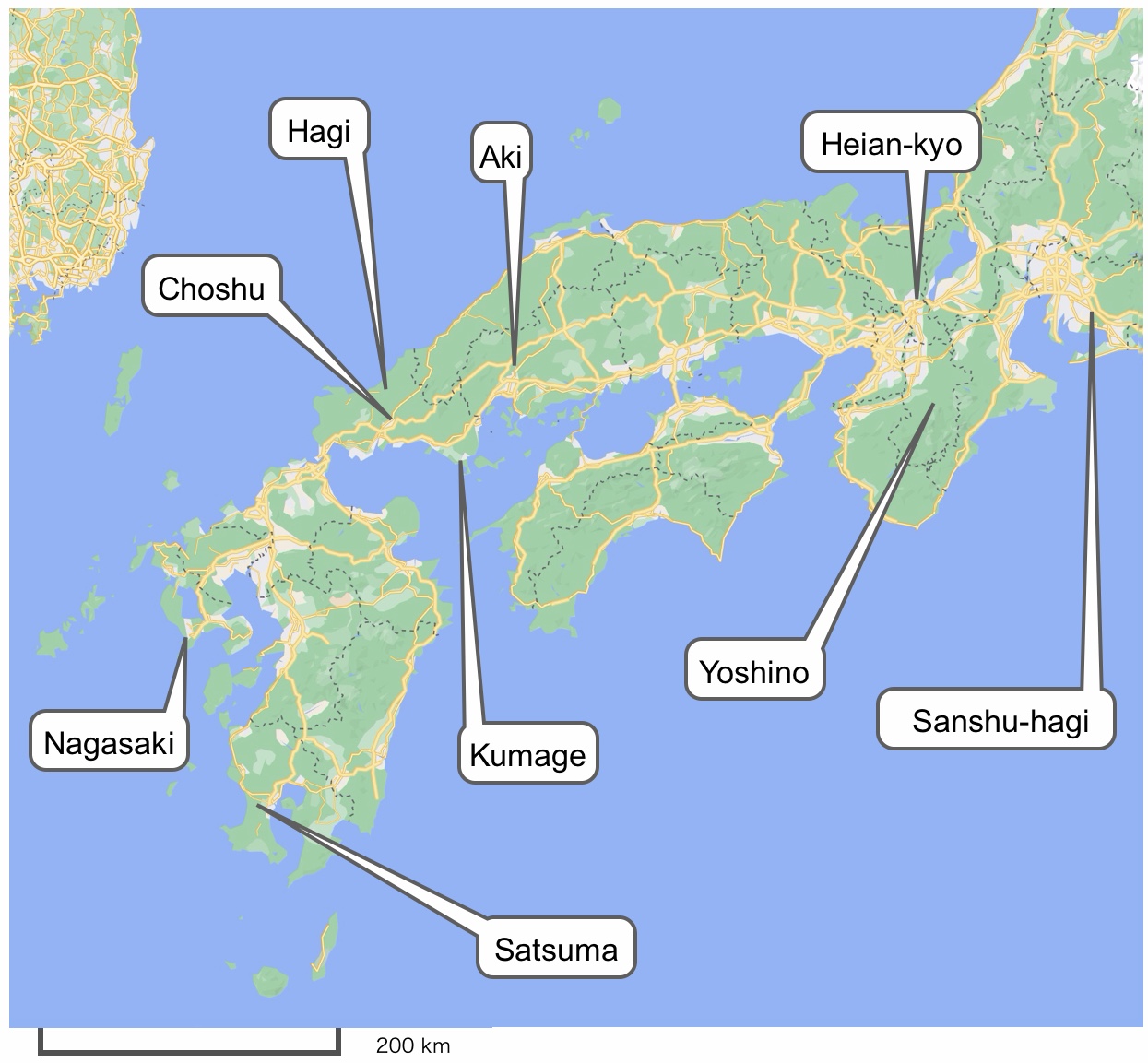
Some descendants of the Southern Dynasty are believed to have moved to the Sanshu-hagi (三州萩) area. They then moved to the western region of Honshu, supported by the Mōri (毛利) clan, which governed the western provinces of Honshu, including Aki (安芸), Suō (周防), and Nagato (長門).
These descendants survived in the northwestern part of the Mōri clan's territory, Nagato. Supported by the Mōri clan, the area was reportedly named Hagi (萩), after their first destination, "Sanshu-hagi." The descendants later moved to Kumage (熊毛) in Suō and declared themselves the Ōmuro (大室) lineage.
2.3.9.6.1.1.4 Detailed Circumstances of the Characters
Itō Hirobumi (伊藤 博文), who would later become the first Prime Minister of Japan, was
born in Kumage in 1841 CE. In 1857 CE, he was recommended to study at Yoshida Shōin's Shōkasonjuku Academy in Hagi.
After his studies at the academy, he was supported by Thomas Glover in Nagasaki and Hugh Matheson in Britain to study abroad in Britain as one of the Chōshū Five in 1863 CE. Upon returning to Japan, he joined the Kiheitai, a volunteer militia of Chōshū. Ōmuro Toranosuke (大室 寅之祐), a boy from the Ōmuro lineage, also joined this militia.

Shokasonjuku Academy
*Attribution:
"Shokasonjuku Academy on Wikipedia"
https://en.wikipedia.org/wiki/Shōkasonjuku_Academy
*Attribution:
https://www.atlist.com/showcase/world-map-with-no-labels
*
"Mori Clan on Wikipedia"
https://en.wikipedia.org/wiki/Mōri_clan
*
"Suo Province on Wikipedia"
https://en.wikipedia.org/wiki/Suō_Province
*
"Nagato Province on Wikipedia"
https://en.wikipedia.org/wiki/Nagato_Province
*
"Hagi, Yamaguchi on Wikipedia"
https://en.wikipedia.org/wiki/Hagi,_Yamaguchi
*
"Ito Hirobumi on Wikipedia"
https://en.wikipedia.org/wiki/Itō_Hirobumi
*
"Choshu Five on Wikipedia"
https://en.wikipedia.org/wiki/Chōshū_Five
*
"Kiheitai on Wikipedia"
https://en.wikipedia.org/wiki/Kiheitai
A controversial picture, reportedly taken in Nagasaki around 1865 CE, has drawn significant attention. The photograph features missionary Guido Verbeck, his son, and 44 Japanese men.
The picture is highly debated because the 44 men bear a striking resemblance to key figures of the later Meiji Restoration who opposed the Tokugawa clan. For instance, the man with the solid physique in black clothes standing behind the center is believed to be Saigō Takamori. (Saigō was known for his solid build, but to avoid assassination, he famously didn't sit for official portraits or photographs.) The fourth man to the left of Saigō, dressed in light clothes, is thought to be Itō Hirobumi.
The central person seated at the front, holding a sword on his left shoulder, is remarkably similar to the later Emperor Meiji and is thus presumed to be Ōmuro Toranosuke. Possible sons of Iwakura Tomomi can also be seen in the picture. This has led to the theory that the photo is a group portrait of revolutionary warriors surrounding Ōmuro, their key figure.
In addition, later in his reign, Emperor Meiji declared that the Southern Dynasty was the orthodox line in the Southern and Northern Courts controversy, despite Emperor Kōmei officially descending from the Northern Dynasty. Furthermore, Emperor Meiji later commissioned the construction of a statue of Kusunoki Masashige near the Imperial Palace.
Another piece of supporting evidence comes from Ōmuro Chikasuke (大室近佑; born 1904 CE), who claimed in Kumage that Ōmuro Toranosuke was indeed Emperor Meiji. Chikasuke's grandfather was Toranosuke's younger brother.
According to this theory, Iwakura Tomomi and Itō Hirobumi allegedly assassinated both Emperor Kōmei and Prince Mutsuhito, replacing the prince with Ōmuro Toranosuke. They then moved the Imperial Palace from Heian-kyō to Edo (Tokyo) to conceal the replacement, ensuring that Emperor Kōmei's acquaintances in Heian-kyō were kept away from the new Emperor Meiji. The true identity of Emperor Meiji is believed to be Ōmuro Toranosuke, a possible descendant of the Southern Dynasty, though the details of this lineage remain unclear.

Verbeck Picture
*
"Guido Verbeck on Wikipedia"
https://en.wikipedia.org/wiki/Guido_Verbeck
*
"Saigo Takamori on Wikipedia"
https://en.wikipedia.org/wiki/Saigō_Takamori
*
"Iwakura Tomomi on Wikipedia"
https://en.wikipedia.org/wiki/Iwakura_Tomomi

Statue of Kusunoki Masashige
2.3.9.6.1.2 The Jike Stepson Theory
In 2003 CE, a Japanese man named Jike Yasuo (地家やすお) sent an email to a private researcher of Japanese conspiracies, claiming to be a great-great-grandson of Emperor Meiji's brother.
According to his theory, Emperor Meiji was in fact Ōmuro Toranosuke from Tabuse, but Toranosuke was not an Ōmuro by blood. Instead, his biological father was a commoner named Jike Sakuzō (地家 作蔵),
meaning Toranosuke had no connection to the imperial bloodline.
According to Jike, Sakuzō was born around 1824 CE. He was a commoner with no
surname who made a living in the shipping industry in Tabuse (田布施), Kumage (熊毛), Suō. He owned two ships, employed more than ten workers, and transported construction materials to Ehime (60 km to the southeast) and sometimes to Osaka (400 km to the east).
Meanwhile, the Kōshōji (興正寺) family, a Buddhist temple faction (the name literally means "generating righteous temple"), resided at Saienji Temple (西円寺) in Ogō (麻郷), Tabuse. Sueko was a daughter of the Kōshōji family.
Sakuzō and Kōshōji Sueko (興正寺 基子; 1832 - 1855 CE) were married around 1846 CE.
Their daughter was born in 1847 CE.
Sakuzō built his house around 1849 CE in the Jike (地家) area of Ogō, Tabuse. He named himself Jike after the location.
Their first son, Torakichi (寅吉), was born in 1850 CE and was originally named Jike Torakichi.
Their second son, Shōkichi (庄吉), was born in 1852 CE.
Their third son was born in February 1854 CE. Jike Yasuo claims to be a
great-great-grandson of this third son.
Sakuzō and Sueko divorced around May 1854 CE. Sueko cared for Torakichi and Shōkichi,
while Sakuzō raised their daughter and third son. In October 1854 CE, Sueko remarried Ōmuro Yahē (大室 弥兵衛). Her two sons became his stepsons, taking on the names Ōmuro Torakichi and Ōmuro Shōkichi. Torakichi's name was later changed to Ōmuro Toranosuke (大室 寅之祐).
*
"Tabuse on Wikipedia"
https://en.wikipedia.org/wiki/Tabuse
*
"興正寺 on Wikipedia"
https://ja.wikipedia.org/wiki/興正寺
*
"麻郷 on Wikipedia"
https://ja.wikipedia.org/wiki/麻郷村
*
"Temple View Tabuse"
https://otera-ichiran.com/otera-yamaguchiken-kumageguntabusecho20/

The Jike (地家) area is a triangular region, approximately 400 meters by 600 meters, located to the east of the road marked as "Shūnan Wide-Area Agricultural Road" (周南広域農道) and to the southwest of Ogō (麻郷).
The present-day town of Tabuse in Kumage District, Yamaguchi Prefecture, (as of 2020 CE) is
a land of mystery. As of 2020 CE, it is a sparsely populated town in Yamaguchi Prefecture, and this was also the case during the late Edo period and the Meiji Restoration.
However, this small town is the hometown of several major historical figures, including the aforementioned Emperor Meiji and the first Prime Minister, Itō Hirobumi, as well as later Prime Ministers Kishi Nobusuke and Satō Eisaku. As will be discussed later, Kishi Nobusuke was released by Rockefeller after World War II and became an operative to place Japan under the control of Koreans. It is unclear whether this is related to the unique character of Tabuse, as the connection between this area and Korean forces remains unknown.
2.3.9.6.2 Emperors after Emperor Meiji
2.3.9.6.2.1 Yoshihito, Emperor Taishō
Yoshihito (1879 - 1926 CE), who became Emperor Taishō, was, on paper, the eldest son of
Emperor Meiji. However, because he opposed the military's acceptance of bribes and its
push for war, he was reportedly assassinated.
*
"Emperor Taisho on Wikipedia"
https://en.wikipedia.org/wiki/Emperor_Taishō
2.3.9.6.2.2 Hirohito, Emperor Shōwa
The Emperor of Japan in 1945 CE, when the atomic bomb was dropped, was Hirohito (1901 - 1989 CE), Emperor Shōwa, who was, on paper, the eldest grandson of Emperor Meiji.

Emperor Showa, Hirohito and Empress Kojun
*Attribution:
https://ja.wikipedia.org/wiki/ファイル:Emperor_Showa_%26_Empress_Kojun_1956-11.jpg
*
"Hirohito on Wikipedia" http://en.wikipedia.org/wiki/Hirohito
According to Raël, 1945 CE marked the 666th generation of humankind on Earth.
2.3.9.6.2.3 Akihito, Emperor Heisei
The first son of Hirohito, on paper, is Akihito (1933 - 2020 CE), Emperor Heisei.
A controversial aspect of Emperor Heisei's reign is the establishment of the Kodomonokuni (Children's Land) theme park, which was founded to commemorate his marriage in 1959 CE. The park, which was soon constructed, has been a subject of suspicion regarding child kidnapping.
He abdicated the throne in 2019 CE.

Emperor Heisei, Akhito
*Attribution:
https://en.wikipedia.org/wiki/File:Emperor_Akihito_199011_1.jpg

Emperor Heisei, Akhito
*Attribution:
https://en.wikipedia.org/wiki/File:Emperor_Akihito_198901.jpg
*
"Kodomonokuni Theme Park on Wikipedia"
https://en.wikipedia.org/wiki/Kodomonokuni_Theme_Park
*
"Akihito on Wikipedia"
https://en.wikipedia.org/wiki/Akihito
2.3.9.6.2.4 Naruhito, Emperor Reiwa
The first son of Akihito, on paper, is Naruhito (1960 - 2020 CE), who ascended the throne in 2019 CE, becoming Emperor Reiwa.
The second son of Akihito, on paper, is Fumihito, Prince Akishino (born 1965 CE). The youngest child of Akihito, on paper, his first daughter, is Sayako (born 1969 CE). The parentage of Fumihito and Sayako is a subject of controversy.

Emperor Reiwa, Naruhito
Attribution:
https://en.wikipedia.org/wiki/File:Emperor_Naruhito_(cropped).jpg
*Attribution:
https://ja.wikipedia.org/wiki/ファイル:Court_Banquets_after_the_Ceremony_of_the_Enthronement2019(1).png
*
"Naruhito on Wikipedia"
https://en.wikipedia.org/wiki/Naruhito
*
"Fumihito, Prince Akishino on Wikipedia"
https://en.wikipedia.org/wiki/Fumihito,_Prince_Akishino

Naruhito and Masako
Chisso Corporation, a Japanese chemical company founded in 1908 CE, originated with carbide products. In 1932 CE, Chisso began producing acetaldehyde using a mercury catalyst at its Minamata plant in Kumamoto Prefecture, in western Japan. The plant continuously discharged wastewater, primarily containing mercury, into Minamata Bay, where it accumulated in fish and shellfish. As residents around the bay unknowingly consumed these contaminated marine animals, mercury built up in their bodies. A strange disease was first reported in 1956, and Kumamoto University began an investigation into its cause. While Chisso vehemently opposed and denied it, mercury started to be suspected.
Egashira Yutaka (江頭 豊; 1908 - 2006 CE)
was a staff member at the Industrial Bank of Japan. His daughter, Egashira Yumiko, married a Japanese diplomatic official, Owada Hisashi. Using his background at the Industrial Bank of Japan, Egashira Yutaka served as Chisso's president from 1964 to 1971 CE and as its chairman of the board from 1971 to 1973 CE. Meanwhile, Fukuda Takeo (1905 - 1995 CE), who will be discussed later as an operative of the former Korean Yi clan, became Japan's Minister of Foreign Affairs in 1971 CE. Owada Hisashi, a foreign ministry official, developed a close relationship with Fukuda. Masako (born in 1963 CE) was the daughter of Ikeda Daisaku and was raised as Owada Masako.
*
"Industrial Bank of Japan on Wikipedia"
http://en.wikipedia.org/wiki/Industrial_Bank_of_Japan
*
"Hisashi Owada on Wikipedia" http://en.wikipedia.org/wiki/Hisashi_Owada
Minamata disease is a neurological syndrome caused by mercury poisoning, leading to ataxia, numbness, and in severe cases, insanity, crippled paralysis, coma, and death. Fetal deformities were especially serious. In 1968 CE,
Kumamoto University and the government concluded that Minamata disease was a central nervous system disorder caused by mercury from contaminated fish and shellfish in Minamata Bay.
Victims began demanding compensation from Chisso, but the company and Egashira Yutaka refused to provide adequate compensation, even resorting to threats in league with a Japanese organized crime group (Yakuza). W. Eugene Smith, an American photojournalist, intended to publish photos of Minamata but was attacked by Chisso's thugs near Tokyo in 1972 CE. Although his sight in one eye was damaged, he published his photos, including the famous work, "Tomoko Uemura in Her Bath" (1972 CE), which depicted a severely deformed girl and raised public awareness of the disease.
Civil lawsuits against Chisso began in 1969 CE, and a criminal trial started in 1976 CE (concluding in 1988 CE). Chisso, Egashira Yutaka, and Owada Hisashi plotted to reduce their liability by approaching the Imperial House. Owada, a diplomatic official, arranged a meeting between Crown Prince Naruhito and his daughter Masako. Masako gained admission to Harvard College through her father's connections. Subsequently, she entered the University of Tokyo and the Ministry of Foreign Affairs, also with the help of personal connections.
At the time, Crown Prince Naruhito, who was registered at Oxford University, privately toured Europe and visited Colmar, northeastern France, in 1984 CE. Masako suddenly appeared in Colmar and accompanied him. In 1986 CE, Masako unexpectedly appeared at a reception for Spain's Princess Infanta Elena in Tokyo and approached Naruhito. Rumors spread that Masako was the top candidate to be the next crown princess. However, Emperor Shōwa opposed the engagement, knowing of Egashira's involvement.
Emperor Shōwa passed away in 1989 CE. Subsequently, Naruhito and Masako married in 1993. Chisso and the Owada family succeeded in reducing criticism against Chisso. However, some people noticed the underlying circumstances, and criticism of Masako arose instead. Feigning a mental illness, Masako began to withdraw from public life, staying inside the palace or imperial villas. For over 20 years, anonymous statements from an alleged medical team have been released annually, but the names of the doctors on this team remain unknown to the public. The illness is therefore believed to be a fabrication.
2.3.9.6.3 Emperor Kōmei's Conspiracy Theory
The stories mentioned above suggest that Emperor Kōmei and his son Mutsuhito were assassinated and replaced by Ōmuro Toranosuke,
who may have been a descendant of the Southern Dynasty or, alternatively, had no connection to the imperial lineage at all.
However, another theory exists. This theory posits that Emperor Meiji was a "fake emperor," deliberately created by the real Emperor Kōmei to deceive foreign
powers and protect both the genuine Japanese
emperors and the Shinto religion. This speculation further suggests that all Emperors residing in Tokyo since the Meiji era are illegitimate, as are a substantial portion of the Imperial Family members living in Tokyo.
This idea is supported by rumors surrounding a man with the pseudonym Kibi Uzumasa (吉備太秦) and a secret organization in Kyoto called the "Kyoto Imperial Line Association Yatagarasu" (京都皇統 八咫烏協会).
The Yatagarasu is a three-legged crow from the Kojiki that is said to have guided Emperor Jimmu and his followers, much like Joshua guiding Moses and his followers in Exodus. Kibi Uzumasa is reportedly a member of the Hata (秦) clan who was raised in Okayama Prefecture. The name "Kibi" (吉備) is the old name for Okayama.
As of 2020, Kibi Uzumasa is rumored to serve the Imperial Family in Tokyo and is often associated with the secret organization, the Kyoto Yatagarasu. This organization is said to be connected to the true imperial power in Kyoto. According to this theory, even though the Imperial Family in Tokyo is a fabricated entity, a man who serves them could be linked to the real imperial power in Kyoto.
This suggests that the "fake" imperial family in Tokyo is sanctioned by the genuine imperial power in Kyoto because it serves a convenient purpose. The theory concludes that Emperor Kōmei and his retainers faked his death to deceive foreign powers and protect the religious traditions of the true imperial line in Kyoto.
*
"Three-legged Crow on Wikipedia"
https://en.wikipedia.org/wiki/Three-legged_crow
*
"Joshua on Wikipedia"
https://en.wikipedia.org/wiki/Joshua
As for the identity of this real imperial line in Kyoto as of 2020 CE, there are several speculative theories.
One theory suggests that Horikawa Tatsukichirō (1891 - 1966 CE), a representative of the true imperial lineage, was born in Kyoto in 1891 CE near the former Imperial Palace. He claimed that he was adopted by the Horikawa family of Fukuoka shortly after his birth. Later, he worked to support the prosperity of the Asian region, helping Sun Yat-sen succeed in the Xinhai Revolution until 1912 CE. It was also rumored that he was Ōmuro Toranosuke's illegitimate son.

Horikawa, the youngest man, front row, toward the left
*
"Horikawa Tatsukichiro on Wikipedia"
https://ja.wikipedia.org/wiki/堀川辰吉郎
Another theory, however, claims that Horikawa Tatsukichirō is not part of the real imperial lineage in Kyoto.
A third guess is Fumihito, Prince Akishino (born 1965 CE), due to the controversial nature of his parentage.
Return to the Home Page