Disclaimer: This is Untrue.
2.4.3 Europe After the Discovery of the Americas and the Rise of the Rothschilds
2.4.3.1 Overview
At the time of Columbus's discovery of the Americas, Europe was characterized by the expanding influence of the Catholic House of Habsburg, even as conflicts between Catholic and non-Catholic powers drove progress.
(The Habsburgs' matrimonial strategy established a rigid social convention across Europe and Western-oriented Russia, dictating that royalty and high nobility must only marry their social equals. This practice reinforced the existing power structures of the ruling class, resulting in a vast, interconnected web of kinship that linked nearly every royal house from Western Europe to Western-oriented Russia.)
Amidst this backdrop, the Society of Jesus (Jesuits) was formed, and on the island of Britain, England and Scotland were unified.
Following these developments, Freemasonry and the rise of the Rothschild family marked the next era of influence.
2.4.3.2 Details
2.4.3.2.1 Background Knowledge for European History After 1490 CE
2.4.3.2.1.1 Introduction
In the region corresponding to present-day France and Germany (as of 2020 CE), the Western Roman Empire was overthrown in 476 CE by the Germanic military leader Odoacer.
The Germanic Franks, who had settled primarily along the Rhine River, filled the resulting power vacuum. They established the Frankish Kingdom, with its history defined by two successive Germanic-descended dynasties, the Merovingian Dynasty (until 751 CE) and the Carolingian Dynasty (751 CE - 987 CE).
This enduring dominance by a Germanic lineage provided the foundational structure for the future nations of France and Germany.
2.4.3.2.1.2 the Holy Roman Empire
The Eastern Roman Empire, however, survived. As the 7th century (the 600s) began, reforms under Emperor Heraclius and the incursions of Islamic forces led to a profound transformation. The official language shifted to Greek, and the military and administrative structures were reorganized. This resulted in a state that exhibited distinct Byzantine characteristics. This entity, also known as the Byzantine Empire, endured until its fall in 1453 CE.
In 843 CE, the Frankish Kingdom was partitioned by the Treaty of Verdun into the East Frankish Kingdom, West Frankish Kingdom, and Middle Francia.
Out of the East Frankish Kingdom, the Ottonian dynasty emerged. Its ruler, Otto I, was crowned "Roman Emperor" by the Pope in 962 CE, reviving the authority of the Ancient Roman Empire's successor state. This state would later be termed the Holy Roman Empire since around 1150 CE.
In reality, however, the Emperor's direct control was limited; the Empire was effectively a confederation of princes who governed their own territories.
The Emperor's power was weak, and the position was maintained through
an electoral system, with the Emperor being chosen by powerful nobles called the Prince-Electors (Kurfürsten).
2.4.3.2.1.3 The Rise of the Habsburgs and the "Habsburg Ring"
The Habsburgs originated as minor lords in the Alsace-Swiss region (northwest Alps), named after Habsburg Castle (German: Habichtsburg, "Hawk's Castle") built in what is now the Swiss canton of Aargau in the early 11th century. The family expanded their influence eastward. After Rudolf I was elected King of Germany in 1273 CE, he defeated the powerful Bohemian King Otakar II, acquiring Austria and Styria. This crucial expansion established the Habsburgs as a major power based in Austria (northeast Alps).
By around 1440 CE, the Habsburgs began to effectively hold the imperial title on a virtually hereditary basis. Through the marriage of Maximilian I to Mary of Burgundy in 1477 CE, the dynasty acquired the wealthy territories of the Netherlands and Burgundy.
Maximilian I (1459 - 1519 CE) was elected King of the Romans (heir-apparent) in 1486 CE and succeeded to the imperial throne in 1493 CE. In 1508 CE, he formally assumed the title of Roman Emperor.
Maximilian I's shrewd matrimonial policy with neighboring powers secured and expanded the power of the Austrian Habsburg line amidst intense rivalry with the Kingdom of France. Furthermore, the marriage of his son, Philip the Handsome (Philip I), to Joanna the Mad of Spain, led to their grandson, Charles I (Charles V), inheriting vast territories and ascending to the Spanish throne in 1516 CE.
In 1519 CE, he was elected Holy Roman Emperor, thereby establishing the Spanish Habsburg dynasty.
This created "Catholic Habsburg Ring"—a vast encirclement of the Kingdom of France that stretched from the Holy Roman Empire and
the Italian Peninsula to Spain Habsburg (the Iberian Peninsula) and the "New World" (the Spanish West Indies or East Endies) in the Americas.
2.4.3.2.1.4 Pressures from the East: The Ottoman Empire and the Rise of Moscow
However, the Habsburg hegemony was far from absolute,
as the dynasty faced formidable challenges from the east.
To the southeast, the Ottoman Empire reached its zenith under Suleiman the Magnificent. Since toppling the Byzantine Empire in 1453 CE, the Ottomans had seized control of the Eastern Mediterranean and the Silk Road. This Islamic superpower posed a constant military threat to Vienna and the Habsburgs' Austrian
territories, effectively serving as a "second front" that drained imperial resources.
Simultaneously, further to the east, the Grand Duchy of Moscow emerged
from the "Mongol Yoke" in 1480 CE. Under Ivan III and later Ivan IV (the Terrible), Moscow
claimed the title of the "Third Rome," positioning itself as the new bastion of Orthodox Christianity on the
European periphery. The rise of this eastern power began to shift the geopolitical balance, challenging the influence of Catholic powers in Eastern Europe.
2.4.3.2.1.5 The Age of Discovery, Technology, and the Shift to the Atlantic
The Ottoman control of traditional land routes to Asia compelled European powers to look westward.
This triggered the Age of Discovery, which was made possible by the advancement of the magnetic compass and improved
shipbuilding. These navigational tools allowed explorers like Columbus (1492 CE) and Vasco da Gama (1498 CE) to traverse open oceans.
Furthermore, the introduction of gunpowder and firearms revolutionized warfare.
The Spanish Habsburgs utilized their immense wealth—the influx of silver and gold from the New World—to equip specialized infantry units,
such as the Tercio, with early muskets. This military superiority was essential for
defending their sprawling territories and maintaining their global hegemony.
2.4.3.2.1.6 The Reformation and the Printing Press
In 1515 CE, Pope Leo X began selling indulgences (a kind of “forgiveness paper” sold by the
Church) to raise funds for the construction of St. Peter’s Basilica.
Martin Luther, a Catholic priest and theologian, objected to the sale of indulgences by
the Catholic Church in 1517 CE in Wittenberg, within the Holy Roman Empire.
Luther
advocated justification by faith alone (salvation through faith, not by good works) and
the centrality of the Bible, denying the authority of the Pope.
These ideas spread widely and gained strong support thanks to Gutenberg’s invention
of the printing press.
In Switzerland, John Calvin, starting around 1536 CE, further called for reforms in worship
practices and church organization, as well as new doctrines and moral discipline.
Together, these movements grew into a major force known as the Protestant Reformation.
*
"Reformation on Wikipedia"
https://en.wikipedia.org/wiki/Reformation
2.4.3.2.1.7 The Great Divergence
These inventions—the magnetic compass, gunpowder, and the printing press—originated in
mainland China. However, they did not undergo transformative development within the relatively stable and centralized Chinese empires. Instead, they flourished in Europe, where intense rivalries and incessant conflicts between states drove rapid technological evolution. This advancement ultimately paved the way for European expansion, not only into the Americas but also into South Asia and East Asia, including mainland China itself.
2.4.3.2.2 Royal Family of Habsburgs, Tudors, Stuarts, and Bourbon
2.4.3.2.2.1 Overview
The political landscape of the 16th century was shaped by dynastic marriages and strategic alliances involving the major European royal houses.
The silver discovered in South America brought immense wealth to Spain; however, England utilized privateers to seize a portion of this treasure. These diverted funds became a critical resource for the strengthening of the English Navy.
While Spain’s wealth was vast, the domestic authority of the British Crown began to weaken due to the rise of the citizenry and the growing influence of Parliament. Meanwhile, on the European continent, the Thirty Years' War erupted between the Austrian Habsburgs and opposing forces. This prolonged conflict led to a period of stagnation for the Habsburgs and other continental powers.
In contrast, by avoiding deep entanglement in these continental land wars, England was able to preserve its national strength and resources, eventually spearheading a full-scale global expansion.
2.4.3.2.2.2 Catholic Habsburg Ring
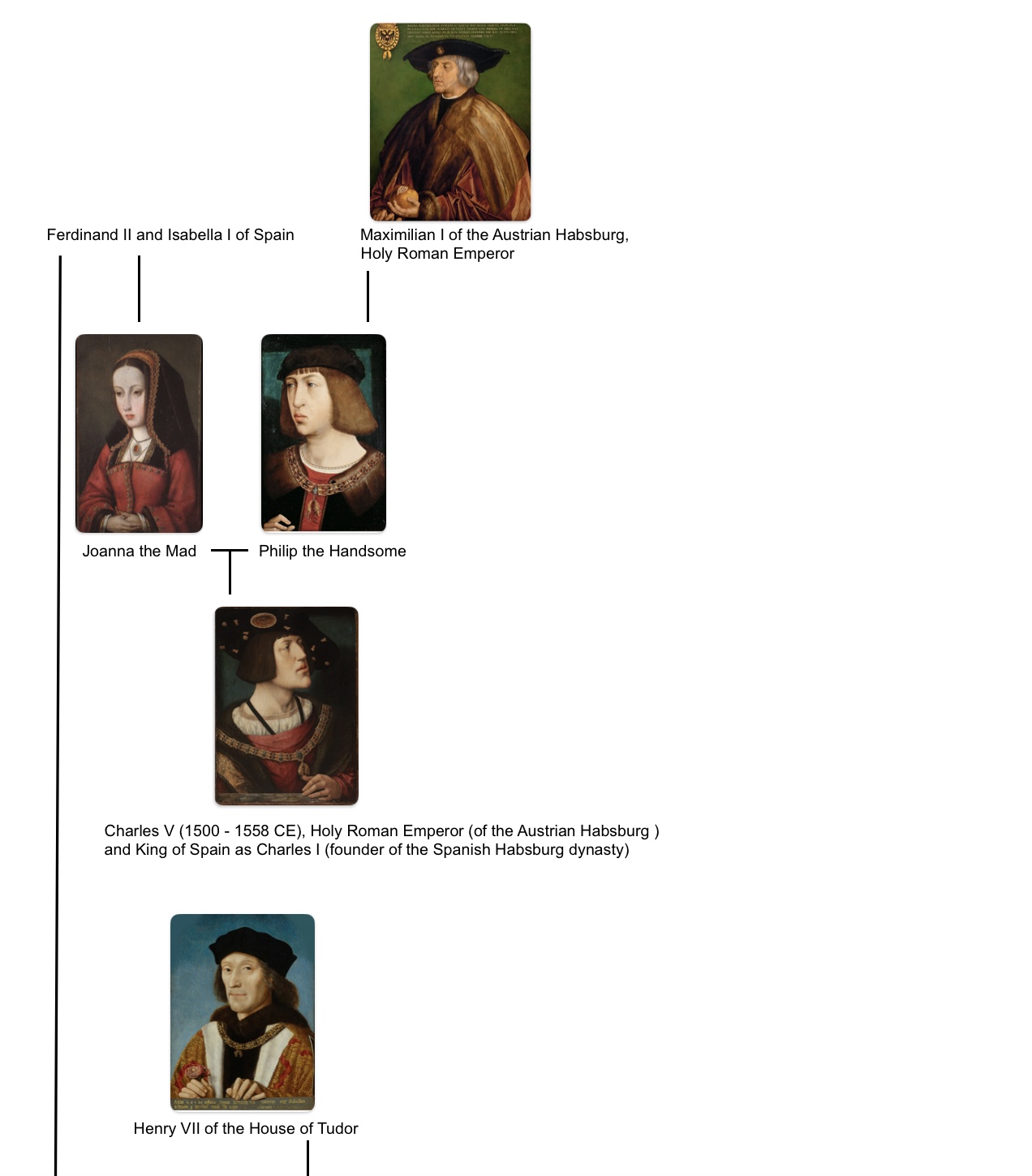
Joanna the Mad (1479 - 1555 CE), daughter of Ferdinand II and Isabella I of Spain, politically married Philip the Handsome of the Austrian Habsburg dynasty (son of Holy Roman Emperor Maximilian I).
This union established the Spanish Habsburg line, which subsequently ruled Catholic Spain.
Their eldest son, Charles V, inherited a vast empire, reigning as the Holy Roman Emperor and simultaneously as Charles I, King of Spain.
Charles V's eldest son, Philip II, succeeded his father as the King of Spain,
while the Austrian Habsburg lands passed to his uncle, Ferdinand I.
The two branches of the family remained closely allied, preserving the
dominance of the Habsburg dynasty.
This is "Catholic Habsburg Ring"—a vast encirclement of the Kingdom of France that stretched from the Holy Roman Empire and
the Italian Peninsula to Spain Habsburg (the Iberian Peninsula) and the "New World" (the Spanish
West Indies or East Endies) in the Americas.
While the "Habsburg Ring" appeared to dominate Europe, its power was constantly stretched
thin by Ottoman pressures from the east and the rise of Protestantism within its borders.
It was within this delicate geopolitical vacuum that the Tudor and Stuart dynasties of the British Isles
engaged in their own fierce struggles for power, often playing the great continental rivals against one another.
In the meantime, vast deposits of silver were discovered in South America,
leading to a massive influx of the precious metal from the New World into Spain.
2.4.3.2.2.3 The Tudor-Stuart Connection (Leading to James I)
Henry Tudor (Henry VII) seized control of England (the southern part of the British Isle) through a battle in 1485 CE, establishing the Tudor dynasty.
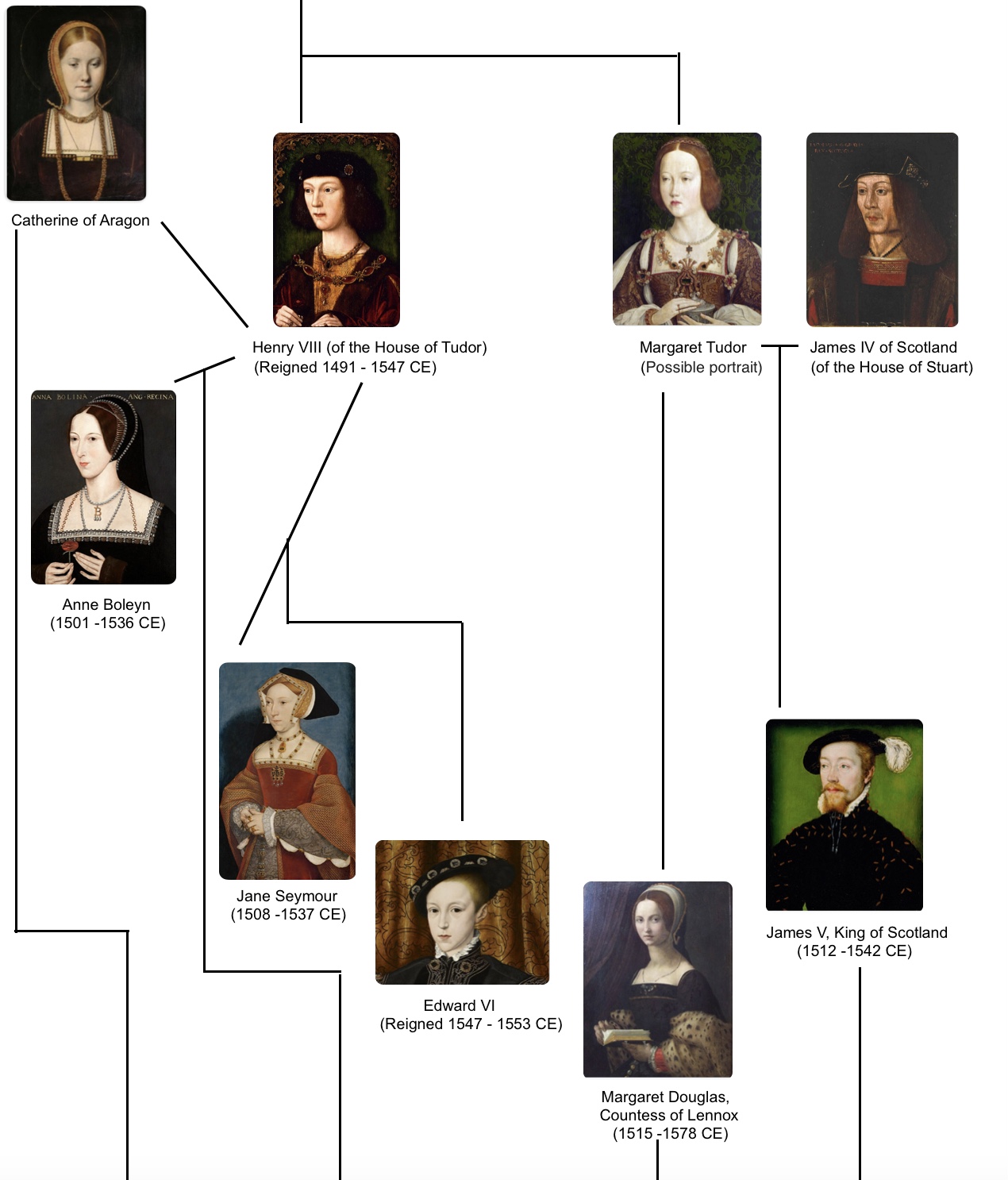
To forge an alliance with Scotland, Margaret Tudor of the House of Tudor married James IV of the House of Stuart in 1503 CE. (This marriage provided the Stuarts' later claim to the English throne.)
Furthermore, Catherine of Aragon (daughter of Ferdinand II and Isabella I), who was the aunt of Charles I of the Spanish Habsburg and the Austrian Habsburg, married Henry VIII of the House of Tudor in 1509 CE.
Henry VIII desired a divorce from his first wife, Catherine of Aragon, due to her failure to produce a male heir. However, Catherine's nephew, Charles V (who was both the Holy Roman Emperor and King of Spain), refused to sanction the divorce. Consequently, Henry VIII established the Church of England by asserting the King's authority over the Church in England, thereby severing ties with the Catholic Church. He then proceeded with the divorce and used Parliament to set the line of succession in his favor.
After the death of Henry VIII, his young son Edward VI succeeded to the English throne, but
his reign was short-lived. The Catholic Mary I, known as "Bloody Mary," then inherited the
throne.
She married Philip II of Spain.
Meanwhile,
John Knox of Scotland, who had been a Church of England clergyman,
studied Protestantism in Geneva and Frankfurt. Upon returning to Scotland, he began preaching the Protestant faith, and subsequently, Protestantism became dominant in Scotland.
The Catholic Mary I attempted to return England to Catholicism, notably through the persecution of Protestants, but her reign lasted only five years.
Subsequently, Elizabeth I ascended.
Between the death of Henry VIII and the accession of Elizabeth I, vast silver
mines were discovered in South America. As massive quantities of silver began flowing into Spain,
English privateers, who were authorized by the Crown to seize enemy wealth, emerged to prey upon these treasure-laden ships.
At the time, England was a relatively minor power. Its privateers were based in southwestern port towns like Plymouth, which were geographically close to Spain and the New World routes.
These mariners shared the frustrations of merchants who were resentful of Spain’s trade monopoly; they also aligned perfectly with the interests of Elizabeth I, who sought to undermine her Spanish rivals and seize their immense wealth.
English privateers allied with Elizabeth I, and a portion of the silver they seized became a vital source of funding for the English Crown.
By seizing Spanish silver, England secured the capital necessary to transform itself from a minor island nation into a formidable maritime power.
This partnership fueled the expansion of privateering while simultaneously strengthening the Royal Navy.
Elizabeth I remains a figure with certain enigmatic characteristics, such as her refusal to marry or bear children and her famously thick, white facial makeup. Related to these mysteries is a theory that she was replaced by a boy during her childhood.
This theory suggests that in 1542 CE, around the age of nine, Elizabeth died of a high fever while staying near the village of Bisley in the Cotswolds to
avoid the plague. Fearing the wrath of her father, Henry VIII, those responsible searched for a similar-looking child nearby,
but could only find a boy. They allegedly substituted this boy for Elizabeth, and he grew up to become Queen Elizabeth I. The veracity of this claim remains unknown.
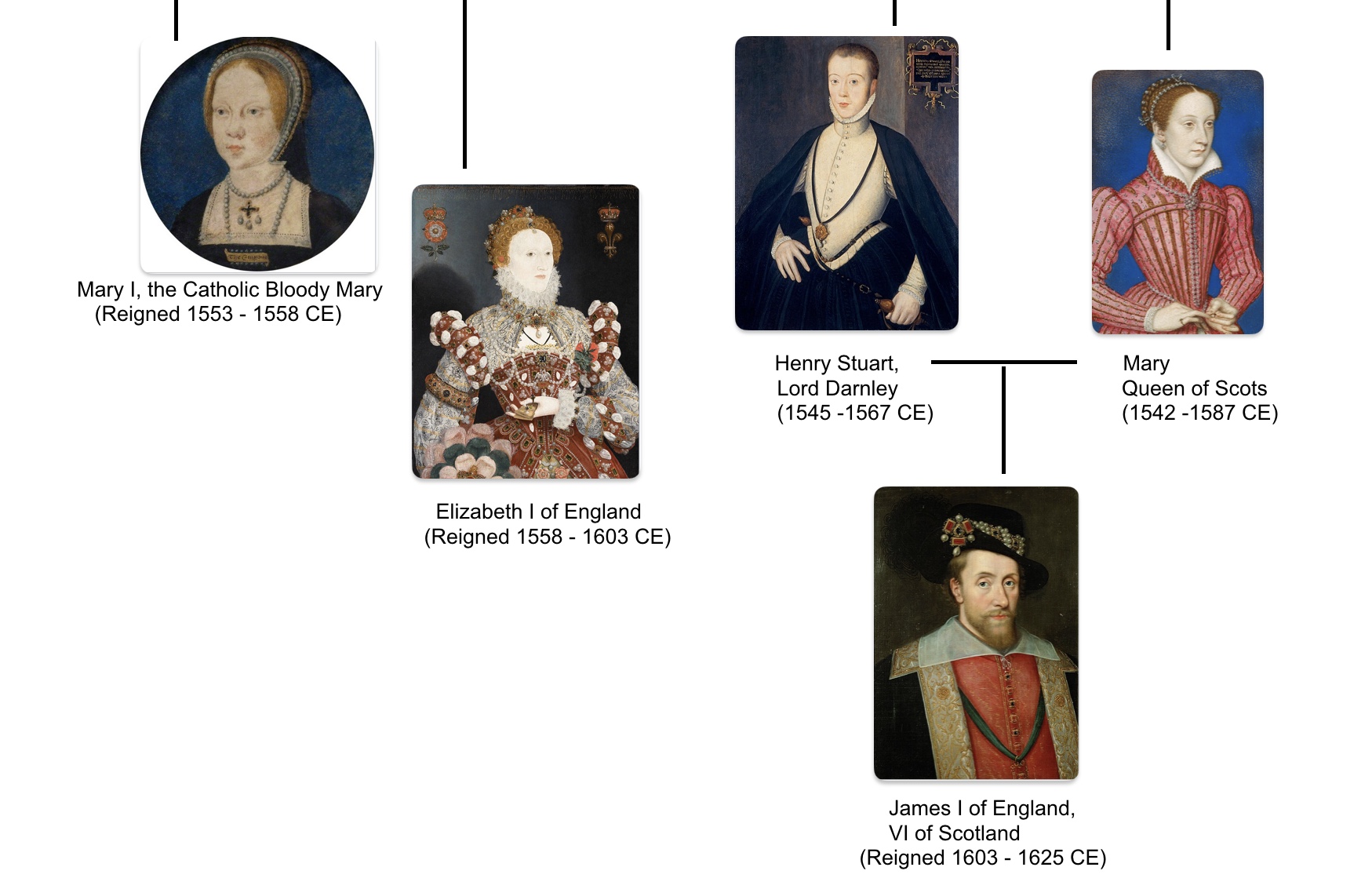
Catholic nations and Mary, Queen of Scots, did not recognize Elizabeth as the legitimate Queen,
maintaining that Mary was the rightful heir to the English throne based on the primacy of the Catholic faith. Despite this, Elizabeth I eventually had Mary executed after accusing her of treason.
The execution of the Catholic heir apparent prompted Spain to launch its massive naval force,
the Spanish Armada, against England in 1588 CE. The invasion consequently ended in a Spanish defeat.
The victory over the Spanish Armada solidified this naval superiority, paving the way for England's global expansion and the eventual rise of the British Empire.
Following the death of Elizabeth I, James VI, King of Scotland (Mary, Queen of Scots' son), inherited the English throne as James I.
At this time, the English crown's authority already extended to Ireland, and James I unified the crowns of England, Ireland, and Scotland under the House of Stuart.
By bringing the long-running war with Spain to an end, his accession marked the beginning of England's full-scale global expansion, including the establishment of a presence in India and the colonization of North America.
The marital relationships between these houses can be illustrated as follows.
*
"House of Habsbug on Wikipedia"
https://en.wikipedia.org/wiki/House_of_Habsburg
*
"Catholic Monarchs of Spain on Wikipedia">
https://en.wikipedia.org/wiki/Catholic_Monarchs_of_Spain
*
"Tudor Dynasty on Wikipedia"
http://en.wikipedia.org/wiki/House_of_Tudor
*
"House of Stuart on Wikipedia"
http://en.wikipedia.org/wiki/House_of_Stuart
*
"John Knox on Wikipedia"
https://en.wikipedia.org/wiki/John_Knox
*The House of Stuart, originating from the High Stewards of Scotland, was founded in 1371 CE.
It is notable that this founding occurred shortly after the period when major Knights Templar members were executed in Paris in 1314 CE, causing the remaining members to flee to various locations, including Scotland. This suggests a potential link between the Stuarts and the Knights Templar (or Freemasons) who sought refuge in Scotland.
*The House of Tudor's Coat of Arms often featured a Lion. In contrast, the House of Stuart's Coat of Arms featured two Unicorns.

An Example of the House of Tudor's Coat of Arms (Henry VIII)
*Attribution:
http://en.wikipedia.org/wiki/File:Coat_of_Arms_of_England_(1509-1554).svg
*
"Tudor Dynasty on Wikipedia"
http://en.wikipedia.org/wiki/House_of_Tudor

The House of Stuart's Coat of Arms
*Attribution:
http://en.wikipedia.org/wiki/File:James_IV_Arms.jpg
James Stuart I maintained Elizabeth I's Church of England and is famous for the Bible as
King James.
Other than that, James Stuart I created a new Coat of Arms (emblem) holding
a Lion and a Unicorn unifying Tudor's and Stuart's supposedly associating with
the Lion and the Unicorn of the unified kingdom prophesied
In the King James Bible.
*In the Book of Ezekiel, it is prophesied that a unified kingdom of Judah and Ephraim will be established in the future. Furthermore, in the Old Testament, Judah was likened to a lion, and Ephraim was likened to a wild ox (or bull). However, in the Septuagint, Ephraim's wild ox was mistranslated as a unicorn, and this rendering was maintained in the Latin Vulgate Bible and in the King James Bible.
(Consequently, the new Stuart's Coat of Arms was succeeded by
the Royal House of Hanover and Windsor, present-day royal house as of 2020 CE.)

New Stuart's Coat of Arms
*Attribution:
http://en.wikipedia.org/wiki/File:Coat_of_Arms_of_England_(1603-1649).svg
2.4.3.2.2.4 The Shift in European Power (c. 1610 – 1650 CE)
A significant shift in the European landscape began around 1610 CE.
In the Kingdom of France, amidst the violent conflict between Catholics and Protestants, the
Valois dynasty came to an end when Henry III was assassinated by a Catholic fanatic.
Although the House of Bourbon succeeded to the throne, its first monarch, Henry IV, was
also assassinated by a radical Catholic. Following these turbulent events, the French monarchy
began to steadily strengthen its central authority around 1610 CE.
In England, the accession of James I led to the conclusion of the long-standing conflict with Spain, allowing the English Navy to spearhead the nation's global expansion.
Meanwhile, Russia, which had been in turmoil following the death of Ivan IV (the Terrible), saw the establishment of the Romanov Dynasty in 1613 CE through an assembly of elites, setting the nation on a path toward growth.
The Thirty Years' War (1618 - 1648 CE) erupted when Protestant nobles within the Holy Roman Empire revolted against the Austrian Habsburgs. Protestant powers such as Denmark and Sweden intervened to support the rebels. Crucially, Catholic
France also joined the Protestant side to weaken its rivals, while the Spanish Habsburgs supported their Austrian kin.
The Austrian Habsburgs allied with the newly established Romanov Dynasty.
Consequently, the Austrian Habsburgs were defeated, and the power of the Spanish Habsburgs was significantly diminished.
Amidst this continental exhaustion, England—having avoided deep involvement in the conflict—successfully preserved its resources and expanded its global influence.
*
"Thirty Years' War on Wikipedia"
https://en.wikipedia.org/wiki/Thirty_Years%27_War
2.4.3.2.2.5 Templar-Related Societies
Referring to the Templar-related societies of the time, the organization known as Causa Nostra (Our Cause) was founded in Venice in 1510 CE. Two years later, in 1512 CE, it evolved into the secret society Ordo Bucintoro. They purportedly held the White Stone of the Holy Grail.
(The name Bucintoro originated from an old Venetian legend and means "a large golden ship ascending into the sky.")
Other than that, the Order of the Knights of St. John was expelled from Rhodes by the Ottoman Empire in 1522 CE.
To support the Knights and counter the Ottoman threat, Charles V, Holy Roman Emperor, ceded Malta, Gozo (the small island adjacent to Malta), and Tripoli (the North African port) to the Order in 1530 CE. The Order subsequently became known as the Sovereign Military Order of Malta.
*
"Sovereign Military Order of Malta on Wikipedia"
https://en.wikipedia.org/wiki/Sovereign_Military_Order_of_Malta
For another thing, the Society of Jesus (the Jesuits) was founded in Paris in 1534 CE.
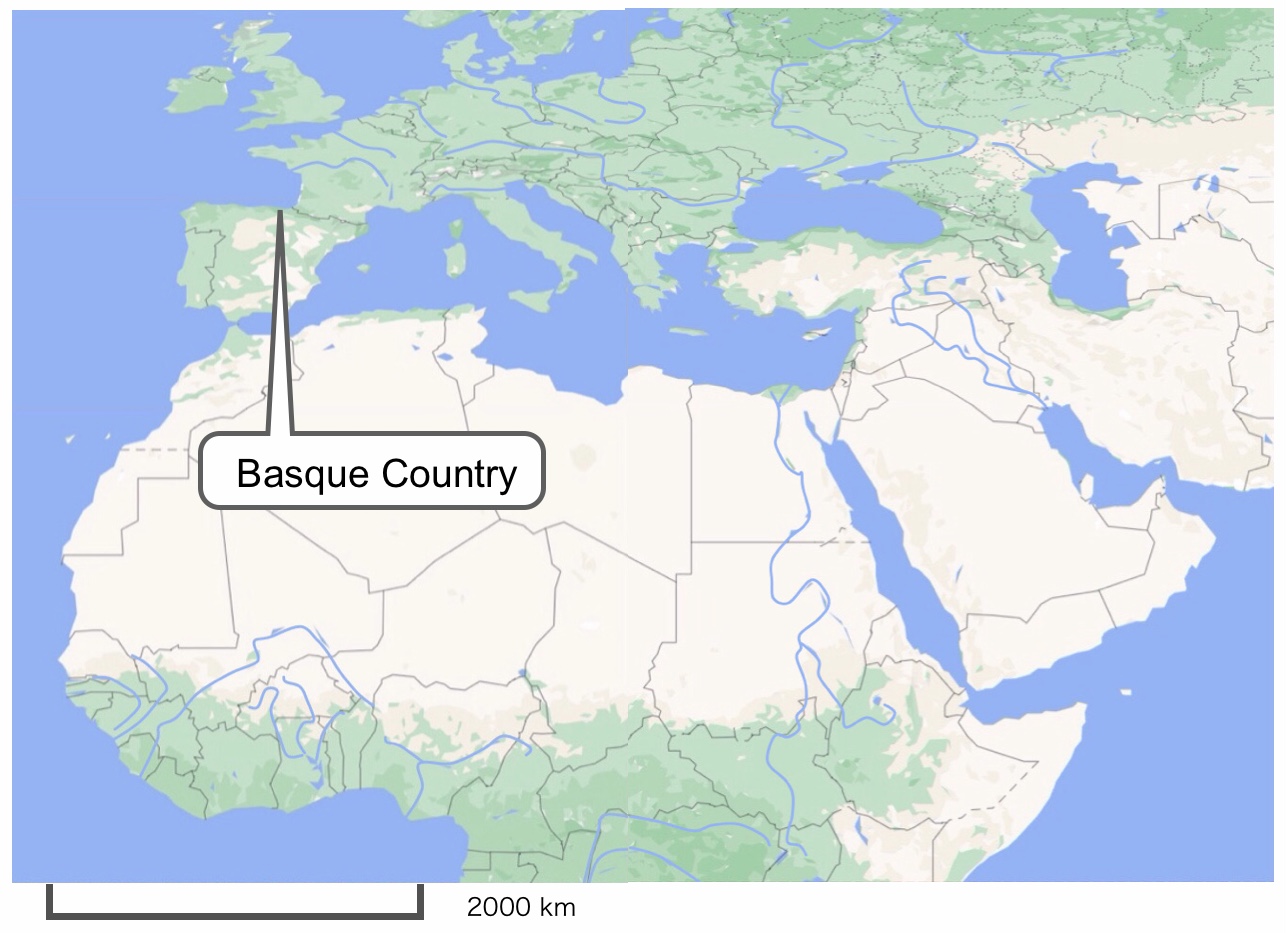
Its central figures were Ignatius of Loyola and Francis Xavier, both of whom were Basque. They were born in the Basque Country, a region located in the western Pyrenees.
*
"Society of Jesus on Wikipedia"
https://en.wikipedia.org/wiki/Society_of_Jesus
*
"Ignatius of Loyola on Wikipedia"
https://en.wikipedia.org/wiki/Ignatius_of_Loyola
*
"Francis Xavier on Wikipedia"
https://en.wikipedia.org/wiki/Francis_Xavier
*Attribution:
https://www.atlist.com/showcase/world-map-with-no-labels
The Basque people possess several distinctive characteristics, particularly concerning their genetics and language.
Regarding the Rh blood group system on red blood cells, the Basques have a remarkably high frequency of the Rh-negative (Rh-) trait, with approximately 35% of the population being Rh-. This means that about 35% of the Basque population lacks the Rh-D antigens on the surface of their red blood cells.
The Rh-D antigen DNA sequences are typically located on the first chromosome (one of the 23 chromosome pairs). Since humans inherit one first chromosome from each parent, the Rh-D antigen will not form only if the sequences are absent in both chromosomes. Based on the 35% Rh- prevalence, it is estimated that approximately 60% of the first chromosomes among the Basque population are negative for the Rh-D sequences ($0.60 \times 0.60 \approx 0.36$, or $36\%$).
In addition to their Rh status, the Basque people are also distinctive for showing a near-absence of both blood type B and AB.
Despite these unique blood traits, the distribution of their haplogroups is quite similar to that of Western Europe:
Y-DNA haplogroups (paternal line) are predominantly R1b (88%), followed by I (7%) and J (3%).
mt-DNA haplogroups (maternal line) are H (51%), U (18%), J (15%), and V (6%).
Aside from these genetic markers, the Basque language is also recognized as highly distinctive, being a language isolate unrelated to the Indo-European family that dominates the surrounding region.
*
"Basques on Wikipedia"
https://en.wikipedia.org/wiki/Basques
*
"Y-DNA Haplogroups by Ethnic Group on Wikipedia"
https://en.wikipedia.org/wiki/Y-DNA_haplogroups_by_ethnic_group
*
"Researchgate mtDNA Haplogroups of Basques" https://www.researchgate.net/figure/Frequency-distribution-as-percentages-of-mtDNA-haplogroups-in-a-sample-of-autochthonous_fig1_5676863

23 Pairs of Human Male DNAs in the Shape of Chromosome
*Attribution:
http://en.wikipedia.org/wiki/File:Chromatin_Structures.png

Schematic View of (1) Antigens on Red Blood Cell and (2) No Antigens on Red Blood Cell
*Attribution:
https://en.wikipedia.org/wiki/File:Rh_blood_cells_drawing.svg
On the other hand, the Rothschild ancestry is thought to date back to 1577 CE with Izaak Elchanan Rothschild (or Isaak Elchanan Rothschild) in Frankfurt, Holy Roman Empire (near Lorraine, later Germany).
He seems to have been the first to bear the name "Rothschild," which was derived from the house he lived in on the Judengasse (the Jewish ghetto in Frankfurt). The name is believed to have originally been "zum roten Schild" ("at the sign of the red shield").
Izaak, who is presumed to be the son of Elchanan Feibisch (who died in 1550 CE), himself died in 1585 CE.
*
"Frankfurt Judengasse on Wikipedia"
http://en.wikipedia.org/wiki/Frankfurter_Judengasse
Aside from that, Rosicrucianism is believed to have originated around 1600 CE within the Holy Roman Empire.
This secret society is often considered similar to Lutheranism and Scottish Freemasonry due to its opposition to the Catholic Church.
*
"Rosicrucianism on Wikipedia"
https://en.wikipedia.org/wiki/Rosicrucianism
*
"Lutheranism on Wikipedia"
https://en.wikipedia.org/wiki/Lutheranism

*Attribution:
https://www.atlist.com/showcase/world-map-with-no-labels
>>>>>>>>>>>>
Meanwhile, Jewish people who had moved to Amsterdam invested in the
Dutch East India Company, founded in 1602 CE. The Company expanded into
Java and became heavily involved in the spice trade.
*
"Dutch East India Company on Wikipedia"
http://en.wikipedia.org/wiki/Dutch_East_India_Company
At that time, the Netherlands and England were frequently in conflict, notably during the
Anglo-Dutch Wars. The Dutch East India Company and the English East India Company
were typically seen as rivals.
*
"Anglo-Dutch Wars on Wikipedia"
http://en.wikipedia.org/wiki/Anglo-Dutch_Wars
However, the two countries signed a treaty in 1619 CE regarding trade in
India and East Asia. Despite the incident known as the Amboyna Massacre in 1623 CE,
the two companies divided their spheres of influence: India for the English East India
Company and Java and nearby regions for the Dutch East India Company.
*
"English East India Company on Wikipedia"
http://en.wikipedia.org/wiki/East_India_Company
*
"Amboyna Massacre on Wikipedia"
http://en.wikipedia.org/wiki/Amboyna_massacre
The English East India Company and the Rothschild family in Frankfurt am Main at that time appear to have had no connection.
2.3.4.14 Foundation of the Polish-Lithuanian Commonwealth in 1569 CE
The Polish-Lithuanian Commonwealth was a federation of Poland and Lithuania established in 1569 CE, ruled by a single monarch. As previously mentioned, Jewish populations from both the west and the east-southeast migrated to the Polish-Lithuanian Commonwealth.

Territory of Polish-Lithuanian Commonwealth as of 1620 CE
*Attribution:
https://en.wikipedia.org/wiki/File:Rzeczpospolita_1619_-_1621.png
2.3.4.15 Migration from Western Europe
The Dutch East India Company was seeking new merchandise in America and found beavers for their fur along the Hudson River, discovered in 1609 CE. The river was named after Henry Hudson, who explored it under both the Dutch East India Company and the English East India Company.
*
"Henry Hudson on Wikipedia"
http://en.wikipedia.org/wiki/Henry_Hudson
>>>>>>>>>>>>
The first permanent English settlement, Jamestown, Virginia (along the East Coast), supported by the Virginia Company of London, began in 1607 CE.
Jamestown's location was advantageous: it was marshy but far enough from the sea to be difficult for the Spanish fleet to find, and its deep river allowed their ships to anchor and quickly escape in case of an emergency.
However, the settlement faced severe hardship. Out of approximately 500 migrants, only about 60 survivors remained by 1610 CE, largely due to starvation. Circumstances gradually improved after they began developing the tobacco industry and plantations in 1612 CE, and the migrants had overcome the starvation crisis by 1620 CE.
>>>>>>>>>>>>
Pilgrims from England migrated to New England (such as present-day Massachusetts) in 1620 CE.
In 1625 CE, the Dutch East India Company settled on an island and named it “New Amsterdam” (present-day New York).
*
"New Amsterdam on Wikipedia"
http://en.wikipedia.org/wiki/New_Amsterdam
New Amsterdam was renamed New York in 1664 CE.
>>>>>>>>>>>>
2.4.3.2.3 Execution of the King by the Power of the People (Puritan Revolution in 1649 CE)
2.4.3.2.3.1 Transition of Human Social Systems on Earth
In the history of Earth's inhabitants, there were many conflicts and killings among tribes in ancient times. However, in the societies that settled down, common people generally lived lives with less killing, albeit with hard labor following the instructions of local rulers. In societies where conflicts between local rulers diminished, powerful regional rulers united, though wary of each other, to form countries, and the most influential among them became the king. The king's authority sometimes extended strongly throughout the country's territory, but at other times it was weak.
While the system of local or national rulers exploiting the populace through labor was common,
exploitation solely through forced labor no longer significantly improved the
performance or output of goods and equipment within the region, nor did it lead to
significant expansion of power. To enhance the performance and output of goods and
equipment and expand influence, it became necessary to grant the people a certain
degree of freedom for their activities. Consequently, instances arose where even a king, if
mishandled in dealing with the populace, could be executed by the power of the people.
The Puritan Revolution in England is considered the first such instance.
The Glorious Revolution that followed can be seen as its natural
consequence, a process that also included the Act of Settlement.
2.4.3.2.3.2 Background of the Puritan Revolution
James I (Stuart) respected the Church of England (Anglican Church) and subsequently
respected the Protestants of Scotland, but was negative toward the Catholics of Ireland.
During James I's reign, a powerful faction known as the Puritans emerged from the Scottish
Protestants. This group asserted that the Anglican Church still retained Catholic elements
and demanded that these elements be thoroughly purged and cleansed, hence they were
called Puritans.
(This was a favorable situation for the Scottish Freemasons.)
Some, believing the Anglican Church could not be reformed,
migrated to the New World to form their own church communities. After briefly
moving to the Netherlands, some sailed on the Mayflower in 1620 CE, settling in
Plymouth (in present-day Massachusetts, USA as of 2020 CE) in North America.
James I's son, Charles I, who succeeded to the throne, also prioritized the
Anglican Church. However, Charles I dealt harshly with the Scottish Protestants,
demanding they adopt the Anglican style, which provoked strong resentment,
especially among the Puritan forces. (Although the Anglican Church is broadly considered
Protestant because it rejects some Catholic doctrines, here it stood in opposition to the
Scottish Protestants.)
At the time in England, Parliament existed as a counterbalance to the Crown.
The House of Lords (Upper House) was composed of hereditary nobles and clergy and
generally supported the King's cause (Royalists). However, the House of
Commons (Lower House) was composed of influential local
landowners (the Gentry) and wealthy merchants from the cities—individuals who had
risen through their own ingenuity and effort. Many of these were Puritans who
opposed the King's faction (Parliamentarians).
2.4.3.2.3.3 Civil War, Puritan Revolution, and Execution
These Parliamentarians asserted their power by enacting and issuing the Militia Ordinance (1642 CE), which stipulated that Parliament could organize
the county militia. Cooperating with the wealthy local gentry and merchants, they raised an
army, and the Civil War against the King's forces began. Furthermore, Parliament passed
the New Model Army Ordinance (1645 CE), establishing a standing army.
The Parliamentarian forces consequently won, and the King initially surrendered (1646 CE). However, the King later escaped and joined forces with non-Puritan forces in
Scotland, attempting to regain the throne and sparking a second war. In consequence, due to the efforts of figures like Oliver Cromwell, the Parliamentarian army was victorious, and King
Charles I was executed (1649 CE), having been deemed an obstacle to peace.
*
"English Civil War on Wikipedia"
https://en.wikipedia.org/wiki/English_Civil_War
2.4.3.2.3.4 Glorious Revolution
Following Cromwell's period of dictatorship (the Protectorate), the monarchy was restored. However, Charles I's son, James II, ascended the throne and began promoting Catholicism. Parliament opposed this move and decided
to install William III of Orange, James II's nephew and a Protestant. James II had no viable opposition, and in 1688 CE, he fled into exile. This event is known
as the Glorious Revolution.
*
"Glorious Revolution on Wikipedia"
https://en.wikipedia.org/wiki/Glorious_Revolution
2.4.3.2.3.5 The Act of Settlement
The Glorious Revolution established Parliament's ultimate authority over the crown.
This authority was formalized by The Act of Settlement in 1701 CE.
This law secured the succession by decreeing that the throne must pass to a monarch
who was not Catholic and was in communion with the Church of England. It specifically
designated Sophia, Electress of Hanover (later Windsor) within the Holy Roman Empire, and her Protestant descendants as heirs if King
William III and Princess Anne died without issue.
*
"Act of Settlement 1701 on Wikipedia"
https://en.wikipedia.org/wiki/Act_of_Settlement_1701
2.4.3.2.4 Situation in the New World (American Continents)
Caribbean sugar plantations began on the English island of Barbados around 1640 CE. (Barbados, having been abandoned by Spain, was possessed by England at that time.)
In an event involving the reconciliation that followed the Second Anglo-Dutch War, New Amsterdam was renamed New York in 1664 CE.
To provide a more complete historical account, France managed to establish a permanent settlement in present-day Quebec in 1608 CE. This territory was named "New France," though its development was comparatively slow.
At that time, all explorers, armies, visitors, migrants, and African slaves traveling to the American continent were sponsored by European countries or capitalists. Ordinary people without sponsors could neither afford the Atlantic crossing nor hope to survive on the continent.
Agents of capitalists and European countries required cheap labor. They initially attempted to use the indigenous people; however, the native population declined rapidly due to new European pathogens, conflicts, and harsh forced labor. Next, capitalists in what is now the USA and the Caribbean recruited cheap laborers from Europe. Most of these European migrants were indentured servants, essentially slaves from the poor classes. Finally, African slaves were primarily utilized on sugar plantations in present-day Brazil, the Caribbean, and the southern region of the present-day USA (as of 2020 CE).
Consequently, the American continent, including the present-day USA, has historically been dominated by capitalists or European powers.
Separately, it is noted that the Rothschilds relocated to a new house called "Hinterpfann" (literally: "house in the back of the saucepan") in the Judengasse (the Jewish ghetto in Frankfurt) in 1664 CE.
>>>>>>>>>>>>
Subsequently, many Sephardic Jewish people migrated to North America around 1700 CE and found success. The Sephardic Jewish community became relatively wealthy.
*
"Early American Jews"
http://www.loeb-tourovisitorscenter.org/jll_jews.shtml
By the way, the flag of England was the Cross of St George. England (the Anglo-Saxon southern part of the island of Britain, including Celtic Wales in the southwestern part) and Scotland (the Celtic northern part of the island) were unified through the Acts of Union in 1707 CE to form the United Kingdom of Great Britain. The Cross of St George and the Cross of St Andrew of Scotland were then combined.
The flag of the English East India Company at that time (before 1707 CE) consisted of the
Cross of St George in the upper-left quarter (canton) and red-and-white stripes.

Flag of the English East India Company as of 1685 CE
*Attribution:
"http://en.wikipedia.org/wiki/File:British_East_India_Company_Flag_from_Downman.jpg"

Flag of the English East India Company as of 1700 CE
*Attribution:
"http://en.wikipedia.org/wiki/File:British_East_India_Company_Flag_from_Lens.jpg"
*
"British East India Company on Wikipedia"
http://en.wikipedia.org/wiki/East_India_Company#Flags
*
"St Geroge's Cross on Wikipedia"
http://en.wikipedia.org/wiki/St_George's_Cross
*
"Flag of Scotland (St Andrew's Cross) on Wikipedia"
http://en.wikipedia.org/wiki/Flag_of_Scotland
*
"Acts of Union 1707 on Wikipedia"
http://en.wikipedia.org/wiki/Acts_of_Union_1707
The "Committee of 300" is said to have originated from the British East India
Company (formerly the English East India Company) in 1727 CE.
*
"Committee of 300 on Wikipedia"
http://en.wikipedia.org/wiki/Committee_of_300
>>>>>>>>>>>>
Elihu Yale (1649 - 1721 CE) was an American merchant and philanthropist who served as the governor of the British East India Company settlement at Madras in East India. He later founded Yale College in Connecticut, USA.
In 1714 CE, the Stuart dynasty ended when Queen Anne died without an heir. Although there were many closer relatives,
Parliament chose George I, Elector of Hanover (later Windsor) within the Holy Roman Empire,
because he was a Protestant, passing over more than 50 Catholic claimants in the process.
George I was succeeded in 1727 CE by his eldest son, George II, Elector of
Hanover (later Windsor) within the Holy Roman Empire, marking
the beginning of an era of direct father-to-son succession that helped stabilize the new dynasty.
*
"House of Hanover on Wikipedia"
http://en.wikipedia.org/wiki/House_of_Hanover
Pirates in the Caribbean became active around 1700 CE, with the heyday of Caribbean piracy occurring around 1720 CE.
While English privateers around 1580 CE were authorized by England, pirates at this time were not authorized by any country.
Their origins varied, primarily in Britain, but some are said to have originated from the Rosslyn Knights Templar or Rosslyn Freemasonry.
Operating in the Caribbean Sea, they attacked Spanish and other vessels under the flag known as the Jolly Roger, which featured the skull-and-bones emblem.
(The skull-and-bones motif itself is often thought to have derived either from the remains of Jacques de Molay or, alternatively, from the crystal skulls mentioned in the theory concerning the Templar Inner Circle Descendants.)

A Typical Jolly Roger Flag
*
"Jolly Roger on Wikipedia"
https://en.wikipedia.org/wiki/Jolly_Roger

A Contemporary Model of Blackbeard's Queen Anne's Revenge

Flags of Blackbeard

Capture of the Pirate, Blackbeard, 1718
*
Blackbeard on Wikipedia
https://en.wikipedia.org/wiki/Blackbeard
*
"Piracy in the Caribbean on Wikipedia"
https://en.wikipedia.org/wiki/Piracy_in_the_Caribbean
George Washington was purportedly born in Virginia in 1732 CE, the son of a wealthy Virginian
tobacco plantation owner who possessed some 200 slaves.
The British government established infantry units in the American colonies,
recruiting local troops, starting around 1740 CE. Washington's half-brother, Lawrence
Washington, became an officer in one such unit. When Lawrence died in 1752 CE, George
Washington purportedly succeeded him to become a militia leader.
Washington purportedly joined Freemasonry in 1753 CE.
Washington subsequently purportedly served as a British colonial officer, battling French troops during
the French and Indian War.
After suffering a defeat in the period of 1754 - 1755 CE, he resigned his commission
and left the troops.
2.4.3.2.5 The Struggle for Global Expansion from Europe: The Seven Years' War (1756 - 1763 CE)
Regarding global expansion from Europe, the Catholic Spanish Habsburgs took the lead, acquiring vast territories in South America and immense quantities of silver.
However, England rose as a major power by seizing this silver through privateering and strengthening its naval supremacy. Furthermore, Protestant local landowners (the Gentry) and wealthy merchants gained significant influence in Parliament. As Parliament began to command the military and assert authority over the monarchy, the nation's momentum increased.
Meanwhile, in Russia, the Romanov Dynasty had emerged as a major European power by around 1750 CE, a direct result of the radical westernization and reforms under Peter the Great.
The Bourbon-led Kingdom of France maintained its national strength after emerging victorious against the Austrian Habsburgs in the Thirty Years' War (1618 - 1648 CE).
Subsequently, within the Holy Roman Empire (present-day Germany as of 2020 CE), the Electorate of Brandenburg (one of the empire's Electors) expanded its power through military buildup. They began to style themselves as the Kingdom of Prussia and came into conflict with the Austrian Habsburgs.
The Kingdom of Prussia and the Bourbon Kingdom of France, seizing the succession of Maria Theresa as a pretext, waged war against the Austrian Habsburgs (The War of the Austrian Succession, 1740 - 1748 CE).
By around 1750 CE, the Kingdom of Great Britain and the Bourbon Kingdom of France, both of which had been expanding their overseas territories, began to clash globally. This led to a world war spanning Europe, India, North America, the Caribbean, and Africa. In this conflict, the Kingdom of France allied with the Austrian Habsburgs and Romanov Russia, while the Kingdom of Great Britain teamed with Prussia. In North America, this was known as the French and Indian War (1754 - 1763 CE), while in other regions, it is referred to as the Seven Years' War (1756 - 1763 CE).
Consequently, the alliance of Great Britain and Prussia emerged victorious. Under the Treaty of Paris in 1763 CE, the Kingdom of Great Britain established its status as the world’s most powerful empire.
The Bourbon Kingdom of France lost nearly all its major colonial possessions.
The specific outcomes were as follows:
North America: Great Britain acquired eastern North America, including the East Coast. Spain ceded Florida to Britain, receiving the Louisiana territory (west of the Mississippi) in return. France effectively withdrew from North America.
The Caribbean: France retained sugar-producing islands (as a trade-off for abandoning North America), while Great Britain acquired islands such as Dominica.
India: Great Britain eliminated French influence and secured the foundation for its eventual control over the entire Indian subcontinent.
Africa: Great Britain acquired Senegal in Northwest Africa as a strategic base for the slave and spice trades.
*
"French and Indian War on Wikipedia"
https://en.wikipedia.org/wiki/French_and_Indian_War
*
"Seven Year War on Wikipedia"
https://en.wikipedia.org/wiki/Seven_Years%27_War
*
"Treaty of Paris (1763) on Wikipedia"
https://en.wikipedia.org/wiki/Treaty_of_Paris_(1763)
However, to recover its immense war expenses, the Great Britain found it necessary to impose taxes on its subjects in the North American colonies. This led to the American Revolutionary War, in which France provided support for American independence as a form of retaliation.
2.4.3.2.6 Rise of the Rothschilds
Mayer Amschel Bauer Rothschild was born in 1744 CE in Frankfurt am Main, Holy Roman Empire (present-day Germany as of 2020 CE). His birthplace was the Judengasse (literally: "Jewish Street"), a Jewish slum composed of some 500 households. (At the time, Jewish residency in Frankfurt am Main was reportedly restricted to 500 households.)
His father, Amschel Moses Rothschild, ran a small shop in the Judengasse dealing in general goods, coins, and pawnbroking. The family is said to have lacked a hereditary surname, instead adopting the name "Rothschild" after the red shield (roth schild) signboard that hung over the shop door.

The Rothschilds' House in the Judenstrasse of Frankfurt
*Attribution:
http://en.wikipedia.org/wiki/File:Haus_der_Rotschilds_in_der_frankfurter_Judengasse.jpg
Mayer Amschel Rothschild suffered a tragic loss when his father died in 1755 CE, followed by his mother, Schönche Rothschild (née Lechnich), in 1756 CE. It is supposed that the parents succumbed to the smallpox epidemic prevalent at that time.
After his parents' deaths, the young Mayer Amschel began working at the age of 13 as a clerk at the Oppenheimer bank in Hanover (now north-central Germany). During his tenure there, he first became acquainted with General von Estorff.
Mayer Amschel returned to Frankfurt am Main at the age of 19 and took over his father's shop, which included dealing in rare coins. He is said to have reconnected with General von Estorff during his business activities in the 1760s CE. Mayer Amschel knew that Estorff was connected to Crown Prince William I, Elector of Hesse (German: Wilhelm I), who was then William IX, Landgrave of Hesse-Kassel (1743 - 1821 CE) and the son of Frederick II, Landgrave of Hesse-Kassel (1720 - 1785 CE).
* It must be noted that Frederick II, Landgrave of Hesse-Kassel (1720 - 1785 CE) is neither the same person as Frederick II, Holy Roman Emperor (1194 - 1250 CE) nor Frederick II the Great, King of Prussia (1712 - 1786 CE).
The Landgrave of Hesse-Kassel was a despotic feudal lord of Hesse-Kassel, a state within the Holy Roman
Empire (located in present-day western Germany as of 2020 CE). Following the
defeat of the Austrian Habsburgs in the Thirty Years' War (1618 - 1648 CE), the Holy Roman
Empire was effectively reduced to merely an aggregation of territorial feudal lordship.
Frederick II's wife was Princess Mary, a daughter of King George II
of Great Britain and Elector of Hanover (later Windsor) within the Holy Roman Empire.
At that time (within the Holy Roman Empire), it was a common social practice for German feudal lords to lend their subjects as troops, ostensibly based on the principles of feudalism and traditional contracts between the lord and the inhabitants. Soldiers provided by Frederick II, or those originating from Hesse generally, were often referred to as Hessians.
When the Jacobite Rising occurred in Scotland in 1745 CE, Frederick II supported his father-in-law, George II of Great Britain, through this rent-a-troop service. (It should be noted that Frederick II and Mary separated in 1755 CE, and Mary moved to Denmark to care for the children of her prematurely deceased sister, taking their son, William I, with her at one point.)
Frederick II later continued the rent-a-troop service for his nephew,
King George III of Great Britain (later the United Kingdom) and Elector of Hanover (later Windsor) within the Holy Roman Empire (George II's grandson),
during the American Revolutionary War of Independence (1775 - 1783 CE).
(Since George II's son, Frederick Louis, died young, his grandson George III succeeded to the throne directly.)
Frederick II amassed considerable wealth from this service, becoming one of the
most affluent figures in Europe at the time.
Frederick II died in 1785 CE, and his son inherited the territory, becoming William IX. (However, as will be mentioned later, William's territory was eventually controlled by the Kingdom of Westphalia—ruled by Napoleon Bonaparte's youngest brother and possibly under Rothschild influence—forcing William IX into exile in Denmark in 1806 CE.)
Following the exhaustion of the Seven Years' War, Great Britain entered the Era of Britain and the Industrial Revolution. This shift was based on their hegemony over India and North America, formally established by the Treaty of Paris (1763 CE).
Meanwhile, Mayer Amschel cultivated relationships with Estorff and his acquaintances through his rare coin business, eventually gaining access to Crown Prince William I and his father, Frederick II. Mayer Amschel was appointed an agent of Crown Prince William I, receiving the title of "Court Factor," in 1769 CE.
Taking advantage of Frederick II's patronage and the military strength provided by the Hessian rent-a-troop service, Mayer Amschel was able to gain political leverage, even extending his influence to Great Britain, including the British East India Company.
This context may imply that Mayer Amschel was potentially able to exert control over the British troops operating in the Thirteen Colonies of northeastern America at the time.
Mayer Amschel Rothschild married Guttle Schnapper (1753 - 1849 CE), the daughter of Wolf Salomon Schnapper, in 1770 CE.

Mayer Amschel Rothschild
*Attribution:
http://en.wikipedia.org/wiki/File:Mayer_Amschel_Rothschild.jpg
*
"Mayer Amschel Rothschild on Wikipedia"
http://en.wikipedia.org/wiki/Mayer_Amschel_Rothschild
Amschel Mayer von Rothschild (1773 - 1855 CE), the second child and first son of Mayer Amschel, was born in 1773 CE. He remained in Frankfurt am Main for the rest of his life.
*
"Amschel Mayer Rothschild on Wikipedia"
http://en.wikipedia.org/wiki/Amschel_Mayer_von_Rothschild
The Boston Tea Party took place in December 1773 CE.
According to the accepted historical narrative, the British government, in alliance with the British East India Company, imposed a tax on tea monopolized by the Company. Colonists resisting Great Britain protested by throwing shiploads of the Company's tea into Boston Harbor, an action which ultimately contributed to the start of the American Revolutionary War of Independence (1775 - 1783 CE).
Notably, 1773 CE was also the year the British East India Company began its involvement in the opium trade between India and China (then the Qing dynasty).
Previously, the Company had imported popular Chinese goods—such as silk, tea, and porcelain—but had no popular European goods to export in return. This trade imbalance forced Great Britain to pay for these Chinese goods largely with silver. To resolve this drain on silver, the British East India Company initiated opium production in India and began exporting it to China in 1773 CE to offset the value of the imported goods. Since the Qing dynasty had prohibited opium, this trade was conducted entirely through smuggling.
2.4.3.2.7 World Revolutionary Movement
It is claimed that in 1774 CE, at the age of 30, Mayer Amschel Rothschild began the "World Revolutionary Movement" by gathering twelve influential individuals in Frankfurt am Main.
This alleged movement operated based on an agenda consisting of 25 articles, which primarily focused on methodology.
The 16th article of this purported agenda is particularly noteworthy. It reportedly suggested engaging in subversive activities under the guise of philanthropy and concealing the true nature of the operation by organizing an Orient Grand Lodge within the Blue Lodge of Freemasonry. Furthermore, it advocated for the spread of atheistic materialism among the goyim (a term for non-Jews).
The claim is that Freemasonry is not an end in itself but can be merely a tool or a front organization.
This statement appears to assume a common understanding of Freemasonry, yet there are two conventional (common) concepts: the Operative Theory and the Speculative Theory.
The Operative Theory asserts that Freemasonry originated as actual working guilds of skilled medieval stonemasons ("operative" meaning actively working). These organizations emerged in Scotland and England in the late 14th century, possibly between 1360 and 1390 CE.
The oldest text involving Freemasonry is said to be "Regius Manuscript" around 1390 CE.
*
"Masonic Manuscripts on Wikipedia"
http://en.wikipedia.org/wiki/Masonic_manuscripts#The_Halliwell_Manuscript.2C_or_Regius_Poem
Craftsmen of stone building (mason) were valuable for kings, they gained some privileges (free privileges) in the feudal societies. Then craftsmen of stone were called freemasons.
They needed tentative accommodations near the construction sites. The local tentative accommodations were called "lodges," "Masonic Lodges" (lodges for masons) to be precise. Then local meeting places or meetings are called "lodges" or "Masonic Lodges."
This theory emphasizes the fraternity's genuine professional roots.
The Speculative Theory explains the evolution of Freemasonry from an operative trade guild to a philosophical fraternity.
Construction of stone buildings declined around 1600 CE, craftsmen of stone decreased. According to the theory, Freemasonry then changed its policy abolishing the membership regulation restricted to craftsmen. Freemasonry changed into a private club for upper class's pastime or kill time. Since craftsmen of stone buildings experienced various regions in Europe, craftsmen's knowledge was interesting and valuable for upper class.
Freemasonry became disjoined from craftsmen of stone buildings, called "Speculative Masonry."
A "Lodge" till that time was merely a local areal organization or a local areal place. In contrast to that, a "Grand Lodge" controls Freemasonry of a region such as a country and a state. The first Grand Lodge is said to be Premier Grand Lodge of England in 1717 CE under George I. "The Constitutions of the Free-Masons" involving London lodge and Westminster lodge was published in 1723 CE. The Constitutions of the Free-Masons was reprinted in Philadelphia by Benjamin Franklin, the Grand Master of Freemasonry of Pennsylvania, in 1734 CE.
*
"History of Freemasonry on Wikipedia"
http://en.wikipedia.org/wiki/History_of_Freemasonry#The_Emergence_of_Speculative_Masonry
It is said that Mayer claimed to found "Grand Orient Lodge" in 1774 CE. On the other hand, "Grand Orient de France" was founded in 1733 CE. Relation between "Grand Orient de France" founded in 1733 CE and Grand Orient Lodge, Mayer claimed in 1774 CE, is unclear. However, "Grand Orient de France" seems somewhat associated with Mayer in later years. Mayer might have been inspired by "Grand Orient de France" signifying the direction of the new dawning light like Orient.
In addition, other complex organizations, "Masonic appendant bodies," could be privately founded by some Freemasons. For example, "Scottish Rite" and "York Rite." Scottish Rite and York Rite could be privately founded groups (Masonic appendant bodies) in Freemasonry.
Origin of Scottish Rite is unclear, while it might date back to 1733 CE. Connection between the Scottish Rite and Mayer at the time (1733 CE) couldn't be verified. However, the 33rd degree of the Scottish Rite works as agents of the Rothschilds in later years. The York Rite is a similar thing of the Scottish Rite, while the York Rite is inferior to the Scottish Rite in significance.
*
"Masonic Appendant Bodies on Wikipedia"
http://en.wikipedia.org/wiki/Masonic_appendant_bodies
*
"Scottish Rite on Wikipedia"
http://en.wikipedia.org/wiki/Scottish_Rite
*
"York Rite on Wikipedia"
http://en.wikipedia.org/wiki/York_Rite
However, as previously mentioned, they were not merely fraternal organizations.
The Templars and Freemasonry were groups with the grand goal of secretly denying Christianity and pursuing their original teachings or truth.
Anyway, the Rothschilds and Freemasonry merged and developed together.
Salomon Mayer Rothschild (1774 - 1855 CE), the 3rd children, the 2nd son, was born in 1774 CE. (later moved to Austria in 1820 CE)
*
"Salomon Mayer von Rothschild on Wikipedia"
http://en.wikipedia.org/wiki/Salomon_Mayer_von_Rothschild
Details of the World Revolutionary Movement were expressed by Adam Weishaupt, a graduate of a Jesuit school, an agent of Mayer. Adam Weishaupt founded Illuminati in Bavaria (southeadt of present-day Germany) in 1776 CE.
The aim of Illuminati (Bavarian Illuminati) is creation of the New World Order. The following aims were claimed involving the New World Order.
(1) Abolition of all ordered governments
(2) Abolition of private property
(3) Abolition of inheritance
(4) Abolition of patriotism
(5) Abolition of the family
(6) Abolition of religion
(7) Creation of a world government
The Barvarian government banned Illuminati in 1784 CE. Adam Weishaupt is said to have fled to Gotha, present-day Thuringia, central Germany (as of 2020 CE), associated with Freemasons and died in 1811 CE.
(If these stories were totally correct, Adam Weishaupt can't be identical with George Washington.)
Anyway, the Rothschilds and Illuminati became leading Freemasonry for the World Revolutionary Movement aiming at the New World Order manipulated by Yahweh.
*
"Adam Weishaupt on Wikipedia"
https://en.wikipedia.org/wiki/Adam_Weishaupt
*
"New World Order (conspiracy theory) on Wikipedia"
https://en.wikipedia.org/wiki/New_World_Order_(conspiracy_theory)
*
"The Judeo Masonic Conspiracy"
http://judeo-masonic.blogspot.jp/2010/02/4-adam-weishaupt-and-bavarian.html?m=1
Return to the Home Page